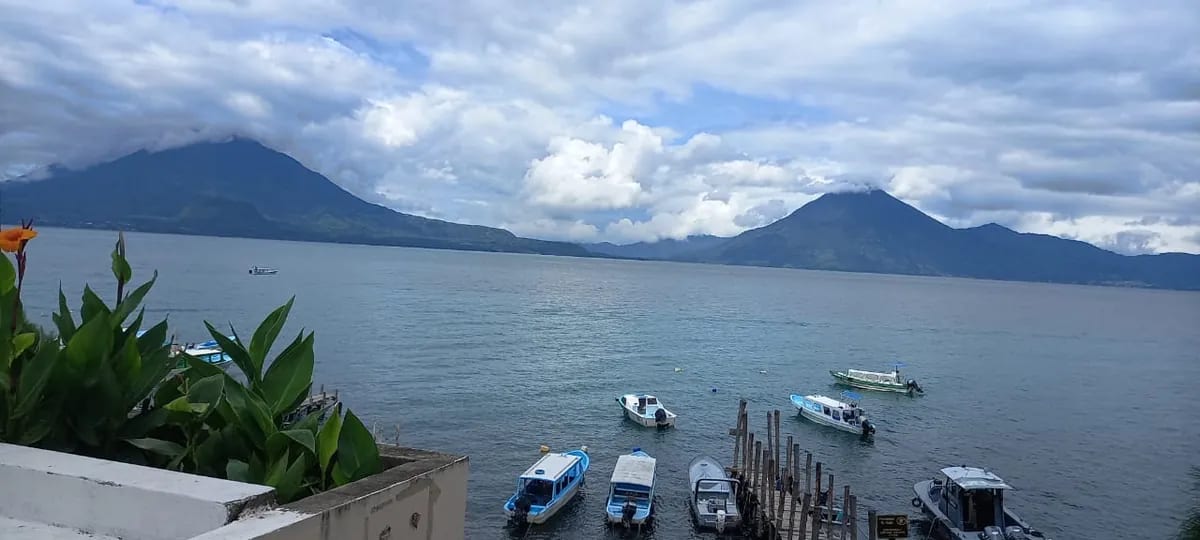
Lake Atitlan’s towns are connected by a network of small motorboats called lanchas — the lake’s water taxi system. For some towns like Jaibalito and Santa Cruz La Laguna, boats are the only way in or out, as no road access exists. Understanding how lanchas work is essential for visiting Lake Atitlan.
In short: Lake Atitlán’s water-taxi network connects 12 lakeside towns. The fare is Q25 to any major town — that is the figure the boatmen’s own association publishes; captains often quote visitors Q40-50, so agree the price before boarding. First boats leave Panajachel about 6:00 AM; INGUAT records service ending between 16:30 and 17:00 — plan your return around 4:30 PM, earlier still in rainy season (May-October). There is no timetable; boats go roughly every 20-30 minutes. The Orange Route (slow) stops at every town Panajachel → Santa Cruz → Jaibalito → Tzununa → San Marcos → San Pablo → San Juan → San Pedro (45-60 min with all the stops; a direct boat is 20-30 min). Private lanchas: Q200-500 for the whole boat. Travel before 1 PM — the Xocomil afternoon wind kicks up choppy water, and it kills people: two tourists died when a lancha capsized on the Panajachel–San Juan run in January 2026. Ask for a life jacket. Sources checked July 2026.
Two Main Routes
Orange Route (Slow Boat / All Stops)
The regular public lancha service runs along the western and northern shores of the lake, stopping at nearly every town:
Panajachel > Santa Cruz La Laguna > Jaibalito > Tzununa > San Marcos La Laguna > San Pablo La Laguna > San Juan La Laguna > San Pedro La Laguna
This is the most common service. Boats depart from Panajachel every 20-30 minutes, making all stops. Because it calls at every village, the full run from Panajachel to San Pedro takes 45-60 minutes — not the 30 minutes a direct boat takes. Budget the hour.
Green Route (Express / Direct)
A direct express boat between Panajachel and San Pedro La Laguna, available only in the early morning (6:00-8:00 AM). Takes 15-20 minutes with no stops. Ask for “directo a San Pedro” at the Panajachel dock.
Santiago Atitlan Route
A separate lancha route connects Panajachel directly to Santiago Atitlan on the southern shore. Boats depart from the same Panajachel dock but go across the lake rather than along the shore. Fare Q25; the crossing takes roughly 30-45 minutes.
⚠ Santiago is the one route where nobody publishes a last boat. INGUAT records the Santiago dock’s service ending between 16:30 and 17:00, and a Panajachel operator describes the Santiago boats as having “horarios muy imprecisos” that depend on how many passengers show up. Do not plan a late return from Santiago — ask your boatman directly what time he is making his last run, and hold him to it.
Price Table
The boatmen’s association publishes one flat fare — Q25 — to any town on its Panajachel route. Duration is the thing that varies, and it varies by which boat you get on, not by how far you are going:
| Route from Panajachel | Fare per person | Direct boat | Stopping (Orange) route |
|---|---|---|---|
| San Pedro La Laguna | Q25 | 20-30 min | 45-60 min |
| San Juan La Laguna | Q25 | 20-25 min | 30-45 min |
| San Marcos La Laguna | Q25 | ~15 min | 25-35 min |
| Santa Cruz La Laguna | Q25 | 10-15 min | 10-15 min (first stop) |
| Jaibalito | Q25 | — | 15-20 min |
| Santiago Atitlán | Q25 | ~30 min | separate crossing (see below) |
| Private lancha, whole boat | Q200-500 | direct, on demand | — |
The stopping route is the one you will probably be on. The public Orange Route calls at every village on the way, so Panajachel → San Pedro is closer to an hour than the half-hour most guides advertise. If you need the fast one, ask at the dock for a directo.
Short village-to-village hops (San Pedro ↔ San Juan, San Marcos ↔ Santa Cruz) cost less than Q25 — commonly quoted around Q10-15 — but no association or authority publishes those, so treat them as approximate and confirm at the dock.
Payment: Cash only. Bring small bills (Q5, Q10, Q20). No credit cards.
Q25 is the fare — and there is no government tariff. The Asociación de Lancheros San Juan Bautista, the boatmen’s own association, publishes the price for its Panajachel route in writing: “El costo de pasaje a cualquiera de los pueblos a orillas del lago… es de Q.25.00” (source, updated April 2025). Hotels around the lake quote the same Q25.
Expect to be quoted more. Captains routinely open at Q40-50 for visitors. That is a tourist markup, not the fare. Agree the price before you step into the boat — ask in Spanish, and say the number out loud. Guatemala’s tourism institute publishes no lancha tariff at all, so there is no official price list to point at; the association’s Q25 is the closest thing that exists.
Schedule
There is no timetable. No public lancha route on Lake Atitlán runs to fixed departure times — INGUAT’s own municipal plan notes the Santiago dock has “tampoco existe una caseta informativa para el turista” (no information booth). Boats run on a frequency, roughly every 20-30 minutes in daylight.
Plan your return around 4:30 PM. This is the number that matters, and most guides get it wrong.
| First boats | 6:00 AM from Panajachel (Tzanjuyú); 6:30 AM from Santiago |
| Service officially ends | 16:30–17:00 (4:30–5:00 PM) — INGUAT, both docks |
| Some operators run later | The San Juan boatmen’s association lists 17:30 from San Juan and up to 19:00 out of Panajachel; lakeside hotels report last boats from San Pedro at 5:00–5:30 PM |
| Rainy season (May–October) | Service winds down about an hour earlier |
Sources: INGUAT, Plan de Desarrollo Turístico Municipal de Panajachel 2020-2023 — “Los servicios inician a las 06:00 y finalizan entre 16:30 y 17:00 horas, todos los días” — and the equivalent Santiago Atitlán plan.
The asymmetry is the whole trap: leaving Panajachel late is easy. Getting back is not. The return leg ends earliest, so build your day around the boat home, not the boat out.
Critical rule: Do NOT miss the last boat. If you miss it, you are sleeping in whatever town you are in — taxis and tuk-tuks cannot reach towns without road access, and a private charter home runs Q300-500. Treat 4:30 PM as your hard deadline and anything later as a bonus.
How to Ride a Lancha
- Walk to the dock. In Panajachel, the main dock (Tzanjuyu) is at the end of Calle del Embarcadero, a 10-minute walk from Calle Santander.
- Ask for your destination. Tell the boat operators which town you want. They will point you to the correct boat.
- Wait for the boat to fill. Public lanchas leave when they have enough passengers (usually 10-15 people). Wait time is typically 10-30 minutes.
- Pay on board or at arrival. Some operators collect payment before departure, others upon arrival.
- Sit down and hold on. Find a seat, keep your bag in your lap, and enjoy the ride.
Safety Tips
- Life jackets: Ask for one. They should be available on every boat but may not be offered automatically.
- Xocomil wind: Lake Atitlan is known for its strong afternoon wind called the Xocomil, which typically kicks up after 12:00-1:00 PM. Morning crossings (before 10 AM) are smoothest.
- Waterproof your electronics. Spray from waves, especially on choppy days, can soak your belongings. A dry bag or ziplock bag is essential for phones and cameras.
- Sit in the back of the boat to stay drier. The bow catches every wave.
- Sunscreen: There is no shade on the boat. The equatorial sun at altitude burns quickly, even on cloudy days.
Town-by-Town Guide
| Town | Character | Best For |
|---|---|---|
| Panajachel | Main hub, most commercial | Shopping, restaurants, transport connections |
| San Pedro | Backpacker hub | Budget travel, nightlife, Spanish schools, volcano hike |
| San Juan | Artisan village | Textile cooperatives, art galleries, painting classes |
| San Marcos | Yoga/wellness village | Yoga retreats, meditation, cacao ceremonies |
| Santa Cruz | Quiet hillside | Diving, hiking, peaceful stays |
| Jaibalito | Remote, no roads | Total escape, birdwatching |
| Santiago Atitlan | Large indigenous town | Maximon shrine, traditional Maya culture |
For detailed town guides, see our Lake Atitlan towns guide. For the two most common crossings from Panajachel, see Panajachel to San Juan La Laguna and Panajachel to Santiago Atitlán.
Where to Stay on the Lake
Which town you sleep in matters more than which boat you take — the lanchas stop running around 5 PM, so your base decides what you can do with an evening. Compare what is actually available around the lake:
Where to stay in Lake Atitlán
Compare Booking.com, Airbnb and hotels on one map. Drag the map and set your dates to see live availability and real prices.
Affiliate links — if you book, we earn a small commission at no extra cost to you.
Connecting to/from the Lake
- From Antigua: Shuttle to Panajachel (Q100-190, 2.5-3 hrs)
- To Quetzaltenango (Xela): Shuttle from Panajachel (Q120-200, 3 hrs)
- To Guatemala City: Shuttle from Panajachel (Q100-200, 3 hrs)
Lake Atitlán Beyond the Boats
For the deeper lake context — town personalities, Mayan culture, festival calendars, where to stay, and the seasonal rhythms of life at the lake — AtitlanVida is a bilingual guide written and maintained by people who live around Atitlán. Pair it with this lancha schedule when you are planning which towns to visit and how long to stay in each.
Planning what to do once you arrive? Most travelers base in San Pedro or San Juan and do the early-morning Indian Nose sunrise hike — and our Lake Atitlán villages guide breaks down all 11 towns, where to stay, and itineraries.
Sources
- Operating hours (official): INGUAT, Plan de Desarrollo Turístico Municipal de Panajachel, Sololá 2020-2023 (p.68) and Plan de Desarrollo Turístico del Municipio de Santiago Atitlán 2022-2026 — “Los servicios inician a las 06:00 y finalizan entre 16:30 y 17:00 horas, todos los días.”
- Fare + frequency (operator): Asociación de Lancheros San Juan Bautista, updated April 2025 — “El costo de pasaje a cualquiera de los pueblos a orillas del lago… es de Q.25.00.”
- Last-boat corroboration: published FAQs of lakeside hotels (Lush Atitlán, La Casa del Mundo, Free Cerveza, Isla Verde), which quote last boats from San Pedro at 5:00–5:30 PM. These are commercial pages that change without notice and are not archived here, so they corroborate rather than source the timetable.
- Xocomil safety: Prensa Libre, 27 Jan 2026 — two tourists died when a lancha capsized in high wind on the Panajachel–San Juan run.
No Guatemalan authority publishes a lancha fare table or timetable — INGUAT’s municipal plans cover the docks in detail and contain no fares, and the boats operate largely outside navigation regulation. Anyone presenting a “precios oficiales” list is not quoting an authority. Sources checked July 2026.

![Panajachel to San Pedro La Laguna: Lancha Boat Guide [2026]](/cdn-cgi/image/width=640,format=auto,quality=80/images/photos/wikimedia-santiago-atitlan-women.webp)
![Guatemala City Airport (GUA) to Lake Atitlan: Every Option, Priced [2026]](/cdn-cgi/image/width=640,format=auto,quality=80/images/articles/og-default.webp)