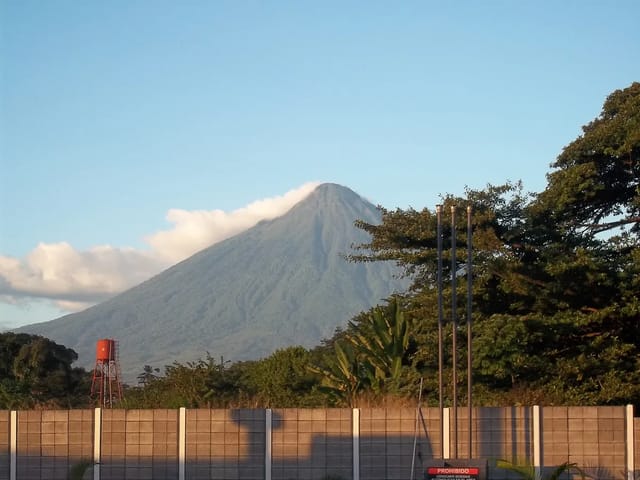
Monterrico is Guatemala’s most established Pacific beach town. About 125 km and 2.5 hours from Guatemala City according to CONAP, it is a nesting refuge for sea turtles, and weekenders from the capital fill its restaurants Friday through Sunday. The real estate market here serves three distinct buyers: Guatemala City families looking for a second home, foreign retirees and remote workers attracted by the Pacific coast lifestyle, and investors building rental properties for the weekend tourism market.
Each of these buyers needs different information. This guide covers what Monterrico real estate listings won’t tell you about: storm history, sector-by-sector risk, title issues, the 3-kilometer coastal strip that the Constitution reserves to the State, and how to evaluate a Monterrico listing on objective value rather than agency framing.
Price ranges by property type (2026)
| Property type | Lot size | Price range | $/m² lot |
|---|---|---|---|
| Inland lot (no construction) | 200-500 m² | $30,000-$100,000 | $150-$300 |
| Beachfront lot (no construction) | 500-1,000 m² | $150,000-$400,000 | $300-$600 |
| Inland house (3 bed) | 250-500 m² | $80,000-$180,000 | $300-$500 |
| Beachfront house (3-4 bed) | 500-1,500 m² | $200,000-$500,000 | $400-$800 |
| Premium estate (5+ bed, pool, large lot) | 1,500-3,000 m² | $350,000-$800,000+ | $200-$500 |
| Luxury beachfront chalet | 2,000+ m² | $500,000-$2,000,000+ | varies |
The premium-estate price-per-m² often looks lower than mid-range houses because the lot is larger. That doesn’t mean it’s a worse deal — it means you’re paying more for land and less for build. Calculate construction-to-lot ratio to compare correctly: a $300,000 / 2,500 m² estate at 400 m² of build is $750/m² built; a $200,000 / 400 m² beachfront at 250 m² of build is $800/m² built. Comparable per built m², but radically different lifestyles.
Sample listing analyzed: $300K beachfront chalet
A 2,500 m² lot, 5 bedrooms, 6 bathrooms, 10-car garage chalet in Monterrico recently listed at $300,000. Run the numbers:
- Price per lot m²: $120 — within the lot-only median for non-beachfront Monterrico ($100-$200/m²); below median for true beachfront
- 5 beds / 6 baths — bath-heavy build (typical of premium properties; 1 bath per bed plus a powder room indicates higher construction grade)
- 10-car garage — uncommon. Useful for groups, weekend rentals, or families with multiple vehicles
- Lot-to-build ratio — if the construction is approximately 400 m² (typical for a 5-bed chalet), the construction-only price is approximately $750/m². That sits in the upper-mid range for Monterrico construction quality.
How to read it: this is a premium estate, not a budget buy. Estates like this compete on lifestyle features (lot size, garage, bathroom count) rather than raw $/m². Compare it with other large-lot estates in Monterrico on price per m² of construction, not against budget houses. (We do not score listings; see our methodology.)
Storm and flood risk
Correction (8 October 2026): an earlier version of this section listed storm-by-storm damage at Monterrico, including storm surge from Eta in 2020, without a source, and called Agatha a hurricane. We have not found a source that documents damage at Monterrico storm by storm, so that table is gone.
What the national record does say: the first assessment report of the Sistema Guatemalteco de Ciencias del Cambio Climático (SGCCC, 2019, chapter 2) lists the cyclones that affected Guatemala from 1974 to 2016, among them:
| Storm | Year | Type in the SGCCC list |
|---|---|---|
| Mitch | 1998 | Hurricane (the report says it crossed the country as a tropical depression from 31 October 1998) |
| Stan | 2005 | Tropical storm |
| Agatha | 2010 | Tropical storm (entered the country on 28 May 2010) |
For a specific property, ask the seller and the neighbors, in writing, whether it has flooded or lost beach, and check its elevation and distance from the shoreline before you buy.
The 3-kilometer coastal State reserve
Correction (8 October 2026): an earlier version of this guide said Article 122 bars foreigners from owning within 200 meters of the high-tide line and that a Guatemalan sociedad anónima solves it. For the ocean, the Constitution sets a 3-kilometer strip, and it reserves that strip to the State for everyone.
Article 122 of the Constitution opens with “El Estado se reserva el dominio” of a strip “de tres kilómetros a lo largo de los océanos”, counted from the high-tide line (text read in the Instituto de la Defensa Pública Penal edition of the Constitución Política on 23 September 2026). Any beachfront lot is inside that strip.
The same article excepts two kinds of property from the reserve:
- property located in urban zones, and
- property with rights registered in the Registro de la Propiedad before 1 March 1956.
Then it adds: “Los extranjeros necesitarán autorización del Ejecutivo” to acquire those excepted properties. The Constitution does not name the office or the procedure for that authorization, and we have not captured an official page that does.
What it means in practice:
- Within 3 kilometers of the high-tide line, the land is State reserve unless it is urban or has rights registered before 1 March 1956. A foreign buyer needs Executive authorization for an excepted property.
- A sociedad anónima is not a way around the reserve. Reserved land belongs to the State, whoever the buyer is. Whether a Guatemalan company with foreign shareholders needs the Executive authorization for an excepted property is a legal question; get a written opinion from a Guatemalan lawyer.
- The rest is leased from OCRET, not owned. Decreto 126-97 (Diario de Centro América, 30 December 1997, read in the Congress copy on 8 October 2026) puts the reserve under OCRET, the Oficina de Control de Áreas de Reserva del Estado of the Ministry of Agriculture, the only body that can lease it (Arts. 2 and 3). Reserve property cannot be titled through titulación supletoria, except where legally constituted documentation exists, and that bar does not affect rights acquired before the law (Art. 4). On the ocean, a housing or recreation lease is capped at 2,000 m² with at most 80 m of beach frontage (Art. 6) and runs up to 30 years, renewable (Art. 9). The 50 m from the high-tide line, or 30 m where the land was already occupied when the law was issued, is public beach and cannot be leased (Art. 8). OCRET’s 2024 regulation asks an individual applicant for a DPI or, for a foreigner, a passport (Acuerdo Gubernativo 151-2024, Art. 16).
- What a beachfront sale may really be. A lessee can assign the whole leased plot and sell the improvements; OCRET registers the transfer once it has the notary’s notice and deed, a legalized copy of the lease and proof the rent is paid up (Art. 26). So ask the seller whether you are buying a registered title or an OCRET lease plus the house on it, and ask to see the lease, its term and the rent receipts.
- Protected area. The Área de Uso Múltiple Monterrico, a CONAP protected area declared in 1977, covers about 2,800 hectares across Chiquimulilla, Guazacapán and Taxisco (CONAP tourism page, read 24 September 2026). Decreto 126-97 leaves protected areas inside the reserve to the body that governs them (Art. 1), so ask your lawyer whether the plot falls inside it.
Before you sign anything, get written answers from a Guatemalan lawyer to three questions: is the lot inside the 3-kilometer strip, is it urban or registered before 1 March 1956, and, if you are a foreign buyer, how will the Executive authorization be obtained? Our foreign buyer rules page sets out the text of Articles 122 and 123.
Sector-by-sector overview
Monterrico has three main sectors with different risk profiles:
Town center (around the main road / Calle Principal): Walkable, restaurants, small grocery stores, ATM access. Generally safe. Higher prices but better infrastructure.
Beachfront strip (south of Calle Principal): All the well-known hotels and beachfront chalets. Hurricane and erosion risk is highest here. Prices command a premium for ocean views.
Inland sectors (north of Calle Principal, toward La Avellana): Cheaper. Some sub-sectors have had narco-trafficking concerns historically, particularly closer to the canal. Always ask local sources before buying inland — a real estate attorney with Monterrico experience will know which exact sectors to avoid.
Title and registration: the most important due diligence
The single most common mistake foreign buyers make in Monterrico is not verifying the property is properly registered at the Registro General de la Propiedad (RGP). Many beachfront and inland lots in Monterrico exist in legal grey zones:
- Possession (posesión) without registration: someone has occupied and built on the land for years, but it is not registered in their name. Possession is not a registered title. Inside the coastal reserve, Decreto 126-97 bars titling the land through titulación supletoria (Art. 4), and it gave anyone possessing reserve land without a lease six months from the law’s entry into force to regularize and legalize their situation (Art. 32). Ask your lawyer what exactly the seller holds before you pay anything.
- Properties with chain-of-title gaps: Old transfers that were never formally registered. These can become very expensive to clean up.
- Properties with disputed boundaries: Common in beach areas where the high-tide line shifts after storms.
Always commission an estudio registral (title study) from a Guatemalan attorney before any deposit; ask for a written quote. The RGP’s own online certification form lists Q50 for 1 to 10 pages and Q5 per additional page (consulta.rgp.org.gt, read 25 September 2026).
Property taxes (IUSI) and ongoing costs
Monterrico is administered by the municipality of Taxisco (Santa Rosa department):
- IUSI rate: under Decreto 15-98 (Art. 11), 2 per thousand of the registered value from Q2,000.01 to Q20,000, 6 per thousand from Q20,000.01 to Q70,000 and 9 per thousand above Q70,000, payable in four quarterly instalments (Art. 21). Decreto 18-2026, published 28 August 2026, replaces these rates from 26 November 2026 (Congress’s decree record): property destined for housing, residential or mixed use, pays zero per thousand, and commercial and other uses pay 3, 6 or 9 per thousand (up to Q500,000; Q500,000.01 to Q1,000,000; above Q1,000,000); see the IUSI reform 2026
- Salt-air maintenance: higher than non-coastal property — budget $1,000-$3,000/year for paint, metalwork, and HVAC corrosion
- Property management (if you don’t live there year-round): $200-$500/month for a caretaker who manages cleaning, security, and emergency response
What to ask the agent
Before any offer, get written answers to these questions:
- Is the property registered at the RGP? Provide the folio number.
- Has the property been in the same ownership for at least 5 years, or are there recent transfers?
- Is the lot inside the 3-kilometer coastal State reserve, and if so, is it urban or were its rights registered before 1 March 1956? If neither, is what is on offer an OCRET lease, and what are its term and rent status?
- Has the property ever flooded or lost beach in a storm? Ask for the answer in writing.
- What is the most recent IUSI assessment value, and what is the municipality’s current rate?
- Are there any pending tax obligations attached to the property?
- Is there an HOA, condominium council, or shared-services obligation? If yes, what are the dues and current balance?
If the agent can’t answer #1 or #2 quickly, walk away. Those are core facts.
Working with us
We track Pacific-coast listings, Monterrico included, using the method described on our Real Estate Methodology page. Every listing, whichever agency is selling it, is handled the same way: price-cut, new and days-listed badges, and its asking price per m² of construction against its zone median. We do not score or rank listings, and the grid carries no flood or storm-risk rating.
If you’re seriously considering a Monterrico purchase, we recommend:
- Read our methodology page to understand what the listing grid measures
- Compare the listing’s price per m² of construction against its zone median in the Pacific-coast listings grid
- Run the title search (estudio registral) before any deposit
- Hire a Monterrico-experienced real estate attorney (not a general practitioner)
- Visit the property at high tide and during the rainy season (May-October) before deciding
Need help finding a property in Guatemala? Email stu@livinginguatemala.com.
Sale listings: Pacific-coast sale listings — every agency in one grid
What a night on Airbnb costs here
Short-stay asking rates by size of place, captured once a month from live Airbnb search results for a weekday stay about a month out, each listing priced for the party size of the search that found it (2, 6 or 12 adults). Read the segments, not one headline number; the full breakdown with typical ranges and localities is on the market’s listings page. See the full breakdown.
Data collected 2026-10-01 for a 2026-11-03 to 2026-11-05 stay. Airbnb prices change daily and by date: check live before booking.
| Type of stay | Median per night | Typical range (p25–p75) | Listings |
|---|---|---|---|
| Entire place, 2 guests | $107* | $86–$132 | 14 |
| Private room in a home, 2 guests | $74* | $55–$76 | 15 |
| Hotel room listed on Airbnb, 2 guests | $89* | $67–$111 | 11 |
| Entire place, 3–4 guests | $106* | $75–$145 | 16 |
| Entire place, 5–8 guests | $269 | $202–$315 | 49 |
| Entire place, 9+ guests | $550 | $371–$656 | 164 |
Nightly rate as Airbnb showed it on those dates for the party size of the search that found each listing (2 adults for every place sleeping up to four; 6 or 12 adults only for larger homes that did not appear in the 2-adult search), with whatever Airbnb prices for that party already inside; where a promotion was displayed it is usually already inside the rate. The capture does not return cleaning or service fees, so there is no "all-in" figure. Sample: 287 listings (286 priced); 85% entire places, 7% hotel rooms, 39% superhosts; 29% displayed a promotion (median 13% off the crossed-out price); median rating 4.88 on a median 41 reviews. Typical place: 3 bedroom(s), 3.5 bath(s). Among listed amenities: Wi-Fi 76%, kitchen 89%, air conditioning 79%, pool 84%, free parking 88% (what the listing lists; absence is not proof it is missing). * = small sample (10–19 listings); — = fewer than 10 listings, no median.
| Locality (as Airbnb labels it) | Median per night, all sizes | Listings |
|---|---|---|
| Monterrico | $342 | 92 |
| El Paredón Buena Vista | $151 | 82 |
| Puerto San José | $554* | 17 |
| El Gariton | $570* | 16 |
| El Pumpo | $449* | 12 |
Localities with at least 12 priced listings and no single host above 40% of them; all sizes mixed, so a locality of large homes reads expensive. Villages and municipios appear exactly as Airbnb labels them.
Captured 2026-10-01 · 2026-11-03→2026-11-05 · USD (capture date · stay queried · currency), searched for 2, 6 and 12 adults, 2-night weekday stay. Captured once a month: a capped sample of Airbnb search results for one fixed 2-night weekday stay about a month ahead, priced for the party size of the search that found each listing (2 adults for anything sleeping up to four; 6 or 12 adults only for larger homes that did not appear in the 2-adult search). Not every listing, only those still open for those dates; the nightly rate Airbnb showed for that stay (a displayed promotion is usually already inside it), not booked rates. Large homes are over-represented in the sample, so compare the guest-count segments, not the overall median. Source: Airbnb search results via Apify.
Check today's prices on other platforms (each button opens that platform's own search for the place named; we do not compare their prices here)
Affiliate links: if you book, we earn a small commission at no extra cost to you. The buttons do not compare prices with the table above; they open each platform's own search. Airbnb has no affiliate program, which is why there is no Airbnb button.