- 📘 Valid passport (≥ 6 months remaining validity)
- 📜 Apostilled birth certificate (translated by sworn translator if not Spanish)
- 🚓 FBI background check (apostilled, ≤ 6 months old)
- 💵 Income proof: rentista/pensionado $1,250/mo · digital nomad $2,000/mo
- 📍 Guatemala address (rental contract or property deed)
- 📷 Recent photos (5cm x 5cm, white background)
Guatemala offers several residency categories for foreigners, including a new remote worker visa launched in October 2025. The process goes through the Immigration Subdirectorate (Subdireccion de Extranjeria) at IGM. You’ll need a valid passport and apostilled documents.
Quick summary: Temporary residency costs $200-$500 USD depending on duration. Rentistas/pensionados need to prove $1,250/month in passive income for direct access to permanent residency. Since 2025, there’s a specific visa for remote workers/digital nomads. Processing takes 2-6 months.
Prices verified February 2026. Check our exchange rate page for today’s USD/GTQ rate.
Which Residency Category Is Right for You?
Use this decision tree to find the best residency path:
- Do you have a job offer from a Guatemalan company? → Employee (migrant worker) category
- Do you work remotely for a foreign company? → Digital nomad visa
- Are you a freelancer or self-employed? → Self-employment (independent worker) or digital nomad visa
- Do you have $100,000+ to invest? → Investor residency
- Do you receive $1,250+/month in pension or passive income? → Rentista/pensionado (direct to permanent)
- Are you married to a Guatemalan? → Family tie (permanent residency after 1 year)
- Are you a Central American citizen? → Simplified pathway (permanent after 1 year temporary)
- Are you enrolled in a Guatemalan school? → Student category
Residency Comparison at a Glance
| Category | Cost | Time to Permanent | Garante Required | Work Allowed |
|---|---|---|---|---|
| Employee | $200-$500 | 5 years | No (2025 reform) | Yes (employer only) |
| Remote worker | $225 (1 yr) | 5 years | No | Yes (foreign employer) |
| Freelancer | $225 (1 yr) | 5 years | No | Yes (self-employed) |
| Investor ($100K+) | $225 + investment | 5 years | No | Yes |
| Rentista/Pensionado | $425 one-time | Immediate | No | No |
| Student | $100 | 5 years after graduation | Yes | Limited |
| Marriage to Guatemalan | $200-$500 | 1 year | No | Yes |
| Central American | $200-$500 | 1 year | No | Yes |
Temporary Residency Categories
| Category | Special Requirement |
|---|---|
| Employee (migrant worker) | Job offer + employer registered as guarantor + MINTRAB permit |
| Remote worker (new 2025) | Foreign income of $2,000+/mo ($3,000 w/dependents) + intl health insurance |
| Independent worker | Notarized declaration of activity + RTU |
| Student | Enrollment certificate + proof of financial means |
| Investor | Minimum investment USD $100,000 |
| Religious minister | Letter from religious organization |
| Intellectual/researcher | Professional credentials |
| Athlete/artist | Contract or invitation |
Permanent Residency Categories
| Category | Requirement |
|---|---|
| Central American citizen | 1 year as temporary resident |
| Family tie | Kinship with Guatemalan citizen (parents/children/siblings) — $700 one-time |
| Extended residence | 5+ years as temporary resident |
| Marriage | 1+ year married to a Guatemalan |
| Rentista/Pensionado | Monthly income min. USD $1,250 |
Costs
| Item | Cost |
|---|---|
| Application submission | USD $25 |
| Temporary residency — 1 year | USD $200 |
| Temporary residency — 2 years | USD $300 |
| Temporary residency — 3-5 years | USD $500 |
| Temporary residency — student | USD $100/year |
| Religious ministers and recognized refugees | USD $50 (one-time) |
| Permanent — rentista/pensionado (one-time) | USD $400 |
| Permanent — marriage or family tie (one-time) | USD $700 |
| Permanent — Central American born (one-time) | USD $500 |
| Permanent — after 5 years temporary (one-time) | USD $700 ($500 Central Americans) |
| Previo notification (only if corrections requested) | USD $5 |
| Registry certification (optional) | USD $15 |
General Requirements (All Categories)
- Residency application form
- Valid passport with legalized copy
- Passport validity certification (from your embassy/consulate)
- Criminal background check (from the last 2 years)
- Police clearance certificate
- Foreign documents apostilled or legalized
- Documents in another language must be translated to Spanish
Rentista / Pensionado Residency
The most popular category for retirees and people with passive income:
- Minimum monthly income: USD $1,250 per individual
- USD $300 additional per dependent
- Valid income sources: bank deposits, investments, pensions
- No Guatemalan guarantor required
- Direct access to permanent residency (not temporary)
- Cannot work for pay in Guatemala
- Must prove continued income every 5 years
Remote Worker Visa (New 2025)
Since October 2025, Guatemala offers a specific category for digital nomads:
- Must be employed by a company outside Guatemala
- Bank statements showing foreign income of $2,000+ USD/month ($3,000 with dependents)
- International health insurance required
- Temporary residency for 1-5 years by fee tier ($200/$300/$500)
- Full guide: digital nomad residency
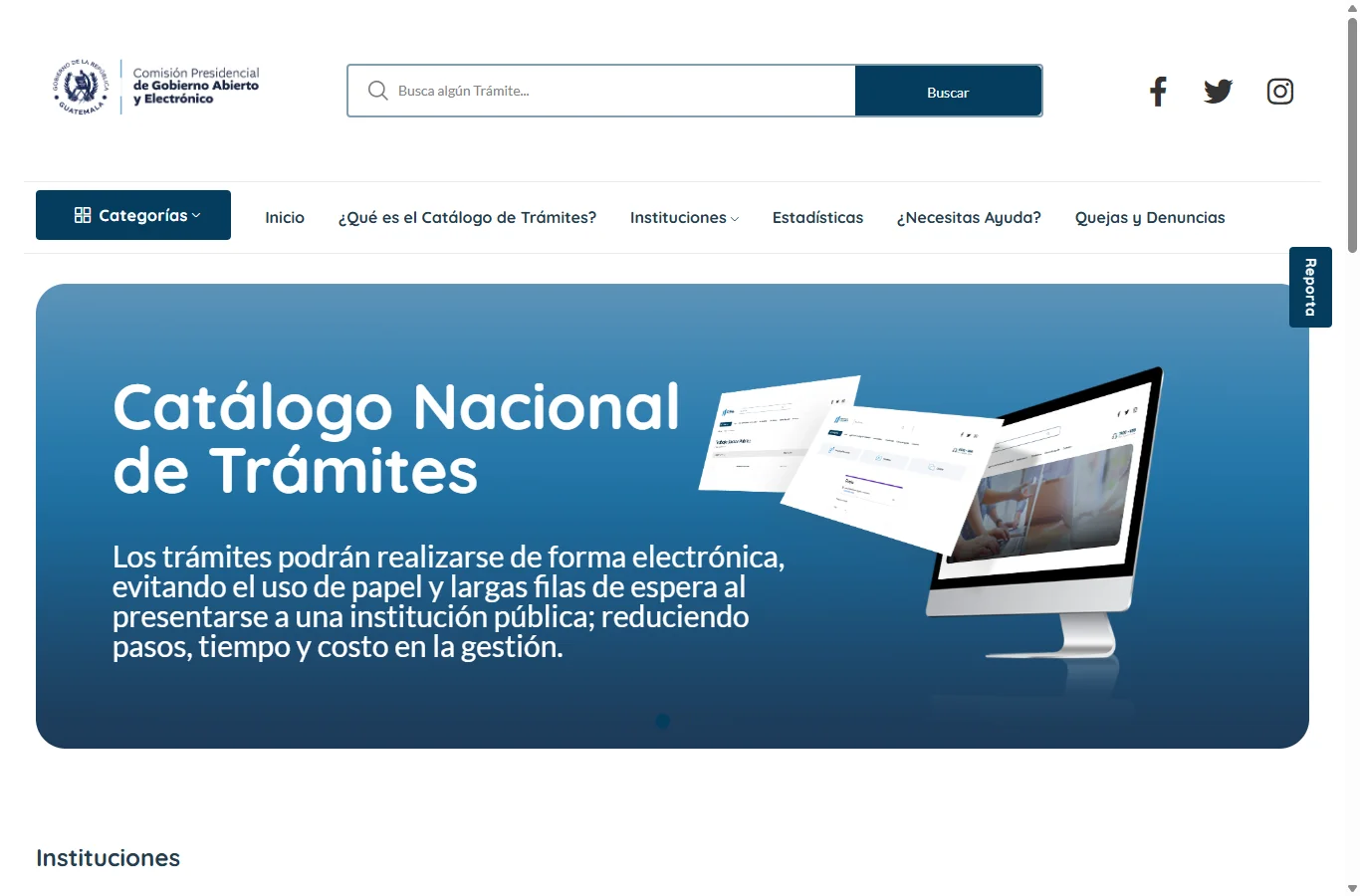
tramites.gob.gt is the Guatemalan government’s open catalog. If you do not know which institution handles a trámite, search here first.
Step-by-Step Process
- Gather all documentation for your category (apostilled/legalized)
- Visit the Immigration Subdirectorate (Subdireccion de Extranjeria) at IGM
- Immigration advisor reviews your documentation and issues a payment order
- Pay USD $25 application fee
- Submit your complete documentation
- IGM evaluates and conducts field verification
- Receive notification of approval or additional requirements
- Pay the residency fee for your category and duration
- Complete resident registration data capture (within 30 days)
- Obtain your residency certificate
Processing Time
- 2-6 months depending on category and documentation completeness
- Incomplete or inactive applications (6+ months of inactivity) are archived
2025 Changes
- New category: Remote worker visa for digital nomads
- Dependents: Can apply at the same time as the principal applicant
- Background checks: Accepted from the last 2 years (previously 5 years)
- Notarial guarantee: No longer mandatory for worker temporary residency
From the US (Diaspora Info)
If you’re a US citizen or resident planning to move to Guatemala:
- Prepare documents in the US first — get your FBI background check, apostille all documents through the Secretary of State and US Department of State
- Application must be submitted in person at IGM in Guatemala City (6a. Avenida 3-11, zone 4)
- No consulate processing — residency applications are only handled in Guatemala
- Budget for the trip: Plan to stay at least a few days for the initial submission; the rest of the process can take months with periodic follow-ups
- Hire an immigration attorney — highly recommended, typical fees Q3,000-Q8,000 ($400-$1,000 USD)
- Apostille process: US documents go through your state’s Secretary of State first, then the US Department of State for the apostille
- After 5 years of temporary residency, you can apply for permanent residency
- For remittance comparison to fund your Guatemala life, check our remittances page
- Review safety information and recommended neighborhoods before relocating
IGM Office
- Subdireccion de Extranjeria, IGM
- 6a. Avenida 3-11, zone 4, Guatemala City
- Phone: 2411-2411
Residency Pathway Timeline
| Milestone | Timeframe | What You Get |
|---|---|---|
| Tourist visa (arrival) | Day 1 | 90-day stay, no work rights |
| Tourist extension (INGUAT) | Day 91-180 | 90-day extension |
| Temporary residency application | Month 3-4 | Legal stay while processing |
| Temporary residency approved | Month 6-8 | Legal residence + work (per category) |
| Annual renewal | Every year | Continued legal status |
| Permanent residency eligible | After 5 years | Indefinite stay, no renewal |
| Citizenship eligible | After 10+ years | Full rights, vote, Guatemalan passport |
Edge Cases & Special Situations
Details
If you have overstayed the 90+90 day tourist period:
- You will be fined for each day overstayed when you try to leave Guatemala, and you cannot leave until it is paid. For the current daily rate and how it is paid, see CA-4 border runs & resetting your tourist visa.
- You can still apply for residency while in irregular status, but IGM may impose additional requirements or fines.
- Best approach: Apply for residency before your tourist visa expires. If your tourist period is ending and residency is still processing, request a constancia de tramite from IGM.
- Do not rely on border runs to reset the clock. Crossing to Honduras, El Salvador or Nicaragua changes nothing — they share one CA-4 clock with Guatemala — and re-entry after leaving the region is at the border officer’s discretion. See the border-run guide for what is and is not permitted.
- After 2025 reforms: Overstay penalties are enforced more strictly. Budget for potential fines if you are already in irregular status.
Details
You can switch between residency categories without starting over:
- Student to worker: Common when you finish studies and get a job. Apply for category change at IGM with your new employment documentation.
- Temporary to permanent: After 5 years of continuous temporary residency in any category.
- Worker to investor: If your situation changes, you can switch categories at renewal time with appropriate documentation.
- Key rule: Your time in any temporary category counts toward the 5-year permanent residency requirement, regardless of category changes.
Details
Since the 2025 reforms, family applications are streamlined:
- Dependents (spouse, minor children) can apply simultaneously with the main applicant.
- Each dependent pays their own fees but uses the principal’s supporting documentation.
- Children born in Guatemala to a foreign resident are automatically Guatemalan citizens (jus soli). They do not need residency.
- Marriage to a Guatemalan: You can apply for permanent residency after 1 year of marriage. Bring your marriage certificate (registered with RENAP) and spouse’s DPI.
Details
Residency applications are most commonly delayed or rejected for:
- Incomplete documentation — missing apostilles, expired background checks, unsigned forms
- Unverifiable income — bank statements from obscure institutions, cryptocurrency-only income, cash-based income with no documentation
- Criminal background issues — any felony conviction may result in denial; misdemeanors are evaluated case-by-case
- Inconsistent information — names or dates that don’t match across documents
- Expired tourist status — applying after significant overstay without addressing the irregular situation
- Failed field verification — not being present at your declared address when the IGM inspector visits
Common Errors and Solutions
These are the real failure modes that delay or block Guatemala residency applications across categories. The same handful of documentation and procedural mistakes account for the majority of rejections at IGM.
FBI background check not apostilled — the criminal background check from the US (or equivalent from any other country) must be apostilled by the issuing country’s competent authority. The US route: FBI Identity History Summary → US Department of State for apostille. Total time: 4-8 weeks. Solution: start the apostille process at home BEFORE flying to Guatemala — do not assume you can do it after arrival.
Background check expired during the application process — IGM accepts background checks issued within the last 6 months. If your apostille process took a long time, the certificate may already be near expiry when you file. Solution: file your residency application within 3 months of the background check issue date.
Passport validity under 6 months — IGM requires at least 6 months of remaining passport validity at filing. Solution: renew your passport in your home country before the residency application; aim for 18+ months of validity.
Foreign documents not translated by a sworn translator in Guatemala — translations from a translator abroad (even certified) are routinely rejected. Only “traductores jurados” registered with MINEDUC are accepted — the Ministry of Education publishes the register at certificados.mineduc.gob.gt. Solution: budget Q200-Q500 per document (market estimate — there is no public tariff) for in-country translation AFTER arrival with the originals.
Birth certificate from RENAP or foreign equivalent missing apostille — the birth certificate must be apostilled if issued outside Guatemala. Solution: order a certified birth certificate from your home country’s vital records office, then apostille via the Secretary of State or equivalent.
Income documentation looks insufficient for rentista category — the officially published minimum is $1,250/month USD for the principal applicant plus $300/dependent (2025 residency regulation). Below that, applications are rejected or draw document requests. Solution: combine income sources (Social Security + pension + investment dividends) into a single summary letter to clear the practical bar.
Field verification fails because applicant is not at declared address — since the 2025 reforms, IGM inspectors visit your declared address. Missing the visit is a common procedural delay. Solution: ensure someone (you, family, building staff) can answer the door during business hours, OR provide a reliable phone contact for the inspector.
Applying for residency while on irregular status — applying AFTER your 180-day tourist period has expired (without obtaining a constancia de tramite) puts you in an irregular position. Solution: file your residency application BEFORE the 90-day tourist visa expires, request the constancia immediately on filing.
Border-run pattern blocks residency intent — multiple recent entries with short stays (typical of border-run nomads) make IGM officers suspicious of your stated residency intent. Solution: if you have done border runs, file the residency application during a single longer stay (not immediately after an exit-and-reentry).
Wrong category selected — applying as “investor” without the $100K threshold, or as “rentista” while you really plan to work, or as “digital nomad” when you have a Guatemalan employer, all lead to back-and-forth and delays. Solution: use the decision tree at the top of this page; if unclear, consult an immigration attorney before filing (Q3,000-Q8,000).
Foreign-issued documents missing the apostille convention path — some countries are not Hague Convention signatories. For those, documents must be legalized through diplomatic channels (consular chain) instead of apostille. Solution: check whether your country is a Hague Apostille Convention signatory. Non-signatory countries: route through your country’s Ministry of Foreign Affairs and the Guatemalan consulate.
Dependents added late, after the principal is approved — under the 2025 reforms, dependents (spouse, minor children) can apply SIMULTANEOUSLY with the main applicant. Adding them later means starting a separate process. Solution: include all dependents in the initial filing — same fees apply but the documentation flow is unified.
Pending Guatemalan criminal record or open case — any open Guatemalan criminal case blocks residency issuance. Solution: resolve the case (acquittal, dismissal, sentence completion) before applying.
Letting a temporary residency lapse — an expired temporary residency breaks the 5-year clock toward permanent residency. Solution: calendar your extension date when the permit is issued, or pay the 3-5 year tier ($500) upfront to minimize renewal events.
Garante confusion — remote workers, the self-employed, rentistas, marriage and family-tie applicants need NO garante under the current regulation. Only employees of Guatemalan companies do (the employer must be registered as guarantor). Don’t pay a facilitator for a guarantor you don’t need.
Tips
- The rentista/pensionado category is the most attractive for retirees — check our cost of living guide to plan your budget
- Using an immigration attorney is highly recommended — typical fees Q3,000-Q8,000 ($400-$1,000 USD)
- All foreign documents must be apostilled (Hague Convention)
- After 5 years of temporary residency, you can apply for permanent
- Once approved, get your “Certificado de Extranjero Domiciliado con CUI” from RENAP, then your DPI
- Compare remittance services on our remittances page for transferring funds
- Start your apostille process early — in the US, the FBI background check + apostille can take 4-8 weeks
Related Tramites
- Digital Nomad Visa — remote worker residency (new 2025)
- Investor Residency — $100K minimum investment pathway
- Retiree Residency (Rentista) — passive income pathway
- Naturalization (Citizenship) — after 10+ years in Guatemala
- Passport — must be valid before applying
- DPI (National ID) — needed after residency approval
- Special Travel Pass — emergency travel document for residents
- Minor Travel Permit — for minors leaving Guatemala
Common Questions
How much does Guatemala residency cost?
Temporary residency costs USD $200 (1 year) to $500 (3-5 years), plus a $25 application fee. Student residency is $100/year. Permanent residencies are one-time fees: $400 rentista/pensionado, $700 marriage or family tie, $500 Central American born, $700 after 5 years as temporary resident.
What is the Guatemala digital nomad visa?
Since October 2025, Guatemala offers a specific temporary residency category for remote workers employed by companies outside Guatemala. It requires proof of a foreign employment contract.
What income do I need for rentista/pensionado residency?
You need to prove monthly income of at least USD $1,250 per individual, plus $300 per dependent, from sources like pensions, investments, or bank deposits.
Do I need residency to live in Guatemala?
Many nationalities get a 90-day visa on arrival, renewable for another 90 days at immigration. For stays beyond 180 days, you should apply for residency.
Can I apply for residency from the US?
You must submit the application in person at IGM in Guatemala City. However, you can prepare all apostilled documents in the US before traveling.
What happens if my residency application is denied?
You can appeal the decision within 5 business days of notification. If denied on appeal, you can reapply after correcting the issues. Common denial reasons include incomplete documentation, unverifiable income, or criminal background issues.