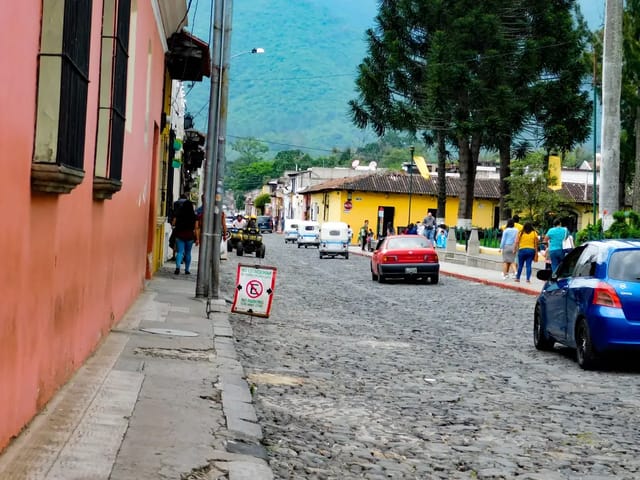
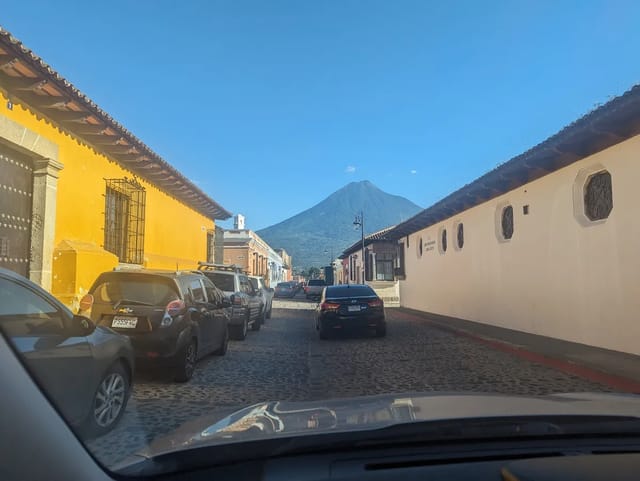
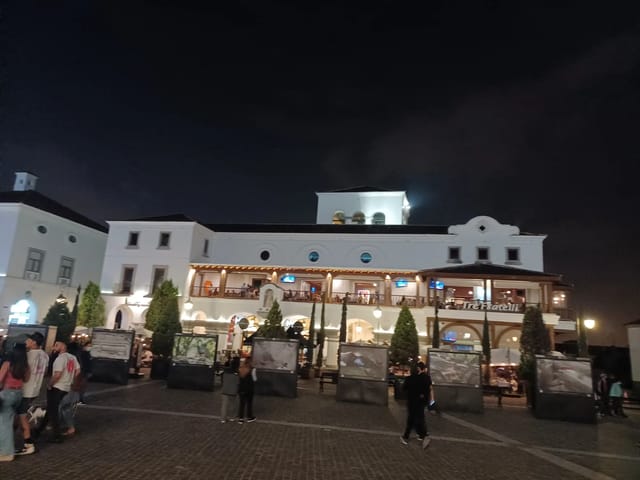
Antigua Guatemala has been a UNESCO World Heritage Site since 1979. UNESCO describes it as the former capital of the Captaincy-General of Guatemala, founded in the early 16th century, built 1,500 m above sea level in an earthquake-prone region, and largely destroyed by an earthquake in 1773. Its colonial center is protected by its own law, the Ley Protectora de la Ciudad de La Antigua Guatemala (Decreto 60-69), administered by the CNPAG.
This guide covers what listings won’t tell you about: sector-by-sector tradeoffs, the CNPAG rules that come with a historic-zone property, property tax, and the questions to ask before an offer.
Sources: UNESCO World Heritage listing for Antigua Guatemala, CNPAG website and the text of Decreto 60-69 published by the CNPAG (read 8 October 2026); Ley del IUSI (Decreto 15-98); Congress’s record of Decreto 18-2026 (read 8 October 2026); AGN and Prensa Libre on Decreto 18-2026 (August 2026).
Sector-by-sector breakdown
Antigua is not a single market. Each sector has a different lifestyle and a different set of rules.
Centro Histórico (the historic core)
The grid of streets of the colonial city. UNESCO notes the city was built on a grid pattern inspired by the Italian Renaissance.
Profile:
- Inside the protected perimeter of Decreto 60-69: every new building or alteration needs a prior CNPAG licence (Art. 23)
- New buildings of two or more floors are prohibited in the conservation area (Art. 23)
- Exterior signs need prior CNPAG authorisation (Art. 26)
Best for: Buyers who are willing to work within CNPAG rules.
Watch for: Prior renovations without a licence. Decreto 60-69 lets the CNPAG set a deadline for altered properties to return to their original state, looking first at added floors, sheet-metal roofs, cornices, finishes and paint, door and window proportions, and metal doors and windows (Art. 27). Ask the seller for the property’s CNPAG licences before buying.
San Pedro las Huertas
Watch for: in a condominium, HOA dues and rules vary. Ask for the current HOA balance, recent special assessments, and read the reglamento before buying.
San Felipe (de Jesús)
Best for: Buyers who want a residential setting near the center.
Jocotenango
A separate municipality next to Antigua. Decreto 60-69 (Art. 10) obliges the mayors of Antigua, Ciudad Vieja, Pastores and Jocotenango to enforce the law and to forward construction applications filed with them to the CNPAG.
Best for: Buyers who want to be close to Antigua outside the colonial center.
Pastores and outlying villages (San Bartolomé Becerra, San Cristóbal el Alto)
Towns around Antigua. Pastores, like Jocotenango and Ciudad Vieja, is named in Art. 10 of Decreto 60-69.
Best for: Buyers who want quiet and don’t need walkable amenities.
Watch for: Always commission a title study and check the certificación de finca at the Registro de la Propiedad.
Antigua market data
As our market report’s methodology explains, sale prices are inscribed at the Registro General de la Propiedad finca by finca, not in a list we can match listings against, so listing data shows asking prices only, not what properties sold for. Our Antigua market report tracks the public listings of Antigua agencies on dated reading days, and the Antigua listings grid shows every agency in one place. Use those, with their dates, rather than any fixed price range.
Water — ask before you buy
We have not found a published source on water reliability by sector in Antigua, so this guide makes no claim about which sectors have problems.
Due diligence:
- Ask for the past 12 months of water bills (a full year shows seasonal patterns)
- Ask whether the property has a working cistern, and its capacity
- Ask the current owner about any water cutoffs
- Walk the neighborhood and ask neighbors about their water supply
CNPAG historic-zone rules
Antigua’s historic center is regulated by the Consejo Nacional para la Protección de La Antigua Guatemala (CNPAG), a decentralised state body created by Decreto 60-69. (Corrected 24 September 2026: this section previously named INGUAT, the tourism institute, as a regulator of the historic zone.)
What the law says (Decreto 60-69, text published by the CNPAG):
- Licence first: any new construction or alteration in the conservation or influence area needs a prior CNPAG licence and must follow the regulating plan (Art. 23).
- Height: new buildings of two or more floors are prohibited there, to preserve the traditional look of the monumental ensemble (Art. 23).
- Plans: must be filed in duplicate and signed by a registered, active architect or civil engineer (Art. 24). The CNPAG can exempt minor works on the Conservator’s written recommendation (Art. 25).
- Enforcement: if work breaks the law, the CNPAG or the Conservator can order it suspended at any stage and, if the Council so decides, demolished at the offender’s cost (Art. 24).
- Signs: exterior signs need prior authorisation (Art. 26).
- Colours: the CNPAG publishes a Cartilla de Colores aprobados (approved colour chart) and a Reglamento de Construcción on its laws page.
- Penalties: unauthorised works are listed as faltas with fines of Q25 to Q50 (Art. 36); destroying, damaging or transforming protected property is a crime with prison terms (Art. 33).
- Selling a registered property: properties with buildings of architectural or historic value inside Antigua’s urban perimeter, surrounding areas and zones of influence must be entered in the CNPAG’s register. Before a full or partial sale of a property in that register, the seller must give the CNPAG prior written notice of the planned sale and its terms, so the CNPAG can pass it to the Executive and urge it to buy the property (Art. 22). Decreto 60-69 also states that the whole city of La Antigua Guatemala is a Monumento Nacional (Art. 12), and Article 122 of the Constitution gives the State a preferential right in any sale of property declared a national monument or located in a monumental ensemble. Ask the seller’s notary how both were handled before you sign.
The CNPAG does not publish a processing time for licences. If you’re buying in Centro, the property’s CNPAG licence history is part of due diligence.
Parking
Antigua’s colonial street grid was laid out long before cars. Check the parking situation of any Centro property in person: off-street spot, garage, or none.
Gated vs. non-gated
Gated condominium: shared guards and a controlled entrance, paid through HOA dues.
Non-gated home: security is your own responsibility (cameras, alarm, neighbors).
Neither is right or wrong. Match it to your lifestyle and how often you are away.
What to ask the agent
Required questions before any offer:
- Is the property registered at the RGP? Provide the finca number.
- Past 12 months of water bills (full year — not one bill).
- Is the property within the CNPAG-protected perimeter? If yes, which CNPAG licences cover the existing construction, is it entered in the CNPAG register, and has the prior notice of sale been given?
- Is there a cistern? What capacity?
- What is the parking situation — off-street spots, garage, none?
- If gated condominium: current HOA dues, balance, last 12 months of meeting minutes, any pending special assessments.
- Any damage from volcanic ash or structural issues from earthquakes?
- Most recent IUSI assessment.
Walk away if any of #1, #2, or #3 cannot be answered with documentation.
Antigua tax considerations
IUSI: under the Ley del IUSI (Decreto 15-98, Art. 11), the annual tax on the registered value is exempt up to Q2,000; 2 per thousand from Q2,000.01 to Q20,000; 6 per thousand from Q20,000.01 to Q70,000; and 9 per thousand above Q70,000. Decreto 18-2026, published 28 August 2026, replaces these rates from 26 November 2026 (Congress’s decree record): property destined for housing, residential or mixed use, pays zero per thousand, and commercial and other uses pay 3, 6 or 9 per thousand (up to Q500,000; Q500,000.01 to Q1,000,000; above Q1,000,000). See property taxes.
Short-term rental: if you intend to rent the property short-term, ask an accountant about the taxes that apply before listing.
All 20 Antigua-area neighborhoods
Each link goes to a full neighborhood guide with its own dated listing data:
Alotenango · Antigua Gardens · Centro Antigua · Ciudad Vieja · Condado del Obispo · El Hato · Hacienda del Comendador · Hacienda San Juan · Jardines de Antigua · Jocotenango · La Reunión · Los Franciscanos · San Felipe de Jesús · San Juan del Obispo · San Lucas Sacatepéquez · San Miguel Dueñas · San Pedro Las Huertas · Santa Delfina · Santa Lucía Milpas Altas · Santo Tomás Milpas Altas
Working with us
We track Antigua-area listings using the method described on our Real Estate Methodology page. Every listing, whichever agency is selling it, is handled the same way: price-cut, new and days-listed badges, and its asking price per m² of construction against its zone median. We do not score or rank listings.
The owner of livinginguatemala.com is a Guatemalan native with direct knowledge of Antigua sectors and the local agency landscape. Our analysis reflects that — and it remains uniform across all listings in our index.
If you’re considering an Antigua purchase, we recommend:
- Read our methodology page
- Compare the listing’s price per m² of construction against its zone median in the Antigua listings grid
- Visit the property at multiple times (weekday morning, weekend afternoon) to understand traffic and noise
- Hire an Antigua-experienced real estate attorney
- Walk the neighborhood before any deposit
Need help finding a property in Antigua Guatemala? Email stu@livinginguatemala.com.
Sale listings: Antigua-area sale listings — every agency in one grid