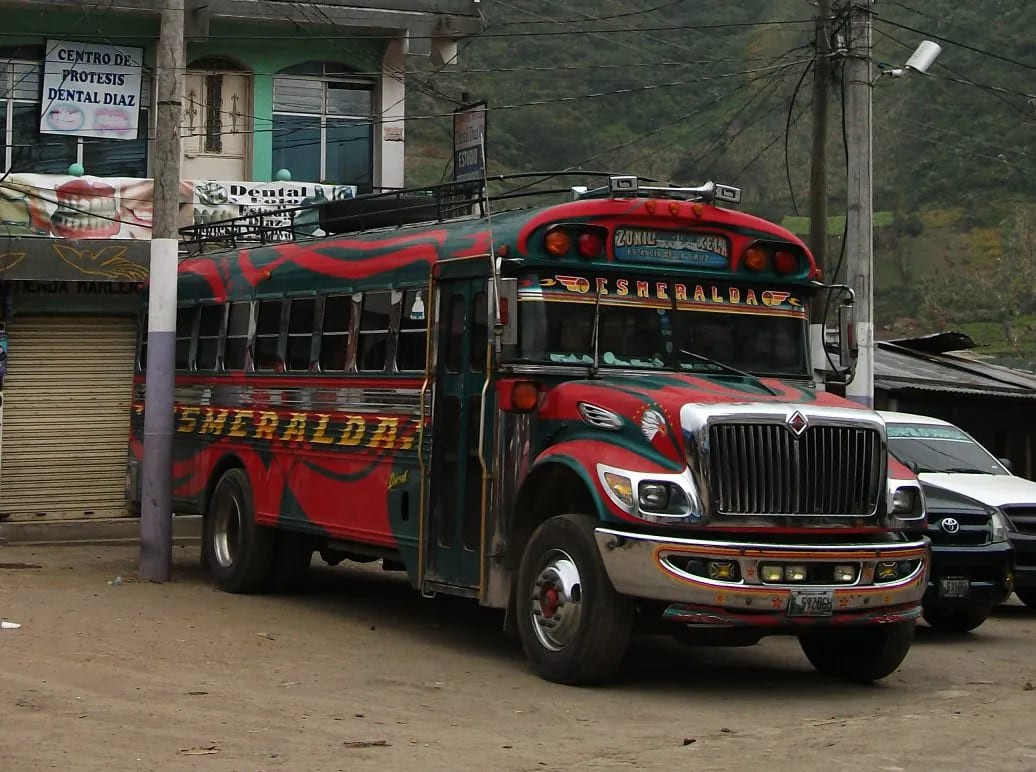
No guide to Guatemala transportation is complete without the iconic chicken bus. These wildly painted, former American school buses are the backbone of Guatemala’s public transport system, covering every road in the country from mountain passes to coastal highways.
Guatemalans do not call them “chicken buses.” That name was invented by tourists who saw passengers traveling with livestock. Locals say camionetas, extraurbanos, canasteras, or simply “el bus.”
In short: “Chicken buses” (locals call them camionetas, extraurbanos, or canasteras) are retired US Blue Bird/International school buses repainted and modified for Guatemalan commercial service — the backbone of public transport. Fares: Q3-10 short, Q10-25 medium (1-2 h), Q20-50 long (2-4 h). The ayudante collects cash on board — carry small bills (Q5, Q10, Q20). Safe for short daytime trips in rural areas and tourist corridors; avoid at night, on major highways, and in Guatemala City. For long distances, Pullman buses (Litegua, Línea Dorada) are safer. Verified May 2026.
Should you ride one? Four questions, answered from the safety and fare sections below.
- Daytime, short hop, rural road or tourist corridor? Ride. That is exactly where chicken buses are fine.
- After dark, a long highway leg, or a Guatemala City route? Don’t. Take Uber, Transmetro, or a Pullman instead.
- Carrying luggage or valuables? Bag on your lap, not the roof rack — roof-rack luggage has been known to disappear.
- Do you have small bills (Q5, Q10, Q20)? The ayudante collects cash on board and often cannot change a Q100 note.
What Are Chicken Buses?
Chicken buses are retired US school buses — the same yellow Blue Bird and International models used across North America. When they reach the end of their service life in the US and Canada, thousands are shipped to Central America for a second career.
In Guatemala, they are taken to workshops where they are:
- Repainted in brilliant colors and designs specific to each bus line
- Modified with more powerful engines (they need the extra power for mountain roads)
- Fitted with chrome details, extra lights, and sometimes custom sound systems
- Converted from a 72-student bus to an “unlimited capacity” commercial vehicle
The result is a functional work of art — and a sometimes terrifying ride.
How Chicken Buses Work
The Crew
Every chicken bus has two people: the driver (piloto) and the ayudante (helper/conductor). The ayudante hangs off the back door shouting the destination, loads luggage on the roof rack, collects fares during the ride, and signals the driver when to stop.
Boarding
- At terminals: Walk to the terminal area (usually near the town market) and look for buses displaying your destination on the windshield or a sign. Ask the ayudante “A donde va?” (Where does it go?) to confirm.
- On the road: Wave down the bus from the roadside. The ayudante will see you and tell the driver to stop.
The Ride
- No schedules. Buses depart when full. More departures in early morning (5-8 AM) and afternoon (2-5 PM).
- No assigned seats. First come, first served. Three per bench is standard. Four is common. Standing in the aisle happens on busy routes.
- To get off: Shout “Parada!” (Stop!) or knock/ring the bell. The bus will stop wherever you are.
Paying
The ayudante walks through the bus collecting fares during the ride. Have the correct change or close to it. Small bills (Q5, Q10, Q20) are best. If you hand over a Q100 note, you may not get change.
Typical Prices
| Distance | Time | Fare (GTQ) | Fare (USD) | Example |
|---|---|---|---|---|
| Under 15 km | Under 30 min | Q3-10 | $0.39-1.30 | Solola to Panajachel |
| 15-60 km | 1-2 hrs | Q10-25 | $1.30-3.25 | Chimaltenango to Solola |
| 60-150 km | 2-4 hrs | Q20-50 | $2.60-6.50 | Panajachel to Quetzaltenango |
Named Routes: Fare, Terminal and Time
The bands above are national averages. Below are the five routes people actually ask about, with the terminal you board at.
First, the honest caveat about every number in this table. No camioneta operator publishes a tariff. There is no ticket, no counter, no rate card and no regulator setting the price — the ayudante collects cash on board and the amount is local convention. Our intercity bus fare feed tracks Litegua, Pullmantur, Línea Dorada, Galgos and Fortaleza del Sur, and it carries no camioneta routes at all, because none of those operators run one. So the fares below are approximate cash fares reconciled across our own route guides on 9 September 2026, not published rates. Treat them as what a local pays. The one exception is the Panajachel–San Pedro lancha, which is a genuine published fare, and it is marked as such.
| Route | Board at | Approx. cash fare | Time | Direct? |
|---|---|---|---|---|
| Guatemala City ↔ Antigua | El Trébol interchange on Calzada Roosevelt, westbound side. Coming back: Antigua’s terminal behind the market on Alameda Santa Lucía | Q10-15 | ~1.5 hrs | Yes — ask for the camioneta directa para Antigua |
| Antigua ↔ Panajachel | Antigua market terminal | Q25-40 total | 3.5-4 hrs | No — 2 to 3 changes |
| Panajachel ↔ Sololá | Pana: the highway entrance above town, where Calle Santander meets the road. Sololá: the market | Q5 | 20-30 min | Yes |
| Xela ↔ Antigua | Xela: Terminal Minerva, Zona 3. Antigua: market terminal | Q30-50 total | 4-5 hrs | No — change at Chimaltenango |
| Panajachel ↔ San Pedro La Laguna | Tzanjuyú public dock, end of Calle del Embarcadero | Q25 by lancha (published fare) | 20-30 min | No camioneta worth taking — see below |
Leg by leg, for the two routes that need a change:
- Antigua → Panajachel: Antigua to Chimaltenango (Q5, 30 min), Chimaltenango to Sololá (Q15-20, 1.5 hrs), Sololá to Panajachel (Q5, 20 min). Some buses run via Los Encuentros instead of straight to Sololá; the total lands in the same Q25-40 range either way. Full comparison on our Antigua to Lake Atitlán guide.
- Antigua → Xela: Antigua to Chimaltenango (Q5, 30 min), then flag any westbound bus on the Pan-American toward Quetzaltenango (Q25-40, 3-4 hrs). Budget up to an hour waiting at Chimaltenango. See Antigua to Quetzaltenango.
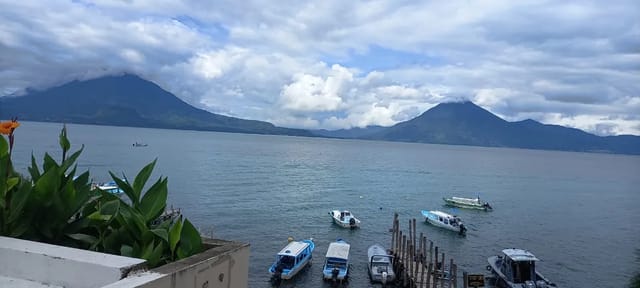
Panajachel to San Pedro La Laguna is a boat trip, not a bus trip. The two towns face each other across Lake Atitlán, but the road between them climbs to Sololá, runs west along the ridge and drops back down — hours of switchbacks to cover about 12 km of water. No local does this by camioneta. Take the public lancha: Q25, 20-30 minutes, and that is the figure the boatmen’s own association publishes (Asociación de Lancheros San Juan Bautista, updated April 2025), which makes it the only genuinely published fare on this page. Expect to be quoted Q40-50 as a foreigner; say “veinticinco” and agree it before you step in the boat. Details on the Panajachel to San Pedro route and the full lancha network.
About the Q25 you will see quoted for Guatemala City ↔ Antigua. Q25 gets repeated a lot for this ride, but it sits inside the Rebuli Pullman band of Q20-30 — a different bus, with a ticket counter, reclining seats, luggage storage and its own terminal. The camioneta from El Trébol is Q10-15. If you are quoted Q25 for a school bus, you are being asked Pullman money for a camioneta seat: either ask again, or go take the Rebuli and get the better seat for the same price. Our Antigua to Guatemala City guide puts all four options side by side.
Major Chicken Bus Hubs
| Hub | Location | Routes |
|---|---|---|
| CENMA | Zona 12, Guatemala City | Southern and western routes |
| Zona 1 terminals | Various, Zona 1, GC | Northern and eastern routes |
| Terminal Minerva | Zona 3, Quetzaltenango | Western highland routes |
| Antigua market | Behind the market | Guatemala City, Chimaltenango |
| Solola market | Solola | Panajachel, Los Encuentros |
Safety: The Honest Assessment
I grew up riding chicken buses and still take them for short trips. But I want to be completely honest about the safety risks:
When they are fine:
- Short daytime trips between nearby towns
- Well-traveled tourist corridors (Panajachel area, around Antigua)
- Rural highland routes during daylight
- When you have no luggage or only a small bag
When to avoid them:
- Night rides, especially in or near Guatemala City. Bus robberies happen.
- Long highway trips. Drivers are paid per trip, not per hour, which incentivizes reckless driving. Highway accidents involving chicken buses make the news regularly.
- Guatemala City routes. The city’s public bus system has a serious crime problem. Use Uber or Transmetro instead.
- When carrying valuables. Keep your bag on your lap. Roof-rack luggage has been known to disappear.
For long distances, use Pullman buses. They have assigned seating, luggage compartments, professional drivers, and are significantly safer.
Practical Tips
- Know your fare before boarding. Ask a local at the terminal or research online. Being overcharged is common for tourists.
- Sit near the front. Less bumpy, easier to exit, and closer to the driver.
- Hold onto your belongings. Backpack on your lap, not in the overhead rack.
- Carry small bills. The ayudante often does not have change for Q100.
- Learn key phrases: “Parada, por favor” (stop please), “Cuanto cuesta a [destination]?” (How much to [destination]?), “Es directo?” (Is it direct?).
- Travel early. More bus options in the morning, safer, and you arrive with daylight remaining.
The Cultural Experience
Despite the safety caveats, riding a chicken bus is one of Guatemala’s most iconic experiences. The colorful exteriors, the booming sound systems, the ayudante’s acrobatic hanging off the back door, and the cross-section of Guatemalan life inside the bus — from market vendors to students to grandmothers with baskets of produce — make it an unforgettable part of traveling here.
Just do it during the day, on a short route, and with your bag on your lap.
Prices verified March 2026. Quetzal/USD conversions are indicative — check today’s exchange rate.