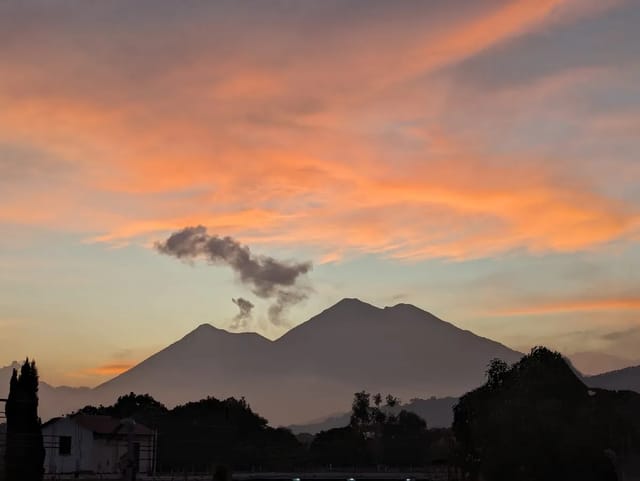
A Guatemalan helada does not look like a northern frost. It arrives on the clearest, stillest night of the week, after a cold front has scrubbed the cloud out, and it lands on valley floors above about 2,800 metres while the hillside 200 metres up stays fine. It kills a field of vegetables by morning and leaves the neighbouring field alone.
MAGA tracks it with one number — five degrees — and publishes only how many municipios it is watching, never which ones. This page runs MAGA’s rule against tonight’s forecast.
Tonight, and the week ahead
Nights 2026-09-20 to 2026-09-26 · 23 highland municipios
Tonight: 0 at or below 0 °C, 2 below MAGA's 5 °C trigger, 21 above it. Over the whole week, 2 of these municipios get at least one night under 5 °C.
| Municipio | Departamento | Elevation (m) | Tonight low (°C) | Against MAGA's trigger | Week low (°C) | Nights under 5°C | Nights at/below 0°C |
|---|---|---|---|---|---|---|---|
| Todos Santos Cuchumatán | Huehuetenango | 3488 | 6.2 | above trigger | 5.2 | 0 | 0 |
| San Juan Atitán | Huehuetenango | 3413 | 6.6 | above trigger | 6.3 | 0 | 0 |
| Ixchiguán | San Marcos | 3273 | 4.3 | under trigger | 4.3 | 2 | 0 |
| San José Ojetenam | San Marcos | 3238 | 4.9 | under trigger | 4.9 | 1 | 0 |
| San Sebastián Huehuetenango | Huehuetenango | 3209 | 7.9 | above trigger | 7.6 | 0 | 0 |
| Chiantla | Huehuetenango | 3119 | 7.8 | above trigger | 7.8 | 0 | 0 |
| Aguacatán | Huehuetenango | 3070 | 6.5 | above trigger | 6.5 | 0 | 0 |
| Totonicapán | Totonicapán | 2965 | 6.4 | above trigger | 6.4 | 0 | 0 |
| San Carlos Sija | Quetzaltenango | 2955 | 6.1 | above trigger | 6.1 | 0 | 0 |
| Ostuncalco | Quetzaltenango | 2928 | 6.5 | above trigger | 6.5 | 0 | 0 |
| Cuilco | Huehuetenango | 2925 | 8.1 | above trigger | 6.8 | 0 | 0 |
| San Rafael La Independencia | Huehuetenango | 2911 | 8.4 | above trigger | 7.5 | 0 | 0 |
| San Francisco La Unión | Quetzaltenango | 2904 | 7.1 | above trigger | 7.1 | 0 | 0 |
| San Lorenzo | San Marcos | 2838 | 6.9 | above trigger | 6.9 | 0 | 0 |
| Sibilia | Quetzaltenango | 2825 | 7.6 | above trigger | 7.6 | 0 | 0 |
| Tecpán Guatemala | Chimaltenango | 2815 | 7.3 | above trigger | 7.1 | 0 | 0 |
| Palestina de Los Altos | Quetzaltenango | 2808 | 7.8 | above trigger | 7.8 | 0 | 0 |
| San Andrés Xecul | Totonicapán | 2786 | 8.2 | above trigger | 8.2 | 0 | 0 |
| San Marcos | San Marcos | 2763 | 7.5 | above trigger | 7.5 | 0 | 0 |
| Quetzaltenango (Xela) | Quetzaltenango | 2488 | 9.7 | above trigger | 9.5 | 0 | 0 |
| Huehuetenango | Huehuetenango | 2176 | 12 | above trigger | 12 | 0 | 0 |
| Santa Cruz del Quiché | Quiché | 2087 | 11.4 | above trigger | 11.4 | 0 | 0 |
| Chimaltenango | Chimaltenango | 1735 | 14.5 | above trigger | 14.1 | 0 | 0 |
Minimum-temperature forecast (Open-Meteo), not a measurement, at each municipality's GADM centroid — not its town square, and highland elevation varies sharply inside one municipio. The 5 °C line is MAGA's own published monitoring trigger, not a definition of frost. MAGA's monitored municipio list is published only as a count. Feed built 2026-09-20T17:01:08.733474Z.
Five degrees is a trigger, not a definition
MAGA’s Centro de Información Estratégica Agropecuaria says the same thing in bulletin after bulletin. On 2 January 2026:
El Ministerio de Agricultura, Ganadería y Alimentación (MAGA), mantiene un monitoreo constante en 173 municipios del país, ante el pronóstico de temperaturas menores a cinco grados centígrados, lluvias superiores a 10 milímetros y vientos ligeros, previstos para este fin e inicio de semana.
On 19 December 2025:
Entre el 19 y el 22 de diciembre, los cultivos y actividades agropecuarias de 51 municipios del país pueden resultar afectados por temperaturas menores a los cinco grados centígrados, según el análisis agrometeorológico elaborado por el Ministerio de Agricultura, Ganadería y Alimentación (MAGA), con base en el pronóstico del Instituto Nacional de Sismología, Vulcanología, Meteorología e Hidrología (INSIVUMEH).
Water freezes at zero, not five. The five-degree line is where MAGA starts paying attention, and the gap between the two is the honest part: a forecast minimum for a whole municipality is an average over terrain that can span a thousand metres of elevation. On a clear, windless night the coldest air pools on the valley floor, and the temperature a lettuce actually sees can be several degrees below the number in the table. That is why the trigger sits five degrees above freezing.
The table therefore reports both: nights under MAGA’s 5 °C line, and nights at or below 0 °C.
What MAGA published, week by week
| MAGA bulletin | Municipios on watch | Departamentos |
|---|---|---|
| 5 December 2025 | 108 | not stated |
| 8 December 2025 | 98 | 10 |
| 19 December 2025 | 51 | not stated |
| 22 December 2025 | 158 | 17 |
| 2 January 2026 | 173 | not stated |
| 9 January 2026 | 182 | not stated |
Six bulletins across five weeks, and not one names its municipios. That gap is the entire reason this page exists — and also the reason it is careful to say it is not MAGA’s list.
Where, and what it hits
MAGA’s 22 December 2025 bulletin is the most specific:
Se reportan temperaturas debajo de los cinco grados centígrados en los departamentos de San Marcos, Huehuetenango, Quiché, Quetzaltenango y Totonicapán, en donde predominan los cultivos de granos básicos (maíz y frijol), café, hortalizas y pastos.
And on the earlier 5 December bulletin, with Chimaltenango added:
Las siembras susceptibles a las bajas temperaturas son hortalizas, café y pastos, especialmente en municipios de Huehuetenango, Quiché, San Marcos, Quetzaltenango y Chimaltenango, en donde históricamente se registran descensos marcados de temperatura.
Those six departamentos are why the table covers those six departamentos.
The livestock effect is indirect and easy to miss. MAGA, 9 January 2026:
En los pastos, las bajas temperaturas ralentizan el crecimiento y reducen su calidad nutricional, volviéndolos más dulces y menos fibrosos, lo que eleva el riesgo de trastornos digestivos en el ganado y afecta la disponibilidad de alimento.
And dry soil makes a frost worse, not better — the counter-intuitive one:
En la mayoría de las áreas agrícolas, la capa superficial registra niveles inferiores al 25 %, situación que limita la capacidad del suelo para amortiguar los efectos del frío. En zonas propensas a heladas, mantener la humedad resulta clave para reducir daños, sobre todo en suelos arenosos donde el drenaje es mayor.
Wet soil stores the day’s heat and releases it overnight. Dry sandy soil does not, which is why the January 2026 combination of sub-5 °C nights, strong wind and 25% topsoil moisture put 182 municipios on MAGA’s list — its highest count of that season.
🔴 MAGA contradicts itself on irrigation timing
This is the one piece of advice a grower most wants, and MAGA has published three different versions of it, each with its own stated reason. We are printing all three rather than picking one, because the contradiction is inside MAGA’s own bulletins and MAGA has not resolved it anywhere we can find.
| MAGA bulletin | What it says | Its stated reason |
|---|---|---|
| 5 Dec 2025 | apply irrigation at the end of the afternoon | to reduce frost forming on the crops |
| 22 Dec 2025 | avoid irrigating in the afternoon | so the soil keeps the heat it absorbed during the day |
| 6 Jan 2026 | light irrigation in the small hours | to stop frost or ice forming on the plants |
In MAGA’s own words, in order:
En zonas altas propensas a heladas, aplicar el riego al final de la tarde, para reducir la formación de escarcha en los cultivos.
También aconsejan realizar un manejo superficial de malezas, evitar aplicar riego en horas de la tarde, para que el suelo mantenga el calor recibido durante el día y cubrir las plantas con materia orgánica seca, como hojarasca o rastrojo vegetal (mulch)
Además, en las zonas altas donde las heladas son frecuentes, se recomienda realizar riegos ligeros en la madrugada para evitar la formación de escarcha o hielo sobre las plantas.
The two bracketing the argument are at least consistent about the mechanism — keep water in the system and the ground gives heat back overnight. Where they differ is when to put it there. If you are deciding tonight, the 6 January advice is the most recent and the most specific; the 22 December advice is the one that explicitly explains what it is trying to protect.
What MAGA agrees with itself about
These are not in dispute across any bulletin we read:
- Cover the vulnerable plants. Cover vegetables, seedbeds and young plants with whatever material is to hand; use dry organic matter as mulch.
- Build structures if you grow at scale. MAGA’s 6 January bulletin describes barreras rompevientos — natural windbreaks of trees and shrubs in rows, or artificial ones of synthetic mesh, plastic or shade cloth — and macrotúneles, which it calls cheaper and more flexible than a conventional greenhouse.
- Plant to the wind and the cold. Sow on high ridges, orient the furrows against the wind direction, and use stakes to keep plants off cold ground.
- Choose the crop. MAGA names onion, sweet pepper and jalapeño chilli as cold-tolerant, and advises against transplanting or new sowing in the critical frost periods.
- Shelter the animals and keep them dry. Housing kept clean and dry, protection from cold night draughts, more feed rather than less.
The season, and who says what
The three agencies split the job cleanly. INSIVUMEH forecasts, MAGA translates it into agricultural risk, CONRED responds.
INSIVUMEH’s weekend meteorological bulletins carry a standing phrase for this, in capitals:
ACTUALMENTE HAY CONDICIONES METEOROLÓGICAS FAVORABLES PARA QUE PUEDAN PRESENTARSE HELADAS METEOROLÓGICAS EN LOS ALTIPLANOS CENTRAL Y OCCIDENTAL.
(That wording is quoted from the bulletin INSIVUMEH publishes under
insivumeh.gob.gt/6128-2/. Read carefully: its byline says 27 March 2026 but the bulletin
itself is stamped for the weekend of 15–16 November 2025. It is quoted here for the phrasing
INSIVUMEH uses, never as a current forecast.)
MAGA’s 22 December 2025 bulletin uses a second term for the same season — heladas agrícolas — and INSIVUMEH’s uses heladas meteorológicas. Both are in the sources; they are not interchangeable, and neither agency defines the difference in anything we captured.
CONRED opened the 2025–26 season on 1 November 2025:
se pronostica el ingreso de alrededor 16 frentes fríos entre los meses de octubre 2025 y marzo 2026, siendo los más intensos entre noviembre y febrero
De acuerdo con registros de esta Secretaría Ejecutiva, los principales eventos asociados a esta temporada son descenso de temperatura, heladas, fuertes vientos y lluvias dispersas en algunas parte del país.
And confirmed in February 2026 where the floor of the year sits:
Estas condiciones generan descensos de temperatura, especialmente durante la noche y la madrugada, principalmente en las regiones del Altiplano Central y Occidente, donde se han registrado las temperaturas más bajas del año.
For people, not crops, CONRED’s advice through the season is consistent:
abrigarse adecuadamente, brindar especial atención a niñas, niños, personas adultas mayores y personas con discapacidad, asegurar techos y ventanas ante la posible presencia de vientos fuertes y mantenerse informada a través de los canales oficiales de CONRED.
La SE-CONRED recomienda a la población abrigarse adecuadamente, mantenerse informada a través de las cuentas oficiales de la CONRED y el INSIVUMEH, y tener a la mano sus medicamentos en caso de padecer enfermedades respiratorias. Si conoce a alguna persona o familia que requiera traslado a un albergue, comuníquese al 119 de la CONRED.
Worth knowing if you are renting in the highlands: almost no Guatemalan house has heating. A 2,500-metre town like Xela is pleasant at midday and 5 °C at 5 a.m. indoors, in a concrete-block room that has been cooling since sunset.
Where else to look
- INSIVUMEH’s own minimum-temperature maps, day by day, for all 22 departamentos: temperatura mínima WRF-GRELL3. They are published as map images rather than as data, which is why this page renders a table instead of reproducing them.
- The other end of the same cold front is a bigger Pacific swell: Pacific marine forecast.
- Dry season is also fire season, and both ride the same dry, clear, windy air: wildfire hotspots.
- Who declares an alert, and what the colours mean: weather alerts and emergency alerts.
- Which climate zone a town is actually in: climate by region. Crop losses reach the market eventually: food prices.
- The two departments at the centre of it: Huehuetenango and Quetzaltenango.
How this page is built and when it updates
- The 5 °C rule is MAGA’s, taken from six of its agrometeorological bulletins published between 5 December 2025 and 9 January 2026.
- The municipio list is ours, and is fixed so the table does not reshuffle day to day: the 18 highest municipios by centroid elevation in the six departamentos MAGA’s frost bulletins name, plus the four departmental capitals not already in that set. 23 rows.
- Coordinates are GADM municipal centroids, not town squares, and elevations were read from the Open-Meteo elevation service on 20 September 2026. Highland elevation varies sharply inside one municipio; a centroid is a defensible point, not the coldest one.
- Everything in the table is a forecast, never a measurement. No claim is made that frost occurred anywhere.
- A failed fetch never overwrites good data. If the forecast cannot be read, the previous file is kept whole and the table shows a stale badge — an empty frost feed in January would read as “no frost anywhere”, which is exactly the failure this repo guards against.
- Cadence: re-read on each daily data run; the forecast covers seven nights.
- Sources and captures for every quotation on this page:
content/research/frost-alerts-2026-09-20.md.
Frequently Asked Questions
Does Guatemala issue frost warnings?
Not as a standing public bulletin with a name. What exists is MAGA’s agrometeorological analysis, built on INSIVUMEH’s forecast, which puts municipios on a monitoring list when minima are forecast below five degrees Celsius — 108 municipios on 5 December 2025, 98 in ten departamentos on 8 December, 51 on 19 December, 158 in seventeen departamentos on 22 December, 173 on 2 January 2026 and 182 on 9 January. INSIVUMEH’s weekend meteorological bulletins carry the standing phrase about favourable conditions for heladas meteorológicas in the central and western highlands, and CONRED covers the cold season in dated bulletins. None of the three publishes a municipio list.
What temperature counts as a frost warning in Guatemala?
Five degrees Celsius is the operational line, and it is MAGA’s, repeated in six bulletins between December 2025 and January 2026: monitoring is triggered by a forecast of temperaturas menores a cinco grados centígrados. That is a monitoring trigger, not a definition of frost — water freezes at zero, and this page reports both. The gap between them is the point: at 2,800 metres, a valley floor radiating heat on a clear windless night can easily sit several degrees below what a forecast for the wider municipio says.
Which parts of Guatemala get frost?
The Altiplano Central and Occidente, in the agencies’ own words. MAGA’s bulletins name San Marcos, Huehuetenango, Quiché, Quetzaltenango and Totonicapán as the departamentos with sub-5 °C readings, adding Chimaltenango to the list of municipios with historically marked drops. INSIVUMEH’s climate outlook puts the coolest mean temperatures in Occidente and the Altiplano Central at 14 °C to 23 °C for the April–June 2026 quarter, against 30 °C to 39 °C maxima in the north, Caribbean, eastern valleys, Bocacosta and Pacific.
When is frost season?
It runs with the cold fronts. CONRED’s season bulletin of 1 November 2025 reported INSIVUMEH forecasting around 16 cold fronts between October 2025 and March 2026, with the strongest between November and February, and its February 2026 bulletin noted the Altiplano Central and Occidente were where the year’s lowest temperatures had been recorded. December and January are when MAGA’s monitored-municipio counts climbed from 108 to 182.
What does a frost actually damage?
Vegetables, coffee and pasture, according to MAGA, concentrated in Huehuetenango, Quiché, San Marcos, Quetzaltenango and Totonicapán. It also hits livestock indirectly: MAGA notes that cold slows pasture growth and reduces its nutritional quality, making it sweeter and less fibrous, which raises the risk of digestive disorders in cattle and cuts the feed available. Dry soil makes all of it worse — MAGA reported topsoil moisture below 25% across most agricultural areas in January 2026, which limits the soil’s ability to buffer the cold.
Should I water my plants before a frost night or not?
MAGA’s own bulletins give three different answers and we are not picking one for you. On 5 December 2025 it advised applying irrigation at the end of the afternoon to reduce frost forming on crops. On 22 December it advised avoiding afternoon irrigation so the soil keeps the heat it took in during the day. On 6 January 2026 it advised light irrigation in the small hours to stop ice forming on the plants. Each has its stated reason, all three are MAGA’s, and MAGA has not reconciled them anywhere we can find.
Is this page MAGA's official list?
No, and it does not claim to be. MAGA publishes the number of municipios it is monitoring and never the names. This page takes MAGA’s own published 5 °C rule and runs it against a minimum-temperature forecast for a fixed set of 23 highland municipios — the 18 highest by centroid elevation in the six departamentos MAGA’s frost bulletins name, plus four departmental capitals. The coordinates are municipal centroids, not town squares, and everything here is a forecast, never a measurement.
What should I do if I live in a cold house in the highlands?
CONRED’s standing advice for the cold season is to wrap up properly at night and in the small hours, to give particular attention to children, older people and people with disabilities, and to secure roofs and windows against the strong winds that come with a front. It adds keeping your medication to hand if you have a respiratory condition, and calling 119 if you know a person or family who needs moving to a shelter. Highland houses in Guatemala are built for altitude sun, not for cold nights — most have no heating at all.