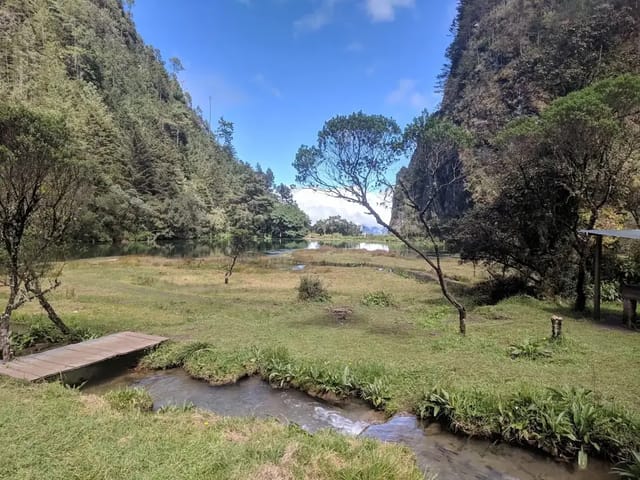
The Cenotes de Candelaria are two spring-fed, open-air cenotes in the municipality of Nentón, Huehuetenango. AGN (23 April 2021) describes them as very close to each other, part of an underground karst water table, up to 30 metres deep, with the smaller one about 80 metres across, and says they are 6 to 8 hours by road from Guatemala City. AGN’s list of recommendations includes a swimsuit, and it says only expert swimmers should swim. They are not the Candelaria Caves of Alta Verapaz, although INGUAT’s own cenotes page mixes the two.
This page covers the Nentón cenotes only, as of 1 November 2026. For the cave system in Chisec and Raxruhá, see our Candelaria Caves page. For the rest of the department, see things to do in Huehuetenango.
Quick summary
| Item | Value |
|---|---|
| Location | Nentón, Huehuetenango (AGN, 2021; INGUAT, 2026) |
| What they are | Two spring-water pools forming natural reservoirs, open-air type (AGN, 2021) |
| Depth | Up to 30 m (AGN, 2021) |
| Size | Smaller cenote about 80 m across (AGN, 2021) |
| Colour | One transparent and turquoise, the other navy blue (AGN, 2021) |
| Water level | Not constant; it can rise or fall (AGN, 2021) |
| Swimming | Only for expert swimmers; bathing at the edges of both cenotes (AGN, 2021) |
| From Guatemala City | 6 to 8 hours by road (AGN, April 2021) |
| From Huehuetenango town | About 4 to 5 hours, for the Nentón attractions (AGN, September 2022) |
| Entry fee | Not stated by AGN or INGUAT |
| Not to be confused with | Candelaria Caves, Chisec and Raxruhá, Alta Verapaz |
What the cenotes are
AGN’s April 2021 article, illustrated with an INGUAT photo, calls them the pozas de Candelaria: two deposits of clear spring water that form natural reservoirs in Nentón. They sit very close to each other and are part of an underground karst water table. AGN explains that the word cenote comes from the Maya tz’onot, meaning well or abyss.
According to the same article:
- They are open-air cenotes, with the characteristic cylindrical shape, plants on their high walls and rock formations.
- The smaller cenote is about 80 metres across, a perfect cylinder with a turquoise colour.
- The water is up to 30 metres deep and changes from blue to turquoise and green with the time of day and the wind; one cenote is completely transparent and the other navy blue.
- The water level is not constant and can rise or fall.
- The surrounding vegetation is thorny scrub forest (bosque chaparral espinoso).
- The water connects with a network of underground rivers in Nentón, and visitors can hike around the cenotes and along the path to them.
- The water is sacred to local people.
INGUAT’s page adds that the area has crystal-clear water, caves and natural formations, and that the site is still relatively unknown to many international travellers. Its opening section, while placing the site in Nentón, describes it as caves forming part of a karst complex of underground rivers, galleries and limestone formations stretching for several kilometres, which is not how AGN describes the two open-air pools (see the getting-there section below).
Swimming
AGN’s recommendations include a swimsuit, but say that only people who are expert swimmers should swim, and that you can take a bath at the edges of both cenotes. AGN gives depths of up to 30 metres and notes that the water is sacred to local people. INGUAT’s page also lists swimming among the things to do. Read our water safety guide before getting in.
Getting there and how long it takes
The dated travel times differ, and one of them describes a different place.
| Source and date | Travel time | Starting point |
|---|---|---|
| AGN, 23 April 2021 | 6 to 8 hours by road | Guatemala City |
| AGN, 16 September 2022 | About 4 to 5 hours, for Laguna Brava, the Candelaria cenotes, the Cimarrón and Río Azul | Town of Huehuetenango |
| INGUAT cenotes page, updated 8 September 2026 | 2 to 3 hours by road | Cobán |
INGUAT’s page places the cenotes in Nentón, but its getting-there section starts from Cobán and says many travellers combine the trip with Semuc Champey or the Quetzal Biotope in Alta Verapaz; its origins section links the system to the Candelaria River, and its accessibility section describes guided tours inside a cave system. Our Candelaria Caves page, sourced to the Ministry of Culture, describes guided cave tours and the río Candelaria in Chisec and Raxruhá, Alta Verapaz: those INGUAT paragraphs fit that system, not the two open-air pools AGN describes in Nentón. Use the AGN figures for Nentón, and build the trip from Huehuetenango: see Guatemala City to Huehuetenango.
INGUAT’s 2026 Huehuetenango guide lists Río Azul, the Candelaria cenotes and Laguna Maxbal among the department’s most striking natural attractions, for travellers with more time who want to explore less accessible areas. It advises asking about the condition of the track, the safety of the access route and whether a guide is needed before setting off. For self-drivers, see our driving in Guatemala guide.
When to go
INGUAT’s cenotes page says the site can be visited all year round and that the dry season, November to April, generally gives better access and more comfortable trails. AGN recommends comfortable clothes for warm weather.
What to bring
AGN’s list: comfortable clothes for warm weather, trainers suitable for walking, sunscreen, personal hygiene items, mosquito repellent, a swimsuit, a cap and sunglasses.
Combine with
AGN (2022) groups the cenotes with Laguna Brava, the Cimarrón and Río Azul as attractions in and around Nentón. INGUAT’s cenotes page also says many people combine their trip with Laguna Brava, Hoyo Cimarrón or the Zaculeu archaeological park.
- Laguna Brava (Yolnabaj), Nentón: the lake in aldea El Aguacate, in the same municipality.
- Candelaria Caves, Alta Verapaz: the separate cave system with the same name.
- Things to do in Huehuetenango: Zaculeu and the Cuchumatanes.
Sources
- AGN, Conozca los cenotes de Candelaria, en Huehuetenango (23 April 2021): https://agn.gt/conozca-los-cenotes-de-candelaria-en-huehuetenango/ (read 1 November 2026)
- AGN, Huehuetenango, destino para este fin de semana largo (16 September 2022): https://agn.gt/huehuetenango-para-este-fin-de-semana-largo/ (read 1 November 2026)
- INGUAT, Guide to the Candelaria Cenotes (published 8 July 2026, updated 8 September 2026): https://visitguatemala.gt/en/natural-wonders/candelaria-cenotes/ (read 1 November 2026); Spanish version: https://visitguatemala.gt/destinos-naturales/cenotes-candelaria/ (read 1 November 2026)
- INGUAT, Huehuetenango: What to see, what to do and how to get there (17 September 2026): https://visitguatemala.gt/en/blog/what-see-do-huehuetenango/ (read 1 November 2026)
Affiliate links — if you book, we earn a commission at no extra cost to you.
Before you pay, check each plan's medical-evacuation limit and its rules for hiking and adventure activities. Three options, as each company describes them on its own site:
- Genki Traveler: a monthly subscription for up to 12 months that covers up to €1,000,000 for unexpected medical care while traveling abroad, at public and private doctors and hospitals.
- SafetyWing Nomad Insurance: the Essential plan is travel medical insurance paid every 4 weeks; the Complete plan is full health insurance with extra travel protections.
- Faye: single-trip plans sold to residents of U.S. states (not U.S. territories); its FAQ lists emergency medical cover of up to $250K and emergency medical evacuation of up to $500K, and adventure and extreme activities need a paid add-on for medical cover.
Limits, prices and the altitude rules side by side: travel insurance for Guatemala · insurance for volcano hikes
Affiliate links: we earn a commission if you buy, at no extra cost to you. Plan descriptions come from each insurer's own site, read September 22-25, 2026; Genki's limit is in euros, Faye's in U.S. dollars; this is not insurance advice. Disclosure
Frequently Asked Questions
Where are the Cenotes de Candelaria?
In the municipality of Nentón, Huehuetenango, according to both AGN (23 April 2021) and INGUAT’s Candelaria Cenotes page (updated 8 September 2026). INGUAT’s page description places them on the border between Mexico and Guatemala.
Are the Cenotes de Candelaria the same as the Candelaria Caves?
No. The Candelaria Caves are a cave system in Chisec and Raxruhá, Alta Verapaz, covered on our Candelaria Caves page. The cenotes are two open-air pools in Nentón, Huehuetenango. INGUAT’s cenotes page itself mixes the two: its getting-there section starts from Cobán and says many travellers combine the trip with Semuc Champey or the Quetzal Biotope in Alta Verapaz.
Can you swim in the Cenotes de Candelaria?
AGN (2021) lists a swimsuit among the things to bring, says only expert swimmers should swim, and says you can bathe at the edges of both cenotes. It gives the depth as up to 30 metres, and adds that local people regard the water as sacred.
How long does it take to get to the Cenotes de Candelaria?
AGN put the trip at 6 to 8 hours by road from Guatemala City (April 2021) and the Nentón attractions at about 4 to 5 hours from the town of Huehuetenango (September 2022). The 2 to 3 hours from Cobán on INGUAT’s cenotes page sits in a section that describes the Alta Verapaz route, so plan from the Huehuetenango figures.
Is there an entrance fee at the Cenotes de Candelaria?
Neither AGN nor INGUAT states an entrance fee on the pages listed on this page. Carry cash and ask locally.