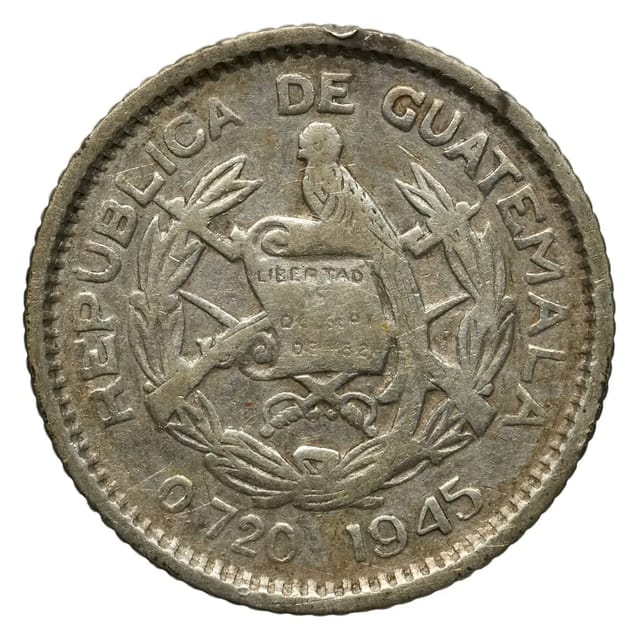
The quetzal was created by Guatemala’s Monetary Law of the mid-1920s, which put the country on the gold standard and made one quetzal equal to one US dollar; based on the dollar rate of the preceding years, one quetzal was set at 60 of the old pesos. Banco de Guatemala (Banguat) dates the reform laws to November 1924 and February 1925, and the first quetzal coins were struck in 1925 in silver and copper, with gold Q20, Q10 and Q5 coins following in 1926. Banguat itself came later: it opened on 1 July 1946, replacing the Banco Central de Guatemala, and issued its first own banknotes on 15 September 1948.
In short: 1924-1925: Monetary Law, gold standard, Q1 = US$1 = 60 pesos. 1925: first silver and copper quetzal coins. 1926: gold coins of Q20, Q10 and Q5. 1946: Banco de Guatemala founded. 1948: its first own notes, including the first Q100. 1997: law allows a Q200 note. 1998: the Q1 coin gets its peace-accord reverse. Today Banguat lists eight notes (Q0.50 to Q200) and six coins (1 centavo to Q1).
Before the quetzal
Banguat’s history of Guatemalan money starts with the Maya, who used quetzal feathers, salt, obsidian, precious stones, jade and, above all, cacao as money. After the Conquest a system based on Spanish coinage was adopted, and Spanish coins, imported or struck at American mints (mainly Mexico, Bolivia and Peru), circulated until the first three decades of the 19th century. Coins of the Central American Federation followed. Under Rafael Carrera’s government the Republic of Guatemala created the peso, with gold and silver pieces.
In the last 30 years of the 19th century the decimal system was used alongside the older binary structure, the old banks issued paper money, and towards the end of the century the one-peso coin stopped being struck. Banguat also records cédulas, tiny notes issued by municipalities and businesses, and private tokens called fichas used on farms, in hotels and in businesses. Under Manuel Estrada Cabrera a Comité Bancario was given the power to issue paper money, and in June 1900 nickel fractional coins (one, a half and a quarter real) were authorised.
The reform of 1924-1925: gold standard and the 60-peso quetzal
Banguat says the Ley Monetaria y de Conversión and the Ley de Instituciones de Crédito were issued in November 1924 and February 1925. Two routes to a gold or gold-convertible currency were weighed: a foreign loan, or building up national resources. The government chose national resources. The Monetary Law then:
- adopted the gold standard;
- created a new monetary unit, the quetzal, equal to one US dollar;
- set one quetzal at 60 pesos, based on the dollar exchange rate of the previous years;
- reserved currency issue to the State.
The new currency led to the founding of the Banco Central de Guatemala as the only issuer, a role that several private banks had held before. Banguat sums up the reform as turning a system of inconvertible paper money into one of great exchange-rate stability. Under the new regime, silver and copper coins were the fractional money and paper money carried the larger denominations.
The first quetzal coins
| Year | Coins issued | Metal |
|---|---|---|
| 1925 | Q1, half quetzal, quarter quetzal, 10 centavos, 5 centavos | Silver |
| 1925 | 1 centavo | Copper alloy |
| 1926 | Q20, Q10, Q5 | Gold |
| 1932 | Half centavo, 2 centavos | Copper and zinc |
Source: Banco de Guatemala, Reseña histórica de la moneda de Guatemala (read 13 November 2026 UTC).
1944-1948: the second reform and Banco de Guatemala
Banguat ties its own creation to the October 1944 Revolution. The second monetary and banking reform started from the view that the classic gold standard, which put the economy’s internal stability below the currency’s external parity, could not work properly in Guatemala; the aim was to give the country institutions that would maintain internal economic stability and help the orderly development of production. In the last months of 1945 Congress issued Decreto 203 (Ley Monetaria) and Decreto 215 (Ley Orgánica del Banco de Guatemala).
On 15 June 1946 the government and the Banco Central signed an agreement under which the Banco Central gave up its rights to issue notes and coin. Banco de Guatemala opened on 1 July 1946, during the government of Juan José Arévalo Bermejo, as an autonomous body with its own assets. It had to take on the liabilities for the notes in circulation and the deposits held at the Banco Central. At first it met demand for cash by issuing coins and overprinting the old Banco Central notes with the words Banco de Guatemala.
| Date | Change | Source |
|---|---|---|
| 15 Sep 1948 | Banguat’s first own notes: 50 centavos, Q1, Q5, Q10, Q20 and, for the first time, Q100; Banguat says they were the same size as today’s notes. Coins of 25, 10, 5 and 1 centavo continue | Banguat history; Banguat institutional page |
| 1949 | Coins redesigned with the motifs still used, with small changes since | Banguat institutional page |
| July 1954 | Coin minting assigned to Banguat; the Casa Nacional de Moneda moves from the Finance Ministry to the central bank | Banguat institutional page |
| 20 Aug 1964 | Decreto Ley 265, Ley de Especies Monetarias (Enrique Peralta Azurdia): coins of 50, 25, 10, 5 and 1 centavos; notes of 50 centavos and Q1, Q5, Q10, Q20, Q50, Q100, Q500 and Q1,000 | Banguat history |
| Early 1970s | Entirely new note designs, whose main motifs are still used | Banguat institutional page |
| 6 Jan 1997 | Decreto 139-96, new Ley de Especies Monetarias, allows a Q200 note | Banguat history |
| 26 Nov 1998 | Decreto 92-98 reforms the reverse of the 1-quetzal coin | Banguat history |
The 1998 change put the peace accord on the coin. Banguat says the Q1 coin carries the word Paz as part of a stylised dove, with the legends PAZ FIRME Y DURADERA and 29 DE DICIEMBRE DE 1996, the date the government and the URNG signed the Acuerdo de Paz Firme y Duradera. The wider history of that period is on our Guatemala history timeline.
Notes and coins Banguat lists today
Banco de Guatemala’s catalogues of notes and coins de actual circulación (read 13 November 2026 UTC) list:
| Banknotes | Coins |
|---|---|
| Q0.50 | 1 centavo |
| Q1 | 5 centavos |
| Q5 | 10 centavos |
| Q10 | 25 centavos |
| Q20 | 50 centavos |
| Q50 | 1 quetzal |
| Q100 | |
| Q200 |
Set against the history: the Q100 note dates from Banguat’s first issue in 1948, and the Q200 note was made possible by the 1997 law. The Q500 and Q1,000 notes that the 1964 law allowed are not in today’s catalogue, and neither is any coin above Q1. Banguat’s history does not give the year the Q1 coin came back into the coin series after the 1964 law, which listed coins only up to 50 centavos; its 1998 entry reforms that coin’s reverse. The Q0.50 note is still in the catalogue; the catalogue does not say how often it is seen in change.
Using this history now
- To see the coins and notes themselves, Banguat’s free museum in Zona 1 is covered on our Museo Numismático guide.
- To check a note’s security features, see how to spot counterfeit quetzal notes.
- For what a quetzal is worth against the dollar today, the Banguat reference-rate averages are on our USD to GTQ averages page.
- Leaving with cash left over: exchanging quetzales back to dollars.
Sources
- Banco de Guatemala, Reseña histórica de la moneda de Guatemala, https://www.banguat.gob.gt/page/resena-historica-de-la-moneda-de-guatemala-0 (read 13 November 2026 UTC).
- Banco de Guatemala, Banco de Guatemala (institutional history), https://www.banguat.gob.gt/page/banco-de-guatemala-0 (read 13 November 2026 UTC).
- Banco de Guatemala, Catálogos de billetes de actual circulación, https://banguat.gob.gt/page/catalogos-de-billetes-de-actual-circulacion (read 13 November 2026 UTC).
- Banco de Guatemala, current-circulation coin catalogue (PDF Billetes_Monedas_Actual_Circulacion), https://banguat.gob.gt/sites/default/files/banguat/Publica/monedasybilletes/Billetes_Monedas_Actual_Circulacion.pdf (read 13 November 2026 UTC).
Frequently Asked Questions
When did the quetzal start, and what was it worth?
Banco de Guatemala dates the reform to the Ley Monetaria y de Conversión and the Ley de Instituciones de Crédito, issued in November 1924 and February 1925. The Monetary Law adopted the gold standard and created the quetzal, equal to one US dollar, and one quetzal was set at 60 of the old pesos. The first quetzal coins were struck in 1925.
What currency did Guatemala use before the quetzal?
The peso, created under Rafael Carrera’s government, with gold and silver pieces, according to Banco de Guatemala. Before that, Spanish colonial coins circulated until the first three decades of the 19th century, followed by coins of the Central American Federation.
When was Banco de Guatemala founded?
On 1 July 1946, during the government of Juan José Arévalo, as part of the second monetary and banking reform. It replaced the Banco Central de Guatemala and at first overprinted the old bank’s notes with the words Banco de Guatemala. Its own first notes followed on 15 September 1948.
Did the quetzal stay on the gold standard?
Banco de Guatemala says the second monetary reform, which followed the October 1944 Revolution, started from the view that the classic gold standard, with internal stability subordinated to the currency’s external parity, could not be applied correctly in Guatemala. Congress issued a new Monetary Law (Decreto 203) and the Banco de Guatemala Organic Law (Decreto 215) in the last months of 1945.
What banknotes and coins are in circulation now?
Banco de Guatemala’s current-circulation catalogues list notes of Q0.50, Q1, Q5, Q10, Q20, Q50, Q100 and Q200, and coins of 1, 5, 10, 25 and 50 centavos and 1 quetzal.
Why does the 1-quetzal coin say Paz?
Decreto 92-98 of 26 November 1998 reformed the coin’s reverse to mark the peace accord of 29 December 1996. Banguat says it carries the word Paz as part of a stylised dove, with the legends PAZ FIRME Y DURADERA and 29 DE DICIEMBRE DE 1996.