The Todos Santos horse race is not a sporting event. It is a Mam Maya ritual — a farewell to the dead held every November 1, in which riders gallop a dirt track toward the town cemetery until dusk. There is no finish line that matters and no prize for being fastest: in the words of one visiting writer, “the winner was the guy who fell off last.”
And the logistics catch most visitors out. The riders start at dawn, but the first public microbus up the mountain from Huehuetenango does not reach Todos Santos until around midday. So the real question is not whether to go — it is how you get there in time for the start, and how to be a respectful guest at something that is, for the town, closer to a sacred vigil than a spectacle.
Quick summary: The horse race of Todos Santos Cuchumatán — Skach Koyl in Mam, also called the carrera de cintas or carrera de las ánimas — runs on Sunday, November 1, 2026, within a festival window of Oct 31–Nov 2. It is a ritual, not a competition. Start time is disputed (6 a.m. per Guatemala.com, 7 a.m. per Prensa Libre; morning and afternoon sessions until ~6 p.m.). The town is 316 km / ~6.5 h from Guatemala City; there is no dawn public transport, so overnight in town or take the overnight round-trip tour from the capital. Sleep in Huehuetenango city (46 km) for comfort, or basic in-town hospedajes for the dawn start. Bring cash from Huehuetenango — no in-town ATM is documented. Dress warm: the town sits at ~2,470–2,500 m and dawn is cold.
Quick facts
| Date | Sunday, November 1, 2026 (festival window Oct 31–Nov 2) |
| Where | Todos Santos Cuchumatán, Huehuetenango — a dirt track leading to the cemetery |
| What it is | Skach Koyl / carrera de cintas — a Mam Maya ritual, not a race for time |
| Start time | Sources differ: 6 a.m. (Guatemala.com) or 7 a.m. (Prensa Libre); runs to ~6 p.m. |
| Track length | Roughly half a mile / several hundred metres — sources give 600 yd, ~800 m, “half-mile” |
| From Guatemala City | 316 km, ~6.5 h by road; no dawn public transport — tour or overnight in town |
| Final leg | Huehuetenango → Todos Santos = 46 km, ~2 h by microbus |
| Where to sleep | Huehuetenango city (46 km) = practical base; in-town hospedajes are very basic |
| Altitude | Town ~2,470–2,500 m (~8,000 ft) — genuinely cold at dawn |
| Cash | Bring quetzales from Huehuetenango; no in-town ATM is documented |
What the race actually is — a Mam Maya ritual
The town’s own municipality is blunt about it: “No es una competencia cualquiera: es un ritual que mezcla valentía, devoción y memoria ancestral” — this is not just any competition; it is a ritual blending courage, devotion, and ancestral memory (municipalidad de Todos Santos Cuchumatán). Guatemala.com puts it the same way: “se trata más de un ritual que de una contienda” — it is more a ritual than a contest.
Riders mount up and ride the streets and the track that leads to the cemetery, in packs of five to eight, back and forth, all day (municipality; Vice). The Mam name most travellers encounter in English-language coverage, Skach Koyl, is translated as the “Race of Souls” (Atlas Obscura) — a reading that fits its Spanish name, the carrera de las ánimas (race of the spirits).
A few things make it unmistakably a ceremony rather than a sport:
- A rooster offering opens it. Before the riding, the cofradía holds a ceremony asking permission of the Saints and of Mother Earth, offering the blood of a rooster (Guatemala.com). The tradition is also known as the juego de gallos — the “Game of Roosters” — with leaders carrying roosters that are eventually sacrificed (soymigrante).
- A spiritual guide signs off. Each participant needs the approval of an Aj’Qi’j (Mam spiritual guide), who determines whether the day is propitious (soymigrante).
- Ceremonial dress. Riders wear red trousers, a white shirt with purple stripes, and a hat decorated with ribbons and feathers (soymigrante); the municipality describes “trajes tradicionales, sombrero con plumas y cintas.” The colored feathers, scarves, and red ribbons are said to represent the connection with the ancestors (Guatemala.com history).
- You commit for four years. By custom, a rider takes part for four consecutive years — no more (soymigrante).
Why horses, and why now? The origin is debated. Historian Aníbal Chajón dates the race to the late 19th century, tied to commerce with the Mexican side of the border, and notes that under Spanish rule until Independence, indigenous people were legally barred from riding horses — a prohibition rooted in the 16th-century conquest (Publinews). The popular narrative holds that the Mam rode to prove they, too, could master the animal (Guatemala.com history). The November timing is tied to the harvest — by early November, the year’s crops are already in (Publinews).
Getting there from Guatemala City — the hard part
Todos Santos Cuchumatán is 316 km from Guatemala City (about a 6.5-hour drive) and 46 km from Huehuetenango city, the departmental capital (Guatevalley). By road you take the CA-1 west toward Chiantla, reach the junction of Tres Caminos after about 26 km, and turn toward Todos Santos on paved road (Guatevalley). There is no single direct bus — the trip is done in two legs.
Leg 1: Guatemala City → Huehuetenango
The Los Halcones row is from the operator’s own website, read 24 September 2026; the other two rows are from a Guatemala.com bus-price guide last updated 6 June 2025 — confirm current prices when you book.
| Operator | Fare | Departs / notes |
|---|---|---|
| Transportes Los Halcones | Gold from Q145 (operator, 24 Sep 2026) | Weekdays 02:00, 07:00, 10:30, 13:00, 14:00, 15:30, 17:00, plus special runs; 6 hours. Full timetable: Guatemala City to Huehuetenango |
| Aero Bus | Q100 promo / Q130 normal | Calzada Roosevelt → Calzada Kaibil Balam (Huehue); 4:15 a.m. & 1:45 p.m. |
| Cristóbal Colón (Pullman, direct) | ~US$16.32 | 7a. Avenida 19-44, Zona 1 |
(Source: Guatemala.com bus prices. We are not listing other operators whose schedules we could not verify on a primary source.)
Leg 2: Huehuetenango → Todos Santos
From Huehuetenango’s terminal, local microbuses climb the 46 km to Todos Santos in about two hours, over the windswept La Ventosa plateau before dropping into the valley. A traveller account documents the Transportes Flor de María microbús at Q20, with departures around 10:20, 11:20, 14:00, 15:15 and 16:15 (travel blog — traveller report, not an operator timetable, so treat these times as indicative and expect roughly hourly service from mid-morning to mid-afternoon).
This is the crux of the whole trip. Even the earliest documented microbus (≈10:20 a.m., ~2 h) lands you in Todos Santos around midday — long after the dawn start. If the morning session matters to you, there are only two real solutions:
- Overnight in Todos Santos the night of October 31 and walk to the track, or
- Take the overnight round-trip tour from Guatemala City (below), which is built to deliver you at 7:00 a.m.
The overnight tour from Guatemala City
For visitors who want the dawn ride without the two-leg puzzle, Nómadas GT sells an INGUAT-authorized overnight round trip. In its 2025 edition the itinerary left Guatemala City the evening before, watched sunrise at the Mirador Diéguez Olaverri around 5:00 a.m., transferred into Todos Santos by 7:00 a.m. to watch the carrera de cintas, departed at 2:30 p.m., and returned to the capital around 10:00 p.m. The package included private transport, passenger insurance, first aid, and staff, and departed from Shell Carabanchel, Rus Mall, Calzada Roosevelt 12-66, Zona 7 (Nómadas GT).
The 2025 price was Q250 promotional / Q335 regular per person. Treat that as the pattern, not a locked 2026 figure — confirm the 2026 date and price directly with the operator.
Status on September 24, 2026: no 2026 departure is posted yet. Nómadas GT’s event page, and the near-identical listing of a second operator, Feliz Viaje, both still show the 2025 trip (leaving the capital at 21:00 on October 31, back around 22:00 on November 1). The fine print on those 2025 listings is worth knowing before you book the 2026 version: a Q150 per person deposit, with the balance paid in cash (Nómadas does not take cards); food and drinks are not included; the Mirador Diéguez entrance (Q10) is extra; Nómadas runs the trip only with a minimum of 10 passengers, reschedules or refunds if that is not met, and gives no refund if you cancel yourself; and it warns that the vehicle may drop you some distance from the race, so bring comfortable shoes. Its packing list: breakfast to eat on the bus, a coat, hat and gloves, and sunscreen.
Where to stay
Base in Huehuetenango city if you want comfort. At 46 km away it is the realistic bed base — it has the hotels and the bus connections — but remember that public microbuses from there will only get you to Todos Santos for the afternoon session. That trade-off is the whole logistics story: comfort in Huehue vs. the dawn start in town.
Where to stay in Huehuetenango
Compare Booking.com, Airbnb and hotels on one map. Drag the map and set your dates to see live availability and real prices.
Affiliate links — if you book, we earn a small commission at no extra cost to you.
Sleep in Todos Santos itself only if you want the morning ride and don’t mind roughing it. In-town lodging is limited to a few very basic hospedajes — think shared, cold-water-to-hot-water bathrooms and simple rooms. A traveller-compiled list names Hospedaje La Paz (among the cheapest, ~Q20 per person, shared bath), Hospedaje Río Limón, Hotel Mam, and Casa Familiar (described as the most comfortable of them, with some private hot-water baths) — but this is a visitor-compiled list, not an official directory, so confirm the place still operates before you rely on it.
One honest gap: we have not found a source confirming that rooms sell out around November 1. It is a small town and the date draws returning diaspora and hundreds of visitors, so booking ahead is prudent — but we won’t state a sellout as fact when no source supports it. Have a Huehuetenango fallback.
When to arrive, and what actually happens when
The festival doesn’t begin and end on November 1. Celebrations build from around October 28 with dancing, intensifying on October 31 — the most raucous day, full of marimba (Publinews; soymigrante). On the night before the race, each captain’s house hosts a party with marimba, drink, and food (Guatemala.com history). Wikipedia frames the whole window as October 31 – November 2, centered on All Saints’ Day.
On race day itself, the schedule is disputed and you should plan loosely:
- ~5:00 a.m. — horses are distributed. Because riders don’t know the animal they draw, the day is considered more dangerous, and this is part of why families treat it as a farewell (Guatemala.com history).
- 6:00 a.m. (Guatemala.com) or 7:00 a.m. (Prensa Libre) — riding begins. Sources genuinely differ; we are not going to pick one for you.
- Midday — a break, per Prensa Libre; then the afternoon session.
- ~6:00 p.m. — the riding winds down (both sources).
The track length is disputed too — reports range from a 600-yard course (Atlas Obscura) to ~800 metres (Prensa Libre) to a “half-mile stretch of dirt road” (Vice). The honest answer is roughly half a mile; nobody publishes an exact, agreed figure.
How to watch respectfully
This is the part that matters most, and it’s where visitors most often get it wrong.
- Photography: ask first. The etiquette in Todos Santos is clear — do not photograph anyone, especially children, without permission (Anywhere.com). The riders are performing a spiritual act in ceremonial dress; a respectful request or a lowered camera is the right call.
- Understand the drinking. Riders drink Quezalteca (a Guatemalan cane liquor) as they ride — these are among the only days of the year for it, and they take a drink on each lap (Vice; Publinews). It is part of the ritual, not a sideshow. Don’t treat it, or the riders, as entertainment to laugh at.
- The death belief — handle it with care. In the local Mam understanding, if a rider dies from a fall it is received as a blessing and a sign of a good harvest year (soymigrante; corroborated by Vice). This is why the pre-race gatherings carry the weight of a farewell — families do not know whether every rider will return alive (Guatemala.com history). It is not gore to gawk at; it is a sacred framing of mortality. Approach the whole day in that spirit.
- Stay behind the fence, keep your distance. A wooden fence lines the track (Prensa Libre), and riders regularly suffer heavy falls (Región Más). We found no source describing formal medical or ambulance presence — so give the course a wide margin and keep children well back.
A note on the town beyond the race: Todos Santos is one of the few places in Guatemala where indigenous men still wear traditional dress daily (Wikipedia). The main market day is Saturday (Anywhere.com), so a Saturday–Sunday visit lets you see everyday highland life before the race. Spanish and Mam are both spoken (Guatevalley).
November 2: the cemetery day
The festival window officially extends through November 2, All Souls’ Day, and the race track itself leads to the cemetery (Wikipedia; municipality). Beyond that, detailed, sourced information about a Nov 2 itinerary in Todos Santos is thin — so we won’t invent one. Expect a quieter, more reflective cemetery day after the intensity of November 1, in keeping with the wider Guatemalan tradition of visiting graves; for the full national picture, see our Día de los Santos guide.
Todos Santos or Sumpango? Pick one — they’re the same day
November 1 forces a choice, because Guatemala’s two headline All Saints’ events happen simultaneously in opposite corners of the country:
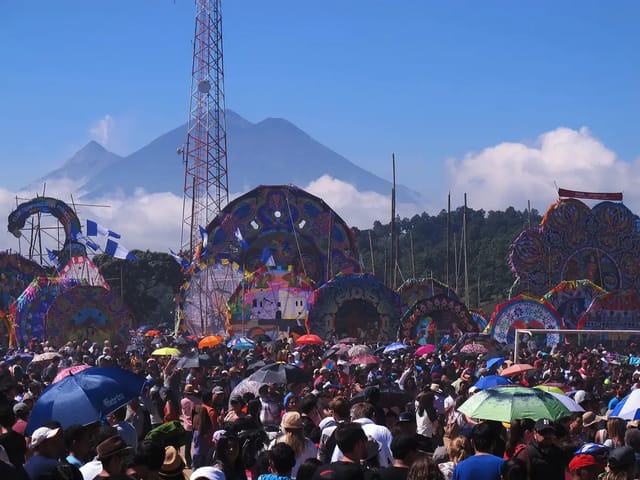
- The giant kite festival in Sumpango — 13 km from Antigua, an easy day trip from the tourist trail, a monumental open-air art exhibition (though the true giants don’t actually fly).
- The Todos Santos horse race — deep in the western highlands, ~6.5 hours from the capital, a raw Mam Maya ritual with almost no tourist infrastructure.
They cannot be combined. Sumpango is the accessible, family-friendly spectacle near Antigua; Todos Santos is the remote, intense, harder-to-reach ceremony. Choose by how far you’re willing to travel and what you’re going for.
Common questions
When is it? Sunday, November 1, 2026 — every year on that date, within an Oct 31–Nov 2 window.
What time do riders start? Disputed: 6 a.m. (Guatemala.com) or 7 a.m. (Prensa Libre), morning and afternoon sessions until ~6 p.m. Be in town the night before to be sure.
Can I get there for the dawn start by bus? No. The first documented microbus from Huehuetenango arrives around midday — overnight in town or take the overnight tour.
Where do I sleep? Huehuetenango city (46 km) for comfort and connections; basic in-town hospedajes if you need the morning ride.
Is there an ATM in town? Not documented — bring cash from Huehuetenango.
Related
- Todos Santos Cuchumatán — the town itself: altitude, language, everyday traje, and market day
- Huehuetenango department – the department you travel through and sleep in: Huehuetenango city, the Cuchumatanes plateau, safety and cost data
- Giant Kite Festival, Sumpango — the other, more accessible November 1 tradition near Antigua
- Día de los Santos in Guatemala — the national All Saints’ holiday this race belongs to
- Halloween in Guatemala — October 31, the night before; not a holiday, and how police handled it in 2025
- Guatemala events calendar — every major recurring event, month by month