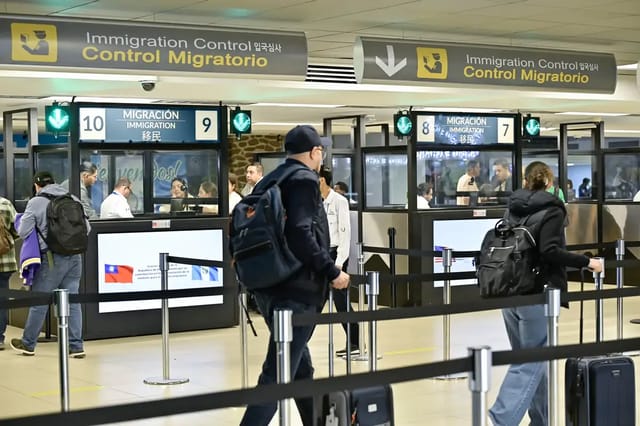
If you qualify to file a Guatemalan residency application, and you actually file it and keep the file active, you probably do not need a border run at all. IGM’s Reglamento de Residencias Guatemaltecas says that presenting the application is itself the authorisation to stay while it is processed, and that no overstay is incurred during that period. That reglamento was signed on 21 May 2025; the commencement date in circulation, 8 October 2025, is practitioner-reported rather than published by the government — we set out below exactly what is and is not documented about it. Almost every border-run guide online, including our own older ones, still frames the decision as prórroga vs. run vs. residency — as if residency were the slow option you cannot use yet. Under Art. 4 it is the option that ends the clock problem for as long as the file stays active and you answer every previo within 30 days.
Quick summary: Acuerdo IGM-016-2025, Art. 4 — “La presentación de la solicitud de residencia temporal o permanente implica autorización de permanecer en el país, durante el diligenciamiento del trámite; por lo tanto, no se incurrirá en exceso de permanencia durante este periodo.” The overstay fine it protects you from is Q15/day (Decreto 44-2016, Art. 194 numeral 2). Filing costs US$25 (Tarifario numeral 3.1). The protection is conditional: a previo left unanswered for 30 days (Art. 35), or six months of inaction (Art. 58), each put the fine back on you. To exit and re-enter while the file is in process you need a visa of its own — US$25 simple / US$100 múltiple, valid 90 days from the date the visa is issued (Art. 42). If no residency category fits you, the US$25 prórroga buys 90 more days to a 180-day ceiling. The border run is what is left after both.
This is general information, not legal advice. For the authoritative current rule, confirm with IGM (igm.gob.gt) before you act.
The rule that changes the decision
Here is the operative text, in full, from the regulation itself:
ARTÍCULO 4. Solicitud de residencia. La presentación de la solicitud de residencia temporal o permanente implica autorización de permanecer en el país, durante el diligenciamiento del trámite; por lo tanto, no se incurrirá en exceso de permanencia durante este periodo.
— Acuerdo IGM-016-2025, Reglamento de Residencias Guatemaltecas
Read the conditions in the same breath as the rule
Art. 4 is not a blanket amnesty for anyone who has ever filed. Two articles of the same reglamento put the fine straight back on you, and they belong next to Art. 4 rather than in a footnote:
ARTÍCULO 35. Plazo para subsanar requisitos. El solicitante de una residencia, en un plazo de treinta días contados a partir del día siguiente de la notificación, deberá cumplir con los requisitos legales requeridos por la Subdirección de Extranjería; de lo contrario, incurrirá en multa por permanecer por más tiempo del que ha sido autorizado y será causal de denegatoria de conformidad con lo regulado en el Código de Migración y en el artículo 36 numeral 3 del presente Reglamento.
ARTÍCULO 58. Archivo del expediente por falta de interés. El Instituto Guatemalteco de Migración procederá a archivar los expedientes en los que la persona extranjera deje de accionar por un plazo igual o mayor a seis meses… Al realizarse el archivo del expediente el extranjero incurrirá en multa por permanecer por más tiempo del que ha sido autorizado según lo establecido en el Código de Migración.
— Acuerdo IGM-016-2025
So the accurate sentence is not that filing ends the clock problem, full stop. It is: filing ends the clock problem while the file is active and you answer every previo within 30 days. Miss a previo, or let the file go quiet for six months, and the fine attaches for having stayed longer than you were authorised to — the authorisation was tied to the trámite being live, so losing it is not a clean slate.
That is not a tolerance, a practitioner workaround, or a customary practice — it is the operative regulation. The fine it shields you from is set by the Código de Migración:
Artículo 194. Sanciones. A las faltas reguladas les son aplicables las siguientes sanciones pecuniarias: … 2. Por permanecer más tiempo del que les ha sido autorizado, sin tener pendiente gestión de ampliación, multa de quince Quetzales por día de exceso de permanencia.
— Decreto 44-2016 del Congreso de la República, Código de Migración
Be careful how those two texts fit together, because most write-ups splice them wrongly — and so did an earlier draft of this page. Art. 194 numeral 2 sets the fine and carves out someone who has a “gestión de ampliación” pending. A gestión de ampliación is, on its face, the prórroga — the extension of an existing stay — and the Código does not say anywhere that a residency application counts as one. Whether IGM treats a residency file as a gestión de ampliación is not settled by the Código, so this page does not rest the residency case on Art. 194.
What supplies the authorisation for a residency applicant is Art. 4 of the reglamento, on its own terms. It does not need the Código’s carve-out to work: it says directly that filing implica autorización de permanecer en el país, and that no se incurrirá en exceso de permanencia during the trámite. Art. 194 numeral 2 is simply the rule that fixes the fine at Q15/day when you are not covered.
On the date this took effect, be precise. The acuerdo was signed in Guatemala City on 21 May 2025 and was approved by the Autoridad Migratoria Nacional through AMN 005-2025. Its own Art. 60 does not name a commencement date — it says the acuerdo “entrará en vigencia conforme lo disponga esa Autoridad.” The date in circulation, 8 October 2025, comes from a law firm’s client alert on the 2025 reforms (Consortium Legal, 22 August 2025), not from a government page we could read. Treat the regulation as current — IGM publishes it as the residency reglamento in force — and treat the specific commencement date as practitioner-sourced.
One more consequence of the same instrument, which matters if your older research said otherwise: Art. 59 of IGM-016-2025 derogates Acuerdo IGM-092-2022 of 25 October 2022, which had itself replaced the 2019 residency reglamento. Any guide still citing Acuerdo Migratoria 04-2019 is two instruments out of date.
Work through it in this order
1. Are you leaving anyway before day 90?
Then there is nothing to decide. Tourists get up to 90 days under Art. 74 of the Código de Migración — “Son turistas o viajeros las personas extranjeras que han ingresado de forma regular con fines lícitos, sin propósito de obtener una residencia temporal o permanente cuyo plazo no podrá ser mayor de noventa días, prorrogable por una sola vez.” Note that the period is a ceiling, not a guarantee, and it is shared across the CA-4 (Guatemala, El Salvador, Honduras, Nicaragua).
One wrinkle in that definition is worth naming, because this page turns on it. Art. 74 describes a tourist as someone who entered “sin propósito de obtener una residencia temporal o permanente” — without the purpose of obtaining residency. The reglamento’s Art. 4 nonetheless speaks to whoever presents a residency application while in the country, and IGM’s published procedure is an in-person filing at its Guatemala City offices. What this page is not telling you is that any tourist may convert a stamp on a whim: the reglamento sets out who may apply and under what category — Arts. 5–14 for temporary residence, Arts. 26–33 for permanent — and you have to actually fit one of them. Whether you do is the next question.
2. Does any residency category fit you today?
This is the question most border-run content never asks. If the answer is yes, filing ends the clock problem — see Art. 4 above — and you stop paying for trips.
| If you are… | The door | Waiting period |
|---|---|---|
| Married 1+ year to a Guatemalan, both the marriage and the spouse’s birth recorded at RENAP | Código Art. 78 lit. b), developed in IGM-016-2025 Art. 28 | One year of marriage |
| A parent, child or sibling of a Guatemalan | Código Art. 78 lit. c), developed in IGM-016-2025 Art. 29 | None stated in the regulation |
| A remote employee paid by a foreign employer | IGM-016-2025 Art. 11 numeral 2 | None — but it is an income test: US$2,000/month from abroad, US$3,000 with dependants |
| Self-employed or freelance | IGM-016-2025 Art. 11 numeral 3 | None — and no income figure at all: a notarial sworn declaration of your activities, an RTU registration, and authorisation to trade |
| Living on a foreign pension or rents | IGM-016-2025 Arts. 31–33 | None — it is an income test |
| Already a temporary resident for 5+ years | Código Art. 78 lit. a), IGM-016-2025 Art. 27 | Five years |
Which of the first two doors opens faster is a real decision with a real trap in it — we work it through in Guatemala residency with no waiting period. The income routes are covered in the digital nomad residency and pensionado / rentista guides, and the whole category map is in the Guatemala residency guide.
3. If no category fits: the prórroga
The extension is the cheap, fully legal bridge, and it is still the right first move for an ordinary tourist.
| Item | What is published | Source |
|---|---|---|
| Fee | US$25.00 | Tarifario IGM-029-2023, numeral 2.2 — “Ingreso de solicitud de prórroga de visa de turista o viajero” |
| What it adds | up to 90 more days, once, 180-day ceiling from entry | IGM-015-2025 Art. 14; Decreto 44-2016 Art. 74 |
| Form | PVT-IGM-01-2026 (an English version is published at the same path) | IGM forms |
| Where | Subdirección de Extranjería, 6a Avenida 3-11, zona 4, Ciudad de Guatemala, Nivel 2 | IGM, “Atención extranjeros, ¿Sabe cómo ampliar su estadía en Guatemala?”, 12 Feb 2025 |
| Hours | Mon–Fri 07:00–15:00 | IGM announcement, 19 Feb 2026 |
| Appointment | IGM’s prórroga guidance is worded permissively: “Puede programar su cita y descargar el formulario en el sitio web igm.gob.gt”. It does not say an appointment is required | IGM, “Atención extranjeros, ¿Sabe cómo ampliar su estadía en Guatemala?”, 12 Feb 2025 |
| Online? | Booking and downloading, yes. Filing, no. These are two different things and they get conflated constantly — you can book the appointment and download the form at igm.gob.gt, but the expediente itself is handed in in person. IGM’s other online services cover data updates, payment orders and certificates | same, plus IGM announcement 19 Feb 2026 |
| Bring | the form · valid passport with the last-entry stamp · one of: onward ticket, international credit card, or a constancia de garante guatemalteco · payment receipt | IGM-015-2025 Art. 15; form PVT-IGM-01-2026 |
Two details from the 2026 form that older write-ups miss. First, “La visa guatemalteca sólo se emitirá en pasaporte válido y vigente con no menos de 6 meses de vigencia” — six months of passport validity. Second, the entry stamp it wants “deberá contener el sello de ingreso al territorio nacional o al de los demás Estados parte (El Salvador, Honduras y Nicaragua). De la fecha de dicho sello se determinará la permanencia en el territorio CA-4.” Your clock starts at the CA-4 stamp, wherever in the four countries you got it.
If your passport is the problem rather than your stamp, see my passport expires while I’m in Guatemala.
4. Only now: the border run
A run still makes sense for one group — people with no residency category open to them who have already used their single prórroga and want to stay past the 180-day ceiling, accepting in the same breath that re-entry past that point is entirely at the officer’s discretion, that no minimum time outside the CA-4 is published anywhere, and that the number of days you get back is not guaranteed to be 90. For how the run itself works, the CA-4 mechanics and which crossings actually reset anything, see CA-4 border runs. What changes by passport — and it changes a lot — is in border runs by nationality.
Filing is not a force field: what it does not do
It does not, by itself, cover you at the border. You are not locked inside the country — but the pending file alone is not what gets you out and back in. Art. 42 requires a visa of its own for that, and the 90 days it is good for run from the date the visa is issued, not from the day you travel:
ARTÍCULO 42. Visa por expediente de residencia en trámite. Todo solicitante de una residencia guatemalteca que se encuentre en trámite, deberá solicitar una visa para poder egresar e ingresar al territorio guatemalteco, durante la tramitación de dicha residencia, la cual podrá ser simple o múltiple y tendrá una vigencia de 90 días improrrogables.
— Acuerdo IGM-016-2025
The visa regulation carries the requirements in Acuerdo IGM-015-2025, Art. 21: the form, an original passport with not less than six months of validity, a transport ticket (or, if you are leaving in your own or someone else’s vehicle, a letter with legalised signature plus proof of ownership), and the payment receipt. Form VET-IGM-01-2026 prices the two modes and describes each in its own words:
- Simple — US$25: “permite al extranjero abandonar el país por un periodo de 90 días contados a partir de la fecha de emisión de la visa, autorizándole un egreso e ingreso”
- Múltiple — US$100: “autorizándole ilimitados egresos e ingresos… por el periodo de validez”
The same form adds a condition worth planning around: the file “no podrá tener gestión pendiente por parte del extranjero solicitante.”
Whether that is cheaper than travelling depends on where you would go and how — we price the trips themselves in what a border run actually costs. What can be said without any comparison is that the trámite visa is the published instrument for leaving and returning with a file open, rather than a grey area.
It does not survive a missed previo — Art. 35, quoted in full above. You have 30 days from the day after notification to cure whatever IGM asks for, and being formally notified of a previo costs US$5 (Tarifario numeral 4.1.4).
It does not survive going quiet — Art. 58, also quoted in full above. Six months without action archives the file, and the fine attaches from that point. Art. 58 adds one more consequence worth knowing: to apply again afterwards you must first settle the fine, “previa cancelación de multa”.
What nobody can tell you honestly
This section exists because the rest of the internet writes these as facts. They are not.
There is no published minimum time outside the CA-4. Nothing on igm.gob.gt states how long you must be out before returning, and our own earlier research reached the same negative conclusion. The widely repeated 72 hours — sometimes 24 hours, sometimes “two nights” — is a traveller convention. Worse, several of the top search results repeating the 72-hour rule are our own pages and one other expat site, so the figure cannot be treated as corroborated by independent sources. We are printing that circularity rather than hiding it.
Officers grant the period; the statute only caps it. Art. 74 sets 90 days as a maximum, prorrogable por una sola vez. What you actually receive is decided at the window. IGM’s own entry-requirements page lists eight things an officer may ask for, and several are explicitly discretionary: a valid passport in good condition, a visa where the nationality’s category requires one, the interview — “Declarar con veracidad la información solicitada a través de la entrevista en relación a la actividad o motivo de viaje” — a letter of invitation when required, no entry restrictions on record, proof of economic solvency “cuando éste lo estime conveniente”, an onward ticket, and a hotel reservation or named contact.
You can be re-admitted for less than 90 days. In a Facebook thread in the group Expats in Guatemala harvested on 2026-09-16, a traveller described driving to El Carmen, walking across to Talismán, having lunch, and walking back the same day: “I was given 50 days which was fine for me.” That is one person, one day, one officer — a traveller report, not a rule. We print it because it is the single most useful warning in the whole topic and it appears nowhere else: do not book flights on the assumption that a run returns you a full 90 days.
The same thread shows how wide the variance is. One commenter: “All depends on pure luck. I have known some who just basically turned and gone straight back. Others said 3 days personally I did 1 night.” Another, from a 2025 road trip: “I asked an immigration official how long I need to stay out until I could return, and he said three days.” A verbal answer from one officer is not a published rule either — but it is a fair warning that some officers hold a number in their head.
Repeat runs are tolerated, not owed to you. Re-entry can be refused, and what is and is not published about refusals and bans is set out in re-entry after deportation or refused entry. A passport that shows back-to-back resets looks like residence on a tourist stamp, which is the pattern an officer is looking for.
The money, side by side
| Path | Published cost | What you get |
|---|---|---|
| Prórroga | US$25 once (Tarifario 2.2) | +90 days, 180-day ceiling from entry |
| File a residency | US$25 to file (Tarifario 3.1) + the residence fee — e.g. US$700 for a permanent residence (3.7), US$200 / 300 / 500 for a 1-, 2- or 3-to-5-year temporary one (3.3.1–3.3.3) | Authorisation to stay while pending (Art. 4), then the status itself |
| Move freely while pending | US$25 simple / US$100 múltiple (VET-IGM-01-2026) | One, or unlimited, exits and entries for 90 days |
| Border run | The trip, repeated every 90 days, indefinitely | A stamp whose length the officer decides |
Recurring costs the comparison usually omits: permanent residents pay a cuota anual de extranjería of US$40/year (Tarifario numeral 4.1.3), and to leave and re-enter as a resident you need a Constancia de Estatus Migratorio, US$30 (Art. 48; Tarifario Art. 5 numeral 3). Fees are paid in quetzales at the day’s rate — check today’s exchange rate before you go to the bank.
One published figure on timing, and only one: IGM says “El trámite de residencia luego de la entrega de expediente, se resuelve en un lapso de 30 días hábiles”. We found no statistical series behind that number, and the longer figures in circulation are individual accounts.
FAQ
Does filing a residency application stop the 90-day tourist clock? That is what the regulation says — Acuerdo IGM-016-2025 Art. 4, quoted in full above, and Decreto 44-2016 Art. 194 numeral 2 exempts anyone with a pending gestión de ampliación from the Q15/day fine.
If my file is pending, can I leave and come back? Not on the file alone. Art. 42 requires the visa por expediente de residencia en trámite — US$25 simple (one exit and entry) or US$100 múltiple (unlimited), both valid 90 days, improrrogables, per form VET-IGM-01-2026.
How long must I stay outside the CA-4? No Guatemalan authority publishes a minimum. “72 hours” is a convention, and several pages repeating it are ours, so it is not independently corroborated.
Will I get a fresh 90 days on re-entry? Not necessarily. Ninety days is the statutory maximum (Art. 74), not an automatic grant; one traveller reported a 50-day re-admission after a same-day crossing in April.
What does the prórroga cost? US$25.00 (Tarifario numeral 2.2), once, adding up to 90 days to a 180-day ceiling, filed in person at IGM zona 4 on form PVT-IGM-01-2026.
What breaks the Art. 4 protection? An unanswered previo after 30 days (Art. 35), six months of inaction leading to archiving (Art. 58), or leaving the country without the trámite visa (Art. 42).
Is a border run ever still the right call? Yes — if no residency category fits you, you have used your single prórroga, and you want to stay past 180 days. That is a much smaller group than the internet implies.
Go deeper
- Guatemala residency with no waiting period — which door opens first when there is a Guatemalan in your family.
- Border runs by nationality — the answer changes completely with your passport.
- CA-4 border runs — the mechanics of the run itself.
- Guatemala residency guide — all categories, documents and the IGM tarifario.
- Working remotely on a tourist stamp — what the instruments actually say, and what they are silent about.
- Certificación de movimiento migratorio — the entry-record document every residency file needs.
- Guatemala visa guide — CA-4 basics and the full crossing list.
- What a border run actually costs in 2026 — the fee ledger, fares and lodging, with a source and date on every figure.
- The IGM prórroga checklist — what to put in the folder before you go to zona 4.
- Doing a border run with a dog or cat — the animal-health layer MAGA, SENASICA and BAHA add to the trip.
Sources: Acuerdo IGM-016-2025, Reglamento de Residencias Guatemaltecas (Arts. 4, 26, 35, 42, 52, 58, 59, 60) — igm.gob.gt; Acuerdo IGM-015-2025, Reglamento de Visas Guatemaltecas (Arts. 14, 15, 21) — igm.gob.gt; Decreto 44-2016, Código de Migración (Arts. 74, 78, 194); Tarifario de Servicios Migratorios, Acuerdo IGM-029-2023; IGM forms PVT-IGM-01-2026 and VET-IGM-01-2026; IGM, Consultas frecuentes de Extranjería, Información Residencias Permanentes, Requisitos de ingreso and ¿Sabe cómo ampliar su estadía?. Traveller reports attributed inline. All sources retrieved 2026-09-16.