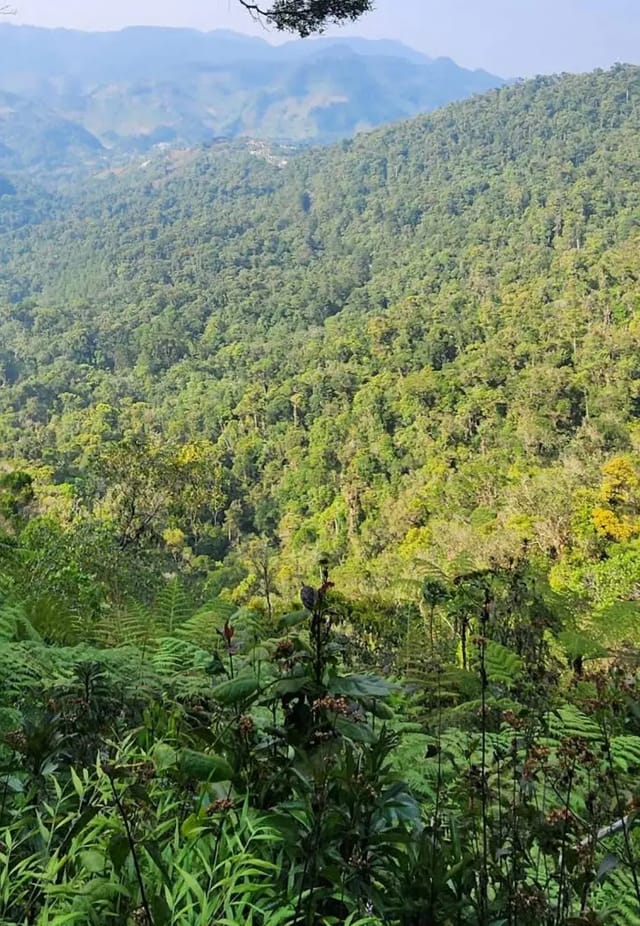
The horned guan (Oreophasis derbianus, in Spanish pavo de cacho or pavón) is Endangered: BirdLife International, the IUCN Red List authority for birds, last assessed it in 2020 and estimates 600-1,700 mature individuals worldwide, decreasing. It lives only in the Sierra Madre de Chiapas, Mexico, and west-central Guatemala. In Guatemala it has been reported from at least 39 localities, and it lives in cloud forest at 2,000-3,500 m.
In short: BirdLife documents nesting on Volcán Atitlán (2005, 2007, 2011) and Volcán Tolimán (2000), and juveniles on Volcán San Pedro (2007) and in the Sierra de las Minas (2009). Two operators sell guided searches: Los Tarrales reserve on the Atitlán volcano, and Cayaya Birding, which says 90-100% of its visits have been successful depending on the site.
Status and numbers
| BirdLife field | Value |
|---|---|
| IUCN Red List category | Endangered (criterion C2a(i)) |
| Year of last assessment | 2020 |
| Mature individuals (global) | 600-1,700 (year of estimate 2000) |
| Population trend | Decreasing |
| Extent of occurrence | 56,300 km² |
| Number of locations | 6-10, severely fragmented |
| Range countries | Guatemala and Mexico (resident) |
BirdLife’s reason for the category: “remaining populations are very small and, given continuing threats, declining.” It derives the 600-1,700 figure from a band of 1,000-2,499 individuals, based on an estimate of 1,000 birds in the late 1970s. For Guatemala it cites a 2007 study (Rivas Romero and Cóbar Carranza) for at least 39 localities and a range of 1,139.4 km². Local density estimates it gives are 10.5 individuals per km² on Volcán San Pedro and 1.6 per km² in the Sierra de las Minas.
eBird (Cornell Lab) describes a large, long-tailed game bird “restricted to undisturbed humid evergreen forest on a few high mountains in Guatemala and adjacent southern Chiapas, Mexico”. It is black and white overall, with a red horn on top of the head and piercing whitish eyes, and is mainly found singly in the forest canopy, “where can be easily overlooked”.
Where in Guatemala BirdLife records it
| Place | What BirdLife’s factsheet reports |
|---|---|
| Volcán Atitlán | Nesting in 2005, 2007 and 2011; a bird incubating in January 2005; an adult with an immature in November 2005 and January 2006 |
| Volcán Tolimán | Nesting in 2000; two nests found in March and April |
| Volcán San Pedro | Two juveniles in September 2007, confirming breeding |
| Albores, Sierra de las Minas | Two juveniles in August 2009, confirming breeding |
| Cerro Cruz Maltín (Huehuetenango), Chuamazán (Totonicapán) | The most recent Guatemalan records on the factsheet (cited 2010 and 2012) |
| San Marcos and Sibinal (San Marcos); Chiantla and Santa Eulalia (Huehuetenango) | New localities found by fieldwork and interviews (cited 2006) |
| Cerro Tecpán (Chimaltenango), Cerro El Amay (Quiché) | Reported by local people; surveys at Cerro El Amay in 2008, 2010 and 2011 did not find it |
| Cuilco, San Sebastián Coatán, San Pedro Soloma | The species has disappeared there after cloud-forest loss (cited 2006) |
BirdLife also calls the horned guan a flagship species for local tourism at Atitlán volcano, San Pedro volcano and Sibinal. Among its references is a 2006 note by Brooks and Gee titled Horned guans and other birds at Fuentes Georginas, Guatemala, and it warns that forest patches along the Zunil-Retalhuleu road may be threatened because they lie in the best altitude band for coffee. See our pages on the San Pedro volcano hike and Fuentes Georginas.
BirdLife’s Important Bird and Biodiversity Areas (IBAs) for the species in Guatemala, with the share under protected areas as it prints it: Cuchumatanes (3.78%), Cerro El Amay (4.27%), Sierra de las Minas - Motagua (56.91%), Tacana - Tajumulco (13.73%), Santiaguito Volcano (25.19%), Atitlan (48.58%) and Antigua Guatemala (18.85%).
Breeding generally takes place in January-June, when two eggs are laid, according to a 1995 Mexican study the factsheet cites. The lack of records in June-August that BirdLife mentions refers to El Triunfo in Mexico, not to Guatemala.
Guided searches
- Los Tarrales Natural Reserve (Patulul, Suchitepéquez) sells a 10-hour Horned Guan Guided Tour: “Take an extreme hike up the volcano in search of the Horned Guan!” Groups are limited to four people and tours must be booked 48 hours ahead (reserve’s page, read 15 November 2026). Prices and booking rules are on our Los Tarrales birding page. eBird lists a hotspot called RNP Los Tarrales–Horned Guan Trail, with 239 species reported as of 15 November 2026 (see Guatemala’s hotspots ranked by species).
- Cayaya Birding, a company running birding tours in Guatemala since 2003, says it runs excursions to “several reliable sites in the western highlands of Guatemala” and that “Depending on the site, 90-100% of our visits have been successful” (company page, read 8 October 2026). That is the operator’s own claim.
Threats and protection
BirdLife lists clearance for subsistence farming and coffee, selective logging, wood extraction, forest fires (more than 330 hectares of cloud forest burned on Volcán Santo Tomás in 2009) and hunting, which it says is mostly for subsistence. It states the species is on CITES Appendix I and legally protected in Mexico and Guatemala. In Guatemala, communities at Sibinal (San Marcos) and Tecpán (Chimaltenango) have designated their forests as municipal protected areas. According to the international studbook, the captive population at the end of 2010 was 88 birds in eleven institutions in six countries.
Related guides
- Guatemala birdwatching guide
- Pink-headed warbler, another highland cloud-forest species
Sources
- BirdLife International (2020), species factsheet: Horned Guan Oreophasis derbianus: https://datazone.birdlife.org/species/factsheet/horned-guan-oreophasis-derbianus (read 15 November 2026)
- eBird (Cornell Lab of Ornithology), Horned Guan: https://ebird.org/species/horgua1 (read 15 November 2026)
- eBird, Guatemala hotspots, all years: https://ebird.org/region/GT/hotspots?yr=all (read 15 November 2026)
- Los Tarrales Natural Reserve, Horned Guan Guided Tour: https://www.tarralesreserve.com/service-page/horned-guan-guided-tour (read 15 November 2026)
- Cayaya Birding, Horned Guan in Guatemala: https://www.cayaya-birding.com/HornedGuan.htm (read 8 October 2026)
Frequently Asked Questions
Where can I see the horned guan in Guatemala, and how rare is it?
BirdLife International lists the horned guan as Endangered (assessed 2020), with an estimated 600-1,700 mature individuals worldwide and a decreasing population. Its range is the Sierra Madre de Chiapas in Mexico and west-central Guatemala. BirdLife documents breeding on the Atitlán, Tolimán and San Pedro volcanoes and in the Sierra de las Minas. Los Tarrales reserve and the tour company Cayaya Birding both sell guided excursions in search of it.
How many horned guans are left in Guatemala?
No Guatemala-only count is published on BirdLife’s factsheet. Its 600-1,700 figure is global (estimate year 2000). For Guatemala it reports at least 39 localities and a range of 1,139.4 km², citing a 2007 study, and local densities of 10.5 birds per km² on Volcán San Pedro and 1.6 per km² in the Sierra de las Minas.
At what altitude does the horned guan live in Guatemala?
BirdLife says it inhabits cloud forest at 2,000-3,500 m in Guatemala, with exceptional low records down to 1,200-1,500 m. In Mexico it lives at 1,400-2,700 m.
Is the horned guan protected?
BirdLife states it is on CITES Appendix I and legally protected in Mexico and Guatemala. It adds that most Guatemalan sites with recent records have protected status, but that weak management allowing illegal hunting and logging inside protected areas is a serious problem.
Does the horned guan live in Honduras?
BirdLife notes unconfirmed reports from Cerro Volcán Pacayita, Honduras, but says unsuccessful searches and interviews in the El Trifinio protected area suggest it does not occur in Honduras. Its country table lists only Guatemala and Mexico.