In short: When a foreign national dies in Guatemala, four things run in parallel: a funeral home (hire one at once — Guatemalan law generally requires burial within 24 hours unless the body is embalmed), INACIF (the forensic institute, involved when the death is violent, suspicious or has no medical history), RENAP (registers the death; a foreigner is identified by passport; first certificate free) and your embassy (notifies relatives and issues home-country paperwork, but pays nothing). The family then picks one of three endings: fly the body home (US Embassy funeral-home estimates: $6,000-$8,000 to the US from one home; $3,500 plus a flight priced later from another), cremate locally ($2,100, ashes shipped for $600), or bury in Guatemala ($2,000 in a public cemetery). The export licence from the Health Ministry is free.
This page is written for the family of an American, Canadian or British national — resident or visitor — who has died in Guatemala. If the person who died was a Guatemalan in the United States, you need the reverse process: repatriation of remains to Guatemala. If the person is alive but seriously ill and needs to get home, see humanitarian repatriation of the living.
The first 24 hours
| Step | What happens | Who |
|---|---|---|
| Immediately | Hire a funeral home — you may choose any | Family (or a representative) |
| Next | Report the death to the embassy; it notifies next of kin | Family / embassy |
| If applicable | If the death was violent, a road accident or unexplained: police involve the Ministerio Público; INACIF may do an autopsy | PNC, MP, INACIF |
| Within 24 h (unless embalmed) | Burial deadline, per the US Embassy’s reading of Guatemalan law | — |
| First days | Death report (hospital or INACIF) → RENAP registration → death certificate | A funeral home can help obtain it (FCDO, Canada) |
| When decided | Embalm and export, cremate, or bury locally | Family instructs the funeral home |
The US Embassy puts it bluntly: “the most important thing for the next of kin to do is to contact a local funeral home immediately”, because “Guatemalan law generally requires burial within 24 hours when the body is not embalmed”. Embalming stops that clock — the embassy’s Disposition of Remains page says that “If the body is embalmed, burial is not required within any specific period”. For a COVID-related death the same page gives six hours.
Cold storage is the other constraint outside the capital: the British Embassy’s bereavement pack warns that “Cold storage facilities are not available in most places outside Guatemala City”. Funerales Reforma quoted transfer prices to the capital from Flores, Puerto Barrios, Huehuetenango, Cobán, Quetzaltenango and other cities (table below).
How the 24-hour rule sits with longer waits. The sources do not reconcile it for you. The same US Embassy page that gives the 24-hour rule also describes the body typically staying at the morgue or at home “for around two to three days” before the funeral; the British pack says that when the police find nothing unusual the body is released within a few days, and calls 24-hour burial “local custom”; and a court order for cremation can take 8 weeks or more. What the sources do say: embalming removes the deadline, both Guatemala City funeral homes above offer cold storage, and cold storage is scarce outside the capital. If the body will wait — for police release, a court order or a family decision — ask the funeral home at once whether it needs embalming or cold storage in the meantime.
Choose the ending: the three options side by side
| Fly the body home | Cremate in Guatemala | Bury in Guatemala | |
|---|---|---|---|
| Must be embalmed? | Yes — required to export non-cremated remains | Not stated in the sources read | No (but burial within 24 h if not embalmed) |
| Extra condition | MSPAS export licence; hermetically sealed metal box | Court order if an unnatural death is suspected — 8+ weeks | Public cemetery: no perpetual care after 6 years unpaid |
| Estimate (US Embassy page, 2024) | $6,000-$8,000 to the US (Funerales Reforma); $3,500 plus a flight priced later (Capillas Las Flores) | $2,100, plus $600 to ship ashes to the US | $2,000 in a public cemetery |
| UK inquest, per the FCDO pack | Not addressed in the pack | Pack: no inquest in the UK after a local cremation | Pack: no inquest in the UK after a local burial |
| Travels with family? | No — Canada warns not to expect the same plane | Subject to the airline; some carry ashes only as cargo | — |
Flying the body home
The US Embassy’s list of what must accompany exported remains:
- “Embalming certificate, Death Certificate (from RENAP) and Guatemalan transit permit”
- “99% hermetically sealed metallic box”
- “Shipping container if the body returns to the U.S. by plane or boat”
The transit permit is MSPAS’s Licencia de traslado sanitario de cadáveres al extranjero, issued by the Unidad de Defunciones y Exhumaciones of the Health Ministry’s DG-SIAS. Guatemala’s service catalogue lists it at Q 0 and states a response time of 25 minutes for issuing the licence itself; the prerequisites below and the police stamp come on top of that. Its requirements are three:
- the medical death certificate;
- the death’s inscription at RENAP;
- an INACIF certificate, "(cuando sea por muerte Violenta)".
After it is issued, the applicant takes it to the Policía Nacional Civil to be stamped. The legal basis cited is Article 117 of the Código de Salud (Decreto 90-97) and Acuerdo Gubernativo 215-2021. The British Embassy’s pack says export paperwork of this kind is arranged by the Guatemalan funeral director.
Canada’s guidance adds two points worth knowing whatever your nationality: the remains must travel with “a copy of the death certificate that includes the cause of death”, and “You should not expect to travel on the same plane as the remains when they are being repatriated”. Funeral homes often want “a payment guarantee or payment upfront before starting the process”.
Cremating in Guatemala
Local cremation is the simplest paperwork trail — unless the cause of death is in doubt. The US Embassy: “if local authorities determine that there is reasonable cause to suspect that the deceased died of unnatural causes, a court order is required to authorize cremation”, and “The process to request and receive a judicial order can take 8 weeks or more”.
For a British national the embassy lists “A local death certificate, a letter from the Next of Kin giving permission to cremate, copy of the deceased’s passport and a letter from the British Embassy Guatemala”. Expect to pay for a casket even so — the US Embassy notes one is often needed to take the body to the crematorium.
To bring ashes home, the US Embassy lists a transit permit, the “Cremation certificate issued by the Cemetery” and the RENAP death certificate, all travelling with the urn. Check your airline first — Canada notes that “Not all airlines will transport cremated remains”, and some carry them only as cargo.
Burying in Guatemala
Possible, and the cheapest of the published estimates. Two rules to know before choosing it, both from the US Embassy’s page:
- “There is no perpetual care for remains buried in public cemeteries in Guatemala” — after six years without arrangements for the niche, remains move to a common grave.
- Remains “may not be disinterred until after four or six years from the date of burial, depending on the specific case”; the page does not say which cases get four years and which get six. Exhumation otherwise needs special circumstances or authorisation. Burial is hard to undo.
If no one can pay for any option, Canada’s guidance spells out the default: arrangements are “at the discretion of the host nation”, which “may include burial in a common grave, or donation of the remains to an educational facility”.
What the funeral homes quoted (US Embassy, April 2024)
These are the only published prices we found. They were given to the US Embassy by the funeral homes themselves, and the embassy calls them “estimates only”. Both homes are in Guatemala City; the embassy’s listing is not an endorsement, and neither is ours.
| Service | Estimate (USD) | Funeral home |
|---|---|---|
| Documentation, embalming and casket for transport abroad | $3,500 | Capillas Las Flores |
| Cold storage | $15 per night | Capillas Las Flores |
| Cold storage | No charge | Funerales Reforma |
| Transport to Guatemala City | $5 per km | Capillas Las Flores |
| Transport of a body to the US | $6,000-$8,000 | Funerales Reforma |
| Air freight of 200 kg (casket + container) to the US — listed as a separate line; the page does not say whether it is part of the $6,000-$8,000 | $1,600 | Funerales Reforma |
| Burial in a public cemetery | $2,000 | Funerales Reforma |
| Cremation, ashes remaining in Guatemala | $2,100 | Funerales Reforma |
| Shipping ashes to the US | $600 | Funerales Reforma |
| Transfer to Guatemala City from Flores | $500 | Funerales Reforma |
| … from Puerto Barrios / Huehuetenango / El Quiché | $400 each | Funerales Reforma |
| … from Cobán / Quetzaltenango | $300 each | Funerales Reforma |
| … from Retalhuleu | $250 | Funerales Reforma |
| … from Escuintla | $150 | Funerales Reforma |
Capillas Las Flores told the embassy the flight itself is priced only two days before travel, on top of the $3,500. Funerales Reforma’s two transport lines are listed separately — $6,000-$8,000 to transport a body to the United States (varying with the metal casket) and $1,600 to ship 200 kg, the embassy’s stated average weight of a casket and its container — and the page does not say whether the first includes the second. Ask for a written quote that itemises both.
INACIF, the police and the autopsy
INACIF is Guatemala’s national forensic science institute. The US Embassy says it performs an autopsy “when there is reasonable cause to suspect that the deceased died of a violent or unnatural cause or does not have a previous medical record”. The embassy lists it at 14 Calle 5-49, zona 1, Guatemala City (+502 2327-8100).
The British Embassy fills in the rest:
- A death that is suspicious or follows a road traffic accident brings in the Ministerio Público (the prosecutor), through the national police.
- If the police do not find the circumstances unusual, “the body will be released for local burial, repatriation or cremation within a few days”.
- The post-mortem report is in Spanish and “is usually available within a month after the death has occurred, but this is not always the case”.
- “The deceased’s clothing is normally destroyed during the postmortem examination”; belongings found on the body may be held by the police for the court.
- Identification by relatives is not normally needed — a passport or driving licence can serve.
The practical effect of an INACIF case is on time and on cremation: the court order for cremation is what produces the 8-week-plus delay.
RENAP: the Guatemalan death certificate everything depends on
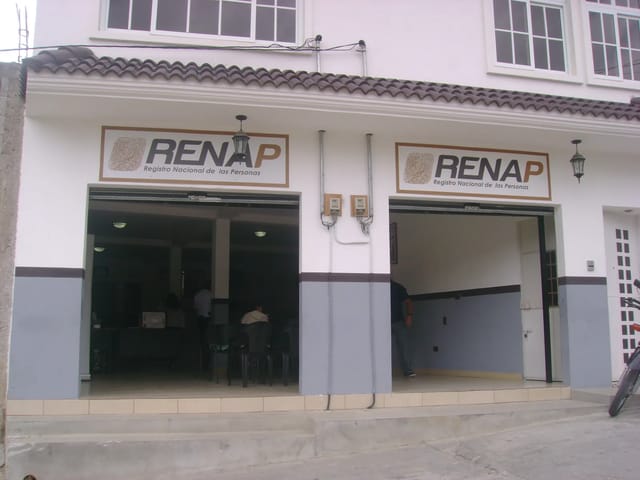
The US CRODA is based on the Guatemalan death certificate issued by RENAP, the national civil registry. RENAP’s requirements page for a death in Guatemala lists the informe de defunción, the deceased’s identity document, and the ID of the person registering the death. For foreigners, RENAP’s rules add “Los extranjeros se identificarán con pasaporte vigente”.
The death report comes from the hospital or from INACIF, and RENAP requires the person who writes it to state “si la causa de la defunción le consta por conocimiento propio o por informe de un tercero”. Documents that are torn, illegible or altered are refused.
- Cost: the first certificate, issued at registration, is free; later copies are Q25 each.
- Where: RENAP’s registry office at 9 calle 0-05, zona 1 in Guatemala City registers deaths 24 hours a day, every day of the year.
- Late registration: after more than a year, RENAP adds a negative certificate from the local registry and a sworn declaration by two adults.
The step-by-step domestic procedure, including hospital versus home deaths, is on our RENAP death registration page; certified copies are covered in RENAP death certificates.
Your embassy: what it does, and what it will not pay for
| United States | United Kingdom | Canada | |
|---|---|---|---|
| Pays for burial, cremation or repatriation? | No — “The U.S. government cannot pay these costs” | No budget for these costs | No — all costs fall to next of kin or estate |
| Notifies next of kin | Yes | Liaises via Consular Directorate, London | Can help notify |
| Home-country record of death | Consular Report of Death of a U.S. Citizen Abroad (CRODA, Form DS-2060, issued electronically) | Optional UK registration (statutory fee) | Local certificate, authenticated by the embassy if needed for insurance or repatriation |
| Needed before it issues | RENAP certificate with a final cause of death, and a final disposition of remains | — | Local certificate authenticated first by Guatemala’s foreign ministry, where required |
| If no family is in Guatemala | Next of kin sends notarised Form DS-5511; embassy can secure personal effects | Belongings stored by the embassy only exceptionally | Consular advice on reaching police, hospital and morgue, and on obtaining documents |
| Passport | Copy of biographic page needed for CRODA | Send to the embassy for cancellation with form D01 | Guidance on the deceased’s passport |
US citizens: the CRODA and the DS-5511
The US Embassy issues the CRODA from the RENAP certificate. It will not issue one “until the Guatemalan death certificate lists a final cause of death and until there is a final disposition of remains” — so a pending INACIF case delays it. The name must match the name on the deceased’s US passport; bring proof of any name change.
To request it, email AmCitsGuatemala@state.gov with the subject line “E11 – CRODA – FULL NAME OF THE DECEASED”, attaching a scan of the RENAP certificate, the passport biographic page, the next of kin’s ID and proof of relationship.
If no family member is in Guatemala, the next of kin signs Form DS-5511, which must be notarised in the United States or at a US embassy or consulate — “the U.S. Embassy cannot accept documents notarized by a Guatemalan notary”. The funeral home then collects a statement from the embassy that lets it take custody of the body. In that situation a consular officer also “has statutory responsibility to secure the personal estate of the deceased, subject to local law”.
The embassy’s 24/7 line is +1-202-501-4444 from abroad; its Guatemala City switchboard is +502 2354-0000. More on the embassy: US citizen services in Guatemala.
British nationals
The FCDO’s November 2025 bereavement pack confirms “There is no obligation for the death overseas of a British national to be registered” in the UK, though registering gives a permanent English-language record. “An inquest will not take place in the UK if a local burial or local cremation takes place”. See UK citizen services.
Canadians
Canada’s first instruction is to “Identify a representative for the deceased”, then notify the insurer and choose a funeral home experienced in international arrangements. The embassy can “Authenticate the local death certificate for insurance or repatriation purposes after it has been authenticated by the local Ministry of Foreign Affairs, if required”. See the Canadian Embassy in Guatemala.
After the funeral: property and money in Guatemala
If the person owned property, a vehicle or bank accounts in Guatemala, the RENAP certificate is also the document that opens a Guatemalan succession. That process is on our inheritance and succession page. RENAP itself describes the certificate as necessary for inheritance claims, life insurance, pensions, savings and investments and debt settlements.
What we could not confirm
- The legal deadline for registering a death at RENAP. The rules sit in RENAP’s Acuerdo de Directorio 104-2015, which we could only obtain as an image scan; no RENAP page we read states the deadline, so this page gives none.
- Current funeral prices. The only published figures are the April 2024 estimates above.
- Travel.state.gov’s general death-abroad pages refused automated access; the US Embassy Guatemala pages were used instead.
Sources
All read on 23 September 2026:
- US Embassy Guatemala, Death of a U.S. Citizen Overseas (dated 12 March 2025) and Disposition of Remains (updated April 2024).
- British Embassy Guatemala City / FCDO, Bereavement Information for Guatemala, November 2025 (PDF).
- Government of Canada, Death outside Canada.
- RENAP, requirements for a death in Guatemala, minimum content of the death report, late registration over one year and its note on death registration.
- Catálogo de Trámites, servicio 1844 — Licencia de traslado sanitario de cadáveres al extranjero (MSPAS).
Related guides
- Repatriation of remains to Guatemala — the reverse direction
- Humanitarian repatriation of the living
- RENAP death registration procedure
- Registering a death that happened abroad
- Inheritance and succession in Guatemala
- Assisted living and nursing homes in Guatemala
Frequently Asked Questions
What should the family do first when an American dies in Guatemala?
Contact a local funeral home immediately. That is the US Embassy’s own advice, because Guatemalan law generally requires burial within 24 hours when the body is not embalmed. Then contact the embassy’s American Citizens Services unit, which notifies the next of kin, explains the options for the remains and later issues the Consular Report of Death of a U.S. Citizen Abroad (CRODA). The family chooses and pays the funeral home; the US government cannot pay these costs.
How much does it cost to send a body home from Guatemala?
The only published figures are estimates two Guatemala City funeral homes gave the US Embassy for its April 2024 Disposition of Remains page: Funerales Reforma quoted $6,000 to $8,000 to transport a body to the United States, depending on the metal casket; Capillas Las Flores quoted $3,500 for documentation, embalming and a casket for transport abroad, with the flight priced separately two days before travel. Local cremation was quoted at $2,100 and shipping ashes to the US at $600. They are estimates, not tariffs — get a written quote.
Can the body be cremated in Guatemala?
Yes. The British Embassy lists what a local cremation needs: a local death certificate, a letter from the next of kin giving permission to cremate, a copy of the deceased’s passport and a letter from the embassy. The catch is the cause of death: if the authorities suspect it was not natural, a court order is required before cremation, and the US Embassy says obtaining one can take 8 weeks or more.
Will there be an autopsy?
Only in some cases. According to the US Embassy, INACIF (the national forensic institute) performs an autopsy when there is reasonable cause to suspect a violent or unnatural death, or when the deceased has no previous medical record. The British Embassy notes the report is in Spanish and is usually available within about a month, though not always. If the police consider the death not unusual, the body is normally released within a few days.
Does the death have to be registered in Guatemala?
Yes — at RENAP, the civil registry. The registration needs a death report from the hospital or from INACIF, the deceased’s identity document and the ID of the person registering. RENAP’s rules say foreigners identify themselves with a valid passport. The first death certificate is free; later copies cost Q25. The US Embassy bases the CRODA on this Guatemalan certificate, and Canada’s guidance also starts from the local death certificate.
Can the family bury their relative in Guatemala?
Yes. Funerales Reforma’s estimate for a burial in a public cemetery, quoted on the US Embassy page, was $2,000. Two conditions matter for later: public cemeteries have no perpetual care — after six years without payment for the niche, remains go to a common grave — and remains may not be exhumed until four or six years after burial, depending on the specific case (the embassy does not say which case gets which), except with authorisation.