When a family member passes away in Guatemala, the bureaucratic process of registering the death and obtaining certificates must be handled alongside the emotional weight of the loss. Understanding what documents you need and where to get them can make an overwhelming time slightly more manageable.
The inscripcion de defuncion (death registration) at RENAP is the official act of recording a death in Guatemala’s civil registry. It is a free process — the first inscription carries no charge. After the death is registered, you can obtain certificaciones de defuncion (death certificates) for Q25 each, which you will need for inheritance proceedings, insurance claims, bank account closures, and updating the civil status of the surviving spouse.
The process requires a death report from the hospital, INACIF (forensic institute), or medical authority, along with the deceased’s identification. In most cases, hospitals and funeral homes assist with much of the paperwork.
Quick summary: Death registration at RENAP is free. Certified copies cost Q25 each. You need a death report from the hospital or INACIF, plus the deceased’s DPI or birth certificate. Registration should be done as soon as possible after the death.
Prices verified April 2026. Check our exchange rate page for today’s USD/GTQ rate.
Cost
| Item | Cost |
|---|---|
| Death registration (first inscription) | Free |
| Death certificate (each copy) | Q25 |
| Legalized death certificate | Q50 |
Requirements
- Death report (informe de defuncion) — from the hospital, health center, or INACIF
- DPI of the deceased — or birth certificate if the deceased did not have a DPI
- DPI of the person registering the death (family member, hospital representative, etc.)
- Medical cause of death — included in the death report
Special Cases:
- Death at home: Contact INACIF or bomberos for evaluation and death report
- Violent or suspicious death: INACIF and the Ministerio Publico handle the investigation and issue the report
- Death of a foreign national: Same process, using passport instead of DPI
- Stillbirth: Different process — registered as a birth and death simultaneously
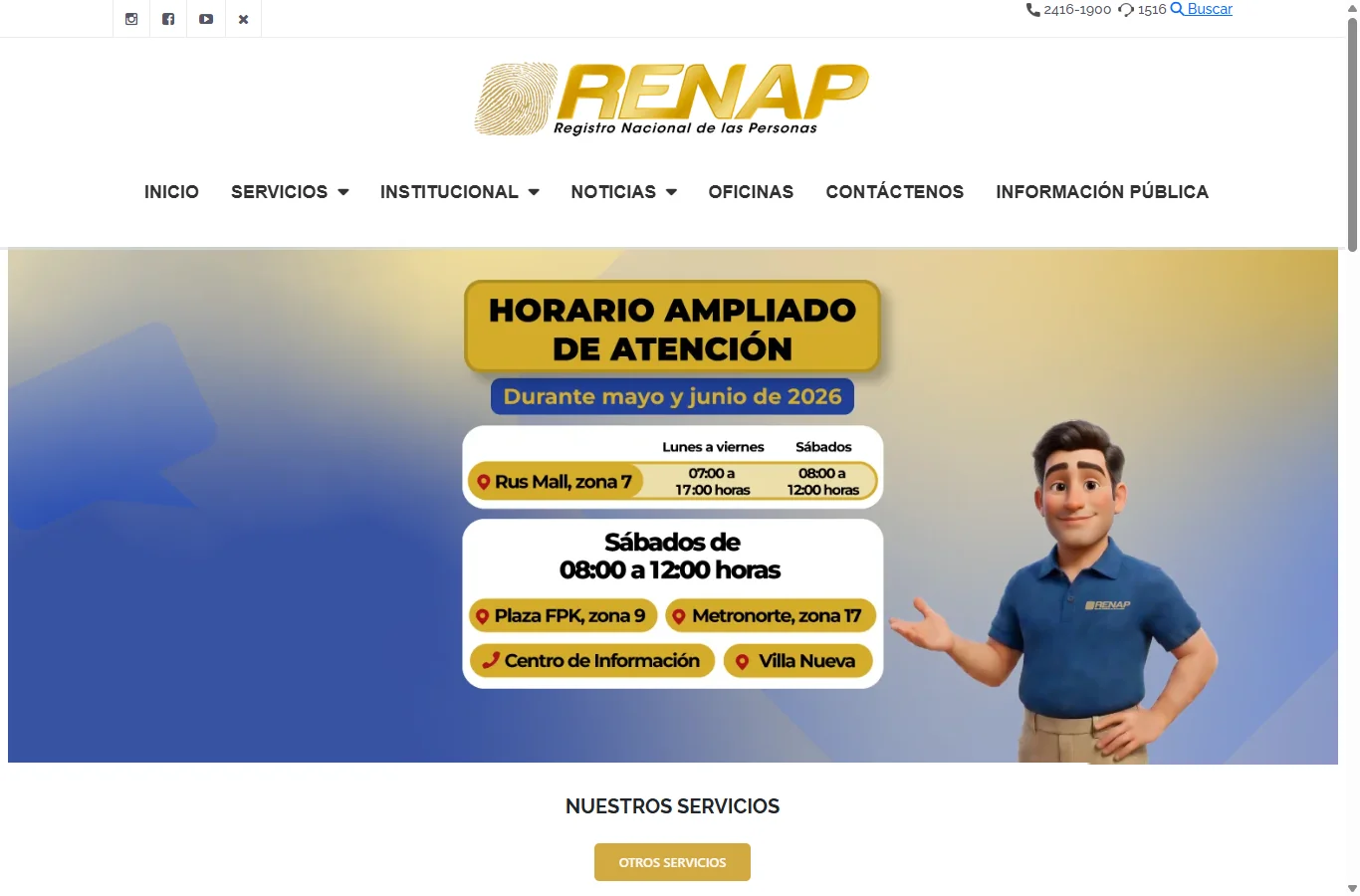
RENAP main page (renap.gob.gt). Extended-hours announcements and new sede openings are posted here — check before traveling to an office.
Step-by-Step Process
- Obtain the death report — the hospital or medical facility where the death occurred issues this document. If the death happened outside a medical facility, contact INACIF (tel: 2220-2020) or the bomberos
- Gather the deceased’s documents — DPI (or birth certificate), and any available marriage certificate if the surviving spouse needs to update their status
- Go to any RENAP office — bring the death report, the deceased’s documents, and your own DPI
- RENAP registers the death — this is free and typically processed the same day
- Request death certificates — order multiple copies (Q25 each) as you will need them for various purposes
Processing Time
- Registration: Same day (usually within hours)
- Certificate issuance: Immediate after registration
- Recommended: Handle the registration within the first few days after the death
What You Need Death Certificates For
After registration, you will need certified death certificates (Q25 each) for:
- Inheritance proceedings (sucesion hereditaria) — whether through a notary (voluntaria) or court (judicial)
- Bank account closure — banks require a death certificate to release funds or close accounts
- Vehicle title transfer — to transfer a registered vehicle from the deceased to an heir
- Insurance claims — life insurance companies require the original or certified copy
- Pension termination/transfer — IGSS and private pension funds
- Property transfer — for land or real estate title changes
- Surviving spouse’s DPI update — to change civil status from “casado/a” to “viudo/a”
- Cancellation of government services — utilities, tax obligations, etc.
Order at least 5-8 certified copies to cover your immediate needs.
Details
When a person dies at home — whether from natural causes, chronic illness, or old age — the process differs from a hospital death because no attending physician can issue a death report:
- Do not move the body. Call INACIF (2220-2020) or the bomberos (122) immediately.
- INACIF or bomberos arrive to evaluate the scene and determine the cause of death.
- If the death is clearly natural (elderly person, known terminal illness), they issue a death report relatively quickly.
- If the cause is unclear, INACIF may transport the body for examination. This can take 24-72 hours.
- Once you have the death report, proceed to RENAP for registration as normal.
In rural areas: INACIF may not have a local office. In these cases, the local health center (centro de salud) or the justice of the peace (juez de paz) can assist with the death report. Contact the municipal government for guidance.
Tip: If the deceased had a known terminal illness, ask their doctor to provide a medical history letter. This can speed up INACIF’s evaluation significantly.
Details
When a death involves violence, accident, suicide, or suspicious circumstances, the process becomes more complex:
- Call PNC (police) at 110 and bomberos at 122 immediately.
- Ministerio Publico (MP) takes jurisdiction over the investigation.
- INACIF performs the autopsy and forensic analysis. Results can take 1-4 weeks depending on complexity.
- MP issues authorization for the body to be released to the family.
- INACIF issues the death report once the autopsy is complete.
- Register at RENAP with the INACIF death report.
Important: Do not disturb the scene. The MP and PNC need to document everything before any cleanup or arrangement.
Delays: In homicide cases, INACIF’s death report may take longer because it serves as evidence in the criminal investigation. This can delay RENAP registration but does not prevent funeral arrangements once the body is released.
Details
The death certificate is the gateway document for all inheritance proceedings. Here is an overview of the two paths:
Sucesion Voluntaria (Notarial — Uncontested):
- All heirs agree on how to divide assets
- Processed through a notary (Q5,000-Q15,000 in fees depending on estate size)
- Takes 2-4 months
- Requires: death certificate, marriage certificate (if applicable), birth certificates of heirs, property documents
Sucesion Judicial (Court — Contested):
- Heirs disagree, or there is no will, or the estate is complex
- Processed through a Juzgado de Primera Instancia Civil
- Takes 6-18 months
- More expensive (Q10,000-Q30,000+ in legal fees)
Critical documents to gather:
- Death certificate (at least 3 copies)
- Marriage certificate of the deceased (from RENAP)
- Birth certificates of all heirs
- Property deeds (escrituras)
- Vehicle registration documents
- Bank account information
- Will (testamento), if one exists
Tip: Start the inheritance process promptly. Banks may freeze the deceased’s accounts, and property cannot be sold or transferred until the succession is resolved.
INACIF (Forensic Institute)
When a death occurs outside a hospital or under circumstances requiring forensic evaluation, INACIF (Instituto Nacional de Ciencias Forenses) is involved:
- Phone: 2220-2020
- Location: 14 Calle 1-51, Zone 1, Guatemala City (main office)
- INACIF has regional offices in all departments
- They handle autopsies, cause-of-death determinations, and issue death reports for non-hospital deaths
- In cases of violent death, INACIF works with the Ministerio Publico
From the US (Diaspora Info)
When a family member dies in Guatemala and you are in the United States:
- Someone in Guatemala must register the death — RENAP registration cannot be done remotely. A family member, the hospital, or the funeral home can handle it
- Request multiple certified copies — have your family send you certified death certificates (Q25 each). You may need them for US-based processes like claiming life insurance or transferring assets
- Consular registration — you can register the death at a Guatemalan consulate in the US. Consular registration is free
- For US legal purposes — a Guatemalan death certificate may need to be apostilled (through the Ministerio de Relaciones Exteriores in Guatemala) and translated into English by a certified translator
- Inheritance from abroad — if you are an heir, you can manage inheritance proceedings through a lawyer with a poder especial (power of attorney). The lawyer will need death certificates and potentially other documents
- If the death occurred in the US — you may want to register it at the Guatemalan consulate for it to be recognized in Guatemala’s civil registry
Tips & Common Mistakes
Order more certificates than you think you need. Every bank, insurer, and government office wants their own copy. Order at least 5-8 copies at Q25 each to avoid multiple trips to RENAP.
Do not delay the registration. While there is technically no strict deadline, delaying the death registration complicates everything — from inheritance to canceling utility accounts. Handle it within the first week if possible.
Keep the DPI of the deceased. Do not destroy or discard the deceased’s DPI. You will need the CUI number for many subsequent procedures. If the DPI is unavailable, a birth certificate can substitute.
Update the surviving spouse’s status. After the death is registered, the surviving spouse should update their DPI to reflect “viudo/a” status. This is important for any future legal matters, including the ability to remarry.
Inheritance requires a lawyer. Whether you choose the notarial route (sucesion voluntaria, faster and cheaper for uncontested inheritances) or the judicial route (sucesion judicial, for contested estates), you will need a lawyer. The death certificate is the first document they will request.
The death is already registered but RENAP won’t issue the certificate
This is the most common dead end for notaries, gestores and families settling an estate: the death is registered, but RENAP’s system returns nothing at the window. It is almost always a question of which door you knock on, not proof that the record is missing.
First: these are two different documents
Many people ask RENAP for a document RENAP does not issue.
| Document | What it is | Who issues it |
|---|---|---|
| Certificación de defunción | The registry proof that the death is inscribed | RENAP |
| Informe de defunción | The document stating the cause of death, used to register the death | The hospital where the death occurred, or INACIF |
RENAP requires the informe de defunción in order to register a death, but RENAP is not who issues it. If what you need is the cause of death, the door is the hospital or INACIF.
You can, however, ask RENAP for a copia certificada de atestados (Q50) — certified copies of the supporting documents held in the inscription file.
If the system can’t find the record
Search by name, not by CUI. The eportal works from the deceased’s CUI. RENAP also runs an online certification-by-name service at portal.renap.gob.gt and in the RENAP SE Android app, built precisely for “cuando no se conoce o no se tenga presente el Código Único de Identificación -CUI-”. You enter the full name and the date of the event. People who died years ago often never had a CUI, which is exactly why they don’t come up.
If you already have the entry details (libro, folio, partida), ask for the services that run against the book rather than the system. At the RENAP office of the municipality where it was inscribed:
Service Fee Copia certificada del asiento del libro Q25 Certificación de inscripción que incluye imagen digitalizada del libro Q25 Certificación literal de inscripción registral Q75 Copia certificada de atestados Q50 Constancia negativa Q25 Civil registry books were kept by the municipalities, and the handover to RENAP was completed on 30 September 2008. An older inscription can exist on paper without having been loaded into the system.
If the inscription genuinely does not exist
Request a constancia negativa (Q25). That document is also what RENAP requires in order to inscribe a reposición de partida (restoration of a lost or missing entry). Per RENAP’s published requirements for the notarial route, you must present:
- “Certificación de la resolución final de las diligencias, en original y duplicado”
- “Constancia negativa de la inscripción a reponer”
And under Article 16 of Acuerdo de Directorio 104-2015 (Reglamento de Inscripciones del Registro Civil de las Personas), every inscription also requires RENAP’s own form and proof of payment for late inscription where applicable.
Reposición has both a notarial and a judicial route. Rectificación — when the entry exists but contains an error — is a different procedure; see Rectificación de partida.
Where to ask
- RENAP Call Center: 1516 · PBX 2416-1900
- Head office: Calzada Roosevelt 13-46 zona 7, Guatemala City
- For pre-digitization records, see Old record search
Common Errors and Solutions
Hospital has not issued the death report (informe de defuncion)
RENAP cannot register a death without a death report from the hospital, INACIF, or medical authority. If the hospital is slow to release it, the registration is stuck. Solution: (1) request the report at the hospital’s admissions/records office (registros medicos), not the nursing station; (2) bring the deceased’s DPI and your own DPI as next of kin; (3) if the hospital says the cause of death is “under review,” ask for a preliminary report — RENAP can accept this and the hospital can update it later; (4) for deaths outside hospitals, you need INACIF (2220-2020) or local bomberos — NOT the hospital.
INACIF report delayed (death at home or violent death)
INACIF can take 24-72 hours for natural deaths at home and 1-4 weeks for violent or suspicious deaths because the report is also evidence. Solution: (1) ask INACIF for a case number and the assigned forensic doctor; (2) if the deceased had a known terminal illness, ask their treating physician to send a medical history letter to INACIF — this can significantly speed up the natural-cause determination; (3) funeral arrangements can usually proceed once the body is released even before the final report is issued.
“Datos del fallecido no coinciden con DPI” / Data mismatch
If the deceased’s name on the death report does not exactly match what RENAP has in their system (typos by the hospital, accent issues, surname variants), RENAP will pause the inscription. Solution: ask the hospital to issue a corrected death report — they can do this once you show them the deceased’s DPI. Do NOT try to register with mismatched data; it creates a flag that complicates inheritance later.
Cannot find the deceased’s DPI to begin the process
If the deceased’s DPI is lost, destroyed, or was never replaced, you can still register the death using their birth certificate plus another official document showing the CUI number. Solution: request a birth certificate from RENAP (Q15) — anyone can do this with the full name and approximate date of birth — and bring it to the registration. The CUI number is on the birth certificate.
Cause of death is “indeterminada” and an institution rejects the certificate
Some insurance companies and pension funds require a specific cause of death. If INACIF could not determine it or marked it “indeterminada” pending further analysis, the institution may reject the certificate. Solution: wait for the final INACIF report (can take weeks for complex cases), then request a corrected death certificate from RENAP. The institution must accept the updated version.
Surviving spouse’s DPI still shows “casado/a” months after registration
The death is registered at RENAP but updating the surviving spouse’s civil status is a separate step. The spouse must visit any RENAP office with the death certificate and request a DPI update (Q100). Solution: do this proactively — it is required before the spouse can remarry, and many inheritance/banking processes ask to see the surviving spouse’s updated DPI showing “viudo/a.”
Related RENAP Procedures
- Birth Certificate — may be needed if deceased had no DPI
- Marriage Certificate — needed for inheritance proceedings and spouse status update
- DPI (National ID) — surviving spouse must update civil status to “viudo/a”
- Divorce Registration — separate process from death of spouse
Common Questions
How much does it cost to register a death in Guatemala?
The first inscription (registration) of a death at RENAP is completely free. Subsequent certified copies of the death certificate cost Q25 each.
Who can register a death at RENAP?
Any family member, the hospital or medical facility, or the funeral home can present the required documents at RENAP. There is no requirement that a specific person handle the registration.
What if the person died at home without medical attention?
If the person died at home, you need to contact INACIF (Instituto Nacional de Ciencias Forenses) or the local bomberos (fire department/paramedics) who will evaluate the situation and issue the death report. Do not move the body until authorities arrive.
How does a death certificate affect inheritance?
The death certificate is the essential document to begin any inheritance process (sucesion hereditaria) in Guatemala. Without it, no assets can be transferred. You will also need it to close bank accounts, transfer vehicle titles, and manage the deceased’s legal affairs.
Is there a deadline to register a death in Guatemala?
The Civil Code requires death registration within a reasonable time frame. While there is no strict fine for late registration, delaying the process complicates inheritance, insurance claims, and other legal matters. Handle it within the first week if possible.