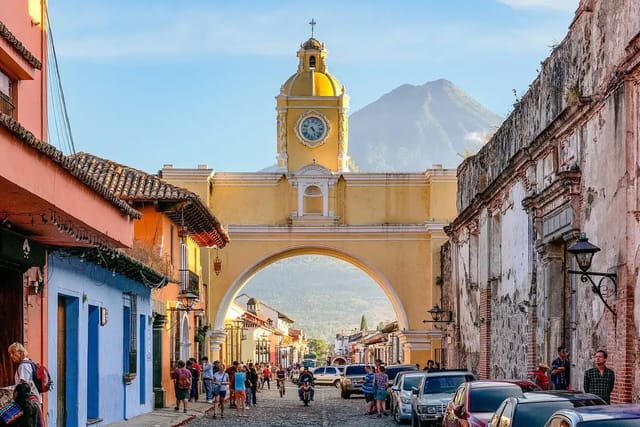
On the governments’ own pages read on 18 November 2026, Panama carries the lower advisory levels (US Level 2 against Guatemala’s Level 3; Canada’s take normal security precautions against a high degree of caution for Guatemala), and its tourist stay depends on your passport: up to 180 days for US citizens and Canadians and 3 months for British citizens, against Guatemala’s 90 days. The US State Department feed dates Guatemala’s advisory 12 March 2026 and Panama’s 19 August 2026. Panama’s National Migration Service (SNM) also lists proof of at least 500 balboas (B/.500.00) and a confirmed reservation to leave the country.
In short: US Level 3 (Guatemala) vs Level 2 (Panama). Canada: high degree of caution (Guatemala, updated 15 November 2026) vs normal security precautions (Panama, updated 16 October 2026). Stay: up to 90 days in Guatemala, extendable once (Migration Code, Article 74), shared across the CA-4 countries; in Panama 180 days for US citizens (US State Department) and Canadians (Canada) and 3 months for British citizens (UK FCDO). Panama’s SNM asks for a passport valid 3 months, 500 balboas of solvency and an exit reservation. Air departure tax: 30 US dollars (Guatemala) vs 40 US dollars (Panama), per the UK FCDO.
Moving or working remotely rather than visiting? The Guatemala vs Panama for digital nomads page covers remote-worker visas and internet, and retiring in Guatemala vs Panama covers pensioner visas and costs.
Side by side
| Guatemala | Panama | |
|---|---|---|
| US State Department | Level 3: Reconsider Travel, due to crime and terrorism (feed date 12 March 2026) | Level 2: Exercise Increased Caution, due to crime (feed date 19 August 2026) |
| US Do Not Travel areas | San Marcos Department, Huehuetenango Department, Zone 18 of Guatemala City, the city of Villa Nueva | The Mosquito Gulf; parts of the Darién Region |
| Canada | Exercise a high degree of caution, with regional advisories (updated 15 November 2026) | Take normal security precautions, with regional risks listed (updated 16 October 2026) |
| UK FCDO | Advises against all but essential travel to areas near the Mexican border (updated 16 November 2026) | Earthquake notice; no area listed that the FCDO advises against (updated 9 October 2026) |
| Tourist stay | Up to 90 days, extendable once (Migration Code, Article 74) | 180 days for US citizens, “strictly enforced” (US State Department, updated 13 August 2026); 180 days for Canadians (Canada); 3 months for British citizens arriving by land or air (UK FCDO) |
| Passport validity | UK: 6 months after arrival, 2 blank pages | SNM: at least 3 months; UK: 6 months after the day you plan to leave, at least 1 blank page |
| Proof of funds | Not listed on the UK FCDO’s entry page | SNM: no less than 500 balboas; UK: 1000 US dollars or a credit card |
| Exit or onward ticket | Not listed on the UK FCDO’s entry page | SNM: confirmed reservation to leave the country; UK: return or onward ticket may be requested |
| Air departure tax (UK FCDO) | 30 US dollars; the FCDO says it is normally included in the ticket | 40 US dollars; the FCDO says it is usually included in the ticket |
| Overstay | Fine paid before leaving (UK FCDO) | 50 balboas per month or part of a month (SNM) |
Travel advisories, read on 18 November 2026
United States. The State Department’s feed rates Guatemala Level 3, Reconsider Travel, due to crime and terrorism, and names as Do Not Travel areas San Marcos Department, Huehuetenango Department, Zone 18 in Guatemala City and the city of Villa Nueva. It rates Panama Level 2, Exercise Increased Caution, due to crime, with the Mosquito Gulf and parts of the Darién Region as Do Not Travel areas. US government employees working in Panama need special authorization to travel to the Mosquito Gulf and the Darién Region, and the State Department says demonstrations tied to the local political situation may occur with little notice.
Canada. Canada’s Panama page says take normal security precautions in Panama and lists regional risks: a high degree of caution in Colón Province and the District of San Miguelito because of high crime; avoid non-essential travel to the townships of Arena, El Cacao and Quebro in Veraguas Province because of damage from the 9 October 2026 earthquake; and avoid all travel to areas south of Metetí in Darién Province to the Colombian border, and to the Mosquito Gulf from Boca de Río Chiriquí to Coclé del Norte. For Guatemala, Canada says exercise a high degree of caution because of high levels of crime, roadblocks and demonstrations, with avoid-non-essential-travel areas that include zones 1 and 3 of Guatemala City; its latest update adds information on a state of siege in the departments of Izabal and Zacapa.
United Kingdom. The FCDO’s Guatemala page advises against all but essential travel within 5 km of the Mexican border from the Pacific coast up to and including the Gracias a Dios crossing, and to Santa Ana Huista, San Antonio Huista and La Democracia in Huehuetenango, and reports a 30-day state of emergency declared in Zacapa and Izabal. Its Panama warnings section, updated 9 October 2026, reports a preliminary magnitude 7.6 earthquake that day about 39 km west of Tonosí, with initial tsunami warnings lifted.
More on how the three governments word Guatemala’s advice: Guatemala travel advice from the UK, Canada and the US.
Entry rules in detail
Panama’s own checklist. The SNM’s frequently-asked-questions page lists these entry requirements: an original passport or travel document with at least 3 months of validity; proof of economic solvency matching the declared stay and in no case less than 500 balboas (children under 18 are exempt); a confirmed reservation to leave the country within the authorised period; and a visa for nationalities that require one. The same page sets the overstay fine at 50 balboas for each month or part of a month overstayed, or 100 balboas for each month or part of a month for a person married to a Panamanian or with Panamanian children.
How long Panama lets you stay depends on your passport. Panama’s SNM does not give a stay length on its FAQ page. The US State Department says US tourists can stay in Panama for 180 days without a visa, that this is strictly enforced, and that you should confirm you get an entry stamp on arrival (country information page, updated 13 August 2026). Canada’s travel advice says Canadians need no tourist visa for stays up to 180 days, that staying longer requires a change of residency status, and that renewing a tourist stay means leaving Panama for at least 30 days; immigration may refuse re-entry to someone who leaves briefly and returns as a tourist. The UK FCDO says British citizens can visit for up to 3 months without a visa when arriving by land or air, cannot normally extend, and may be detained if they try to extend by visiting a neighbouring country and returning. The 180 days comes from the State Department’s country information page; its travel advisory does not state a stay length.
What the UK says Panama’s border officers may ask. An accommodation address and contact phone number, a return or onward ticket (particularly when arriving by land from Costa Rica without Costa Rican residency), and proof of at least 1000 US dollars or a credit card. That funds figure is the FCDO’s; the SNM’s own minimum is 500 balboas. Each figure is given here as its own page states it.
Guatemala’s rules. Article 74 of the Migration Code (Decreto 44-2016), on the IGM’s site, says a tourist’s stay may not exceed ninety days and may be extended once. The UK FCDO says those 90 days start when you enter any of Guatemala, El Salvador, Honduras or Nicaragua and do not restart at each border, with an extension of up to 30 days for a fee paid before the 90 days run out; Canada says you may request an extension equal to the days first authorised, paid at the Guatemalan Migration Institute. The UK also says British travellers need a passport valid 6 months after arrival with 2 blank pages, must complete Guatemala’s online immigration declaration before entering and before leaving, and may be asked for an illegal entry fee at land borders. How the CA-4 count works in practice: the CA-4 border run; what overstaying costs in Guatemala: Guatemala overstay fine.
Shared rule. The UK FCDO says both countries require a yellow fever vaccination certificate from travellers coming from a country listed as a transmission risk.
The two countries in World Bank figures
All figures below come from the World Bank’s World Development Indicators, each indicator pulled for both countries in one request, so each pair uses the same source and year.
| Indicator (year) | Guatemala | Panama |
|---|---|---|
| GDP per person, current US dollars (2025) | 6,598 | 19,790 |
| GDP per person, PPP, current international dollars (2025) | 15,197 | 43,902 |
| Price level, share of US prices (2025, computed as described below) | about 43.4% | about 45.1% |
| Population (2025) | 18,687,881 | 4,571,189 |
| Surface area, sq km (2024) | 108,889 | 75,320 |
| Intentional homicides per 100,000 people (2023) | 23.4 | 11.7 |
| Life expectancy at birth, years (2024) | 72.7 | 79.8 |
| Consumer price inflation (2025) | 1.5% | -0.2% |
| Personal remittances received, % of GDP (2025) | 20.8% | 0.7% |
How these figures are computed. The price-level row is the World Bank’s PPP conversion factor for GDP (series PA.NUS.PPP) divided by its official exchange rate (series PA.NUS.FCRF) for 2025. The World Bank defines its price level ratio as a PPP conversion factor divided by the corresponding market exchange rate, with the United States as the base; this page uses the official exchange rate series for that rate. The World Bank’s own price-level series now sits in its WDI Database Archives. The two live series were pulled from the World Bank API on 18 November 2026 by this site’s wb_pairs.py script. The World Bank records Panama’s official exchange rate as 1 local currency unit per US dollar, so Panama’s ratio equals its PPP factor. A price level is an economy-wide ratio, not the price of a hotel room or a meal. The homicide row is the World Bank series for 2023; Guatemala’s monthly police counts quoted elsewhere on this site are a different series and are not comparable with it.
For the Guatemala and Mexico pairing, see Guatemala vs Mexico.
The other comparisons
The same side-by-side format covers Guatemala or Costa Rica and Guatemala or Colombia.
Sources
- US State Department: travel advisories RSS feed, read 18 November 2026; advisory pages: Guatemala, Panama.
- US State Department: Panama country information, entry and exit requirements, last updated 13 August 2026, read 18 November 2026 through the Department’s Country Travel Information data service (cadataapi.state.gov), which serves the same text.
- Government of Canada: Panama travel advice, last updated 16 October 2026, read 18 November 2026.
- Government of Canada: Guatemala travel advice, last updated 15 November 2026, read 18 November 2026.
- UK FCDO: Panama travel advice, updated 9 October 2026, read 18 November 2026.
- UK FCDO: Guatemala travel advice, updated 16 November 2026, read 18 November 2026.
- Servicio Nacional de Migración (Panama): preguntas frecuentes, read 18 November 2026.
- Código de Migración, Decreto 44-2016, Article 74 (PDF on the IGM site), read 18 November 2026.
- World Bank World Development Indicators API (one request per indicator: NY.GDP.PCAP.CD, NY.GDP.PCAP.PP.CD, PA.NUS.PPP, PA.NUS.FCRF, SP.POP.TOTL, AG.SRF.TOTL.K2, VC.IHR.PSRC.P5, SP.DYN.LE00.IN, FP.CPI.TOTL.ZG, BX.TRF.PWKR.DT.GD.ZS), series last updated 11 November 2026, read 18 November 2026.
- World Bank indicator definition: price level ratio (PA.NUS.PPPC.RF), read 18 November 2026.
Frequently Asked Questions
Is Panama safer or easier to visit than Guatemala, according to official sources?
The US State Department rates Guatemala Level 3 (Reconsider Travel) and Panama Level 2 (Exercise Increased Caution). Canada tells its citizens to exercise a high degree of caution in Guatemala and to take normal security precautions in Panama. Guatemala allows tourists up to 90 days under its Migration Code; Panama’s stay depends on nationality: 180 days for US tourists (US State Department) and for Canadians (Canada), and 3 months for British citizens (UK FCDO). Panama’s migration service asks for proof of at least 500 balboas and a confirmed reservation to leave the country.
Which parts of Panama do the US and Canada say not to visit?
The State Department says do not travel to the Mosquito Gulf and parts of the Darién Region, both due to crime. Canada says avoid all travel to areas south of Meteti in Darién Province to the Colombian border and to the Mosquito Gulf, and avoid non-essential travel to the townships of Arena, El Cacao and Quebro in Veraguas Province because of damage from the 9 October 2026 earthquake.
How long can I stay in Panama as a tourist?
It depends on your passport. The US State Department says US tourists can stay up to 180 days without a visa (updated 13 August 2026). Canada’s travel advice says Canadians do not need a tourist visa for stays up to 180 days and must leave Panama for at least 30 days to renew a tourist stay. The UK FCDO says British citizens can visit for up to 3 months without a visa when arriving by land or air and cannot normally extend. Panama’s migration service FAQ lists the entry documents but not a stay length.
What does Panama ask for at the border?
Panama’s National Migration Service lists a passport valid for at least 3 months, proof of economic solvency of no less than 500 balboas (not required for children under 18), a confirmed reservation to leave the country, and a visa for nationalities that need one. The UK FCDO tells British travellers they may be asked to show 1000 US dollars or a credit card and a return or onward ticket.
How long can tourists stay in Guatemala?
Article 74 of Guatemala’s Migration Code (Decreto 44-2016) sets a tourist stay of no more than 90 days, extendable once. The UK FCDO says the 90 days are shared with El Salvador, Honduras and Nicaragua and do not restart at each border, with an extension of up to 30 days for a fee.
Is Guatemala or Panama cheaper and richer, by World Bank figures?
On World Bank data for 2025, GDP per person was 6,598 current US dollars in Guatemala and 19,790 in Panama. The World Bank’s PPP conversion factor divided by the official exchange rate gives a price level of about 43.4% of US prices for Guatemala and about 45.1% for Panama in 2025.