Getting married in Guatemala involves both the ceremony and the civil registration at RENAP (Registro Nacional de las Personas). Unlike some countries where religious and civil marriages are separate events, Guatemala recognizes marriages performed before three types of authorities: a municipal alcalde (mayor), a notario (notary public), or a ministro de culto (minister of worship). Regardless of who performs the ceremony, the marriage must be inscribed at RENAP to be legally valid.
The municipal route is the cheapest because it carries no professional fee — but no municipality publishes a tariff for celebrating a marriage, and none we could reach publishes a statement that it is free either. Before a notary the Codigo de Notariado arancel rates the two acts a notarial marriage requires (the notarial act and its protocolizacion), and fees are freely contracted on top of that.
Quick summary: Before a mayor: no published municipal tariff. Before a notary: Q320.00-Q7,020.00 adding only the arancel rows and the two Q10.00 stamps, plus Q5.00 per sheet. Marriage certificate at RENAP: Q25.00; inscribing the marriage has no published fee. Both spouses need valid DPIs and birth certificates; under Art. 99 witnesses sign the act only if there are any.
Published figures re-verified 2026-09-21 against the Codigo Civil, the Codigo de Notariado (CENADOJ), Decreto 82-96 and the RENAP tariff (Acuerdo de Directorio 15-2020).
Cost
| Item | Cost | Instrument |
|---|---|---|
| Civil marriage before the mayor | No published tariff | Civil Code, Art. 92 and Art. 103 (papel simple) |
| Notary fee — notarial act | Q100.00-Q2,000.00 | Codigo de Notariado, Art. 109 numeral 7 |
| Notary fee — protocolizacion of the act | Q200.00-Q5,000.00 (rated as a deed of undetermined value) | Codigo de Notariado, Art. 109 numerals 8 and 1 |
| Per sheet written | Q5.00 per sheet or fraction | Codigo de Notariado, Art. 109 numeral 16 |
| Notarial stamp — notarial act | Q10.00 | Decreto 82-96, Art. 3 numeral 2 c) |
| Notarial stamp — protocolizacion | Q10.00 | Decreto 82-96, Art. 3 numeral 2 b) |
| Notary working outside the office | Q50.00 per hour, plus Q6.00 per km outside town | Codigo de Notariado, Art. 108 |
| Inscribing the marriage at RENAP | No published fee | RENAP tariff AD 15-2020 carries no marriage line |
| Marriage certificate (RENAP) | Q25.00 | AD 15-2020, Art. 2 numeral 4 |
| Birth certificate per person | Q15.00 | AD 15-2020, Art. 2 numeral 1 |
| Constancia negativa | Q25.00 | AD 15-2020, Art. 2 numeral 8 |
| DPI replacement, if needed | Q100.00 | AD 15-2020, Art. 2 numeral 14 |
| Edictos (foreign spouse, 15 days) | No published price — set by each newspaper | Civil Code, Art. 96 |
Requirements
Both Spouses Must Present:
- DPI vigente with civil status showing “soltero/a” (single)
- Certificacion de nacimiento from RENAP (we found no published validity window; confirm with the officiant)
- Witnesses: the Civil Code (Art. 99) says the act must be accepted and signed by the spouses and by the witnesses, if there are any — it sets no number and bars no relatives. Ask the officiant how many they will want
- If either spouse was married before: the legal document proving the dissolution or annulment of the previous marriage (Art. 95)
If One Spouse Is Foreign:
- Birth certificate from country of origin — apostilled or legalized
- Certificate of no impediment (certificado de solteria) from country of origin — apostilled or legalized
- Spanish translation by a sworn translator (traductor jurado) if documents are not in Spanish
- Edictos — Art. 96 requires notices published for fifteen days in the Diario Oficial and in another paper of wide circulation before the ceremony; they lapse if the marriage is not celebrated within six months
Special Cases:
- Widows/widowers: Must present the death certificate of the previous spouse
- Divorced persons: Must present the divorce inscription from RENAP with updated civil status on DPI
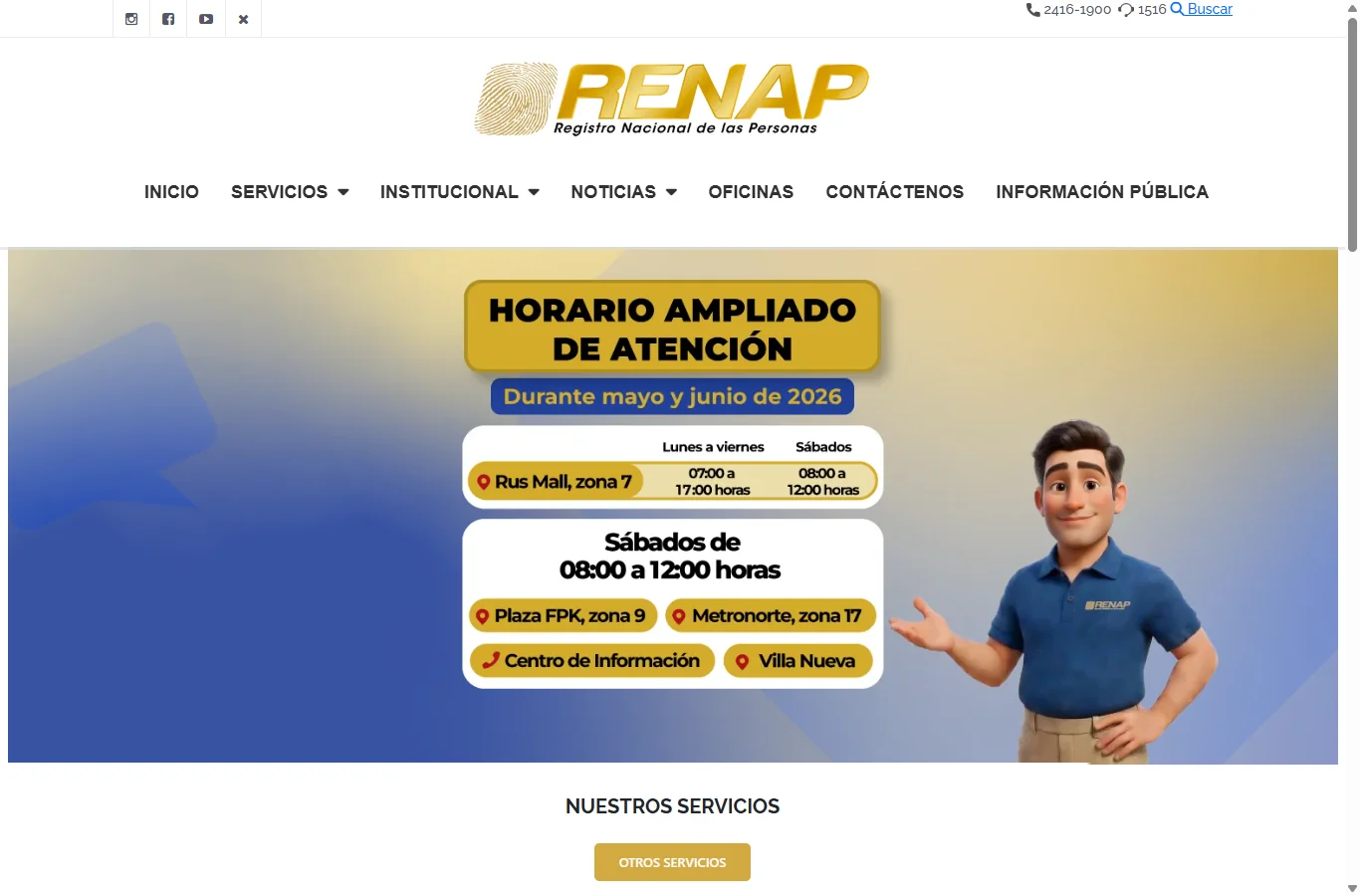
RENAP main page (renap.gob.gt). Extended-hours announcements and new sede openings are posted here — check before traveling to an office.
Step-by-Step Process
Option 1: Marriage Before the Mayor
- Gather documents — DPIs and birth certificates; ask the municipality what else it will ask for
- Ask whether witnesses are required and how many — the Civil Code sets no number; Art. 99 has the witnesses sign the act only if there are any
- Visit your municipality’s civil registry and request a marriage date
- Attend the ceremony — the mayor (or designated official) performs the ceremony at the municipal hall
- Sign the marriage act — the spouses sign, and the witnesses if there are any
- Municipality sends documentation to RENAP for inscription
- Request your marriage certificate at RENAP (Q25) once inscribed
Option 2: Marriage Before a Notary
- Choose a notary and agree on fees — the arancel rates the notarial act at Q100.00-Q2,000.00 and the protocolizacion at Q200.00-Q5,000.00, but Art. 106 lets both sides contract freely
- Provide documents to the notary for review
- Notary prepares the marriage act — an acta notarial, which must then be protocolized (Civil Code Art. 101)
- Ceremony — can be at the notary’s office or location of your choice
- Notary sends testimony to RENAP for inscription
- Request your marriage certificate at RENAP (Q25)
Option 3: Marriage Before a Minister of Worship
- Your church/religious institution handles the ceremony
- Minister must be legally authorized to perform civil marriages
- Minister sends documentation to RENAP for inscription
- Request your marriage certificate at RENAP (Q25)
Processing Time
- Ceremony scheduling: no municipality we could reach publishes a lead time; ask your Registro Civil
- RENAP inscription: no turnaround published by RENAP. The Civil Code (Art. 102) gives the mayor 15 working days to send the certified copy
- Marriage certificate: Immediate once inscribed (available online at eportal.renap.gob.gt for Q25)
Collective Weddings (Matrimonios Colectivos)
Several municipalities run group ceremonies where a number of couples marry the same day before the mayor. We publish no schedule or venue: as of 2026-09-21 no reachable municipal page published the date, the place or the cost of the next session.
Requirements for collective weddings are the same as for individual ceremonies before the mayor. Ask the municipality where you plan to marry whether it runs them and when; we publish no telephone number or schedule that we could not source.
Details
If one or both spouses are foreign nationals, additional documentation and steps are required:
For the foreign spouse:
- Birth certificate from their home country, with apostille (Hague Convention countries) or legalization (non-Hague countries)
- Certificate of no impediment (certificado de solteria) — a document from their home country confirming they are legally free to marry. In the US, not all states issue this; an affidavit sworn before a notary public can substitute
- Sworn Spanish translation of all documents not in Spanish — must be done by a traductor jurado authorized in Guatemala (no published tariff; ask for quotes)
- Valid passport with current immigration status in Guatemala
Capitulaciones matrimoniales (mandatory only in the four cases of Art. 118): Capitulaciones matrimoniales are a prenuptial property agreement. Art. 118 makes them mandatory when either spouse has assets worth two thousand quetzales, earns more than two hundred quetzales a month from a profession, art or trade, or administers property of minors or incapacitated persons, and when the woman is Guatemalan and the man is a foreigner or naturalized Guatemalan. Otherwise Art. 93 asks the couple to declare the economic regime they adopt if they do not present a capitulaciones deed, and without capitulaciones Art. 126 applies the community of acquests (comunidad de gananciales). What Art. 96 does impose when one spouse is foreign are the edictos. If you do choose capitulaciones, there is no published tariff; the notarial arancel rates a deed of undetermined value at Q200.00-Q5,000.00 and fees are freely contracted.
Common pitfalls:
- US documents need an apostille from the Secretary of State of the issuing state, NOT a notary stamp
- Some countries do not issue certificates of no impediment — check with the nearest Guatemalan consulate for accepted alternatives
- Apostille and translation lead times are not published by any source we could open — start early and ask each issuing office directly
After the wedding:
- Register the marriage at a Guatemalan consulate if the foreign spouse wants it recognized in their home country
- For US immigration purposes, obtain the RENAP marriage certificate (Q25.00; there is no separate “international” version in RENAP’s tariff) plus an apostille from the Ministerio de Relaciones Exteriores, for which Guatemala reports to the Hague Conference only the Q10.00 stamp tax
Details
Guatemala recognizes marriages performed by three authorities, but not all carry the same legal weight:
Civil marriage (before mayor or notary):
- Full legal standing from the moment the marriage act is signed
- Automatically inscribed at RENAP
- Governs property rights, inheritance, and legal obligations
Religious marriage (before minister of worship):
- Legally valid ONLY if the minister is registered with the Ministerio de Gobernacion as authorized to perform civil marriages
- Must be inscribed at RENAP — the minister is responsible for sending the documentation
- If the minister is NOT authorized, the ceremony is purely symbolic with no legal effect
Common misconception: Many Guatemalans believe a church wedding is automatically legally valid. It is not. If the minister did not send the documentation to RENAP, you are not legally married — regardless of how elaborate the ceremony was.
How to check: Request a marriage certificate at any RENAP office or at eportal.renap.gob.gt. If RENAP has no record of your marriage, it was never inscribed and you are legally single.
How to fix it: If your religious marriage was never registered, you have two options:
- Ask the minister to submit the original documentation to RENAP (if still available)
- Have a civil ceremony (before a mayor or notary) to formalize the union
Details
While the core requirements for civil marriage are set by the Civil Code and apply nationwide, individual municipalities may have procedural variations:
Guatemala City (Municipalidad de Guatemala):
- Collective weddings: no schedule published on a reachable municipal page as of 2026-09-21
- Confirm the document deadline with the Registro Civil — it is not published
Antigua Guatemala (Sacatepequez):
- Popular destination weddings — notarial path recommended
- Notaries charge premium rates for destination ceremonies; no published tariff covers travel weddings beyond the arancel (Art. 108: Q50.00 per hour outside the office, plus Q6.00 per km outside town)
- Some hotels coordinate with notaries for wedding packages
Outside the municipal seat:
- Art. 104 lets the mayor, or whoever acts in his place, travel to where the marriage must take place, provided the couple supplies the means of transport
General advice: Call your municipality’s Registro Civil well before your planned date to confirm its specific requirements and schedule — those vary and are not published.
From the US (Diaspora Info)
If one or both partners are Guatemalans living in the US:
- Consular marriages — Guatemalan consulates can register marriages performed in the US. We publish no fee for the consular registration because none appears in a tariff we could open; ask your consulate
- Getting married in Guatemala — confirm with the officiant whether both spouses must be physically present; the Civil Code text we read (Art. 99) describes the ceremony with the spouses present
- US marriage recognition — a marriage performed in Guatemala is generally recognized in the US, but you may need an apostilled marriage certificate translated into English
- Document preparation — if the US-based spouse needs a certificate of no impediment, contact your county clerk or state vital records office. Some states do not issue this document, in which case an affidavit sworn before a notary public can substitute
Tips & Common Mistakes
Check your DPI civil status first. Your DPI must show “soltero/a.” If you were previously married and divorced, make sure your DPI has been updated to reflect your current status; Art. 95 requires the document proving the previous marriage was dissolved.
Ask what validity window the birth certificate needs. No source we could open publishes one — the officiant sets it. Certificates cost Q15.00 each (AD 15-2020, Art. 2 numeral 1) at any RENAP office or online at eportal.renap.gob.gt.
Bring a health certificate for each partner. Civil Code Art. 97, as reformed by Decreto 8-2007 (CENADOJ annotated Civil Code updated to 8 August 2025), makes the constancia de sanidad obligatory for both partners. It is issued by a public health centre or an active registered physician and states that the person has no incurable contagious disease harmful to the other spouse or to descendants, and no physical defect that makes procreation impossible. People who live where there is no active registered physician or public health centre, and couples who have already lived in a de facto relationship that makes it unnecessary, are exempt. Art. 97 sets no price; ask the officiant what else they require.
Foreign documents take time. If your spouse is foreign, allow time for apostilles, translations and notarization, and remember Art. 96: edictos run for fifteen days in the Diario Oficial and another paper before the ceremony, and lapse after six months. Sworn translators set their own prices; none are published.
Follow up on RENAP registration. The officiating authority is supposed to send the marriage act to RENAP, but delays happen. Check with RENAP 2 weeks after the ceremony to confirm your marriage was inscribed.
Common Errors and Solutions
DPI shows “casado/a” because a previous marriage was never inscribed
A frequent cause of rejection. Even if you have been separated for years or believe you are single, if a previous civil marriage was never formally dissolved at RENAP, your DPI may still reflect it — or worse, you may be unaware of the situation entirely. Solution: request a consulta de estado civil at any RENAP office before starting the marriage process. If a prior marriage shows up, you must complete a divorce inscription and update your DPI first. See divorce inscription.
Birth certificate rejected as too old at the marriage appointment
Officiants ask for a recent RENAP birth certificate, but no source we could open publishes a validity window — not the Civil Code articles on marriage, not the RENAP service page. Solution: ask your officiant what window they apply, then request fresh certificates close to the ceremony (Q15.00 each, AD 15-2020 Art. 2 numeral 1, at any RENAP office or eportal.renap.gob.gt).
Foreign spouse cannot get a “certificate of no impediment” from their home country
Not all countries issue a certificate of no impediment to marry. The US is the most common example — most states do not issue one. Solution: an affidavit sworn before a US notary public, then apostilled by the state’s Secretary of State, is accepted by Guatemalan authorities as a substitute. Some consulates can issue guidance letters confirming this. Check with the specific Guatemalan consulate or notary handling your case before paying for translations.
Edictos not published in time when one spouse is foreign
Art. 96 requires that, before the ceremony, edictos run for fifteen days in the Diario Oficial and in another paper of wide circulation, and that they lapse if the marriage is not celebrated within six months of publication. Couples often plan the date without allowing for that window. Solution: start the edictos well before the intended date and keep the ceremony inside the six-month window. Neither paper publishes a rate we could open, so we quote no price.
Religious ceremony happened but RENAP has no marriage record
If the minister of worship was not legally authorized by the Ministerio de Gobernacion to perform civil marriages, or if the minister was authorized but failed to send the documentation, the marriage has no legal effect — regardless of how elaborate the ceremony was. Solution: request a marriage certificate at any RENAP office or eportal.renap.gob.gt. If RENAP has no record, you have two options: (1) ask the minister to submit the original documentation if still available; (2) marry again before a mayor or notary to formalize the union legally.
Officiating authority sent documents to RENAP but inscription is delayed
RENAP publishes no turnaround for the inscription. What the law does set is the officiant’s deadline: the Civil Code (Art. 102) gives the mayor 15 working days to send the certified copy of the act, and fines non-compliance one to five quetzales. Solution: a few weeks after the ceremony, check at RENAP whether the marriage is inscribed (you can search at eportal.renap.gob.gt). If not, contact the officiant — the mayor’s office, notary, or minister is responsible for sending the documentation and confirming it was received.
After marriage, DPI still shows “soltero/a”
Updating civil status on the DPI is a separate step, not automatic. Both spouses should visit any RENAP office with the marriage certificate and request a DPI update (Q100.00 each, AD 15-2020 Art. 2 numeral 14). Solution: do this proactively after the inscription is confirmed — many subsequent procedures (joint bank accounts, IGSS beneficiary, property purchases, immigration filings) ask for DPIs that match your actual marital status.
Related RENAP Procedures
- Marriage Certificate — obtain a certified copy after inscription
- Birth Certificate — required for both spouses
- DPI (National ID) — must show “soltero/a” status; update to “casado/a” after marriage
- Divorce Registration — must be completed before remarriage
- Union de Hecho — alternative to marriage for couples with 3+ years of cohabitation
Common Questions
How much does it cost to get married in Guatemala?
Before a notary, the arancel rates the notarial act at Q100.00-Q2,000.00 and its protocolizacion at Q200.00-Q5,000.00, plus Q5.00 per sheet and two Q10.00 stamps — Q320.00 to Q7,020.00 adding only the published rows, though fees are freely contracted (Art. 106). Before the mayor there is no published municipal tariff. Church marriages must also be registered civilly at RENAP; the certificate is Q25.00, while the inscription itself has no published fee.
Can a foreigner marry a Guatemalan citizen?
Yes. The foreign spouse must prove their identity and freedom to marry in a reliable manner. What the Civil Code (Art. 96) does impose is the edictos: notices published for fifteen days in the Diario Oficial and in another paper of wide circulation before the ceremony, lapsing if the marriage is not celebrated within six months. Capitulaciones matrimoniales are mandatory only in the four cases of Civil Code Art. 118: either spouse has assets worth two thousand quetzales; either earns more than two hundred quetzales a month from a profession, art or trade; either administers property of minors or incapacitated persons; or the woman is Guatemalan and the man is a foreigner or naturalized Guatemalan. Outside those cases, Art. 93 only asks the couple to declare the economic regime they adopt if they do not present a capitulaciones deed.
What are the matrimonios colectivos in Guatemala City?
They are group ceremonies where several couples marry the same day before the mayor. Several municipalities have run them, but as of 2026-09-21 we could not reach any municipal page publishing the date, venue or cost of the next session, so we publish no schedule. Confirm with the municipality where you plan to marry.
How long do I have to register the marriage at RENAP?
The marriage should be registered at RENAP promptly after the ceremony. The officiating authority (mayor, notary, or minister) is responsible for sending the documentation to RENAP for inscription. If they fail to do so, you should follow up directly.
Is a religious wedding legally valid in Guatemala?
Yes, if the minister of worship is legally authorized to perform civil marriages and registers the ceremony with RENAP. A purely religious ceremony without civil registration has no legal standing for purposes of property rights, inheritance, or immigration.