The certificacion de nacimiento (birth certificate) is the single most fundamental document in Guatemala’s civil registry system. You need it to get your first DPI, to apply for a passport, to register a marriage, to enroll in school, and as a supporting document for dozens of other procedures. It is issued by RENAP and contains your full legal name, date and place of birth, parents’ names, and other vital data.
The good news is that obtaining a birth certificate is one of the simplest and cheapest procedures in Guatemala’s bureaucratic system. You can get one at any RENAP office for Q15 — typically in minutes — or request it online through the RENAP electronic portal from anywhere in the world. For Guatemalans in the diaspora, this is often the first step in handling any legal matter back home.
One important detail to remember: birth certificates in Guatemala have an expiration date for official use. Most institutions require certificates issued within the last 6 months (some require 3 months). This means you cannot stockpile certificates — you need a fresh one each time you start a new procedure.
Quick summary: Costs Q15 (~$2 USD). Available at any RENAP office (immediate) or online at eportal.renap.gob.gt (1-3 days). Valid for 6 months for most procedures. Available from anywhere in the world.
Fees re-verified 1 September 2026 against RENAP’s own tariff instruments — Acuerdo de Directorio 15-2020 (Arts. 2, 6, 7) and its reform Acuerdo de Directorio 62-2022, published in the Diario de Centro América on 10 November 2022. All unchanged. Check our exchange rate page for today’s USD/GTQ rate.
Cost
| Item | Cost | Source |
|---|---|---|
| Birth certification at any RENAP office in Guatemala | Q15 | AD 15-2020 Art. 2 nº1 |
| Legalisation of the civil registrar’s signature (added to the Q15) | +Q50 | AD 15-2020 Art. 2 nº12 |
| The same certification requested from abroad — consulate, embassy, mobile consulate, or electronically | US$6 | AD 15-2020 Art. 6 nº1 |
| Online with digital signature | Q15 | AD 15-2020 Art. 2 nº1 |
| Card-payment surcharge, on any RENAP service paid electronically by debit or credit card | +25% | AD 15-2020 Art. 7 |
So a Q15 certification paid online by card comes to Q18.75, which Art. 9 rounds up to the next whole unit — Q19. Any other RENAP service requested from abroad is billed at US$1.00 per Q1.00 (Art. 8).
There is no separate “international format” certificate. The US$6 line is a place-of-request price for the ordinary birth certification, not a different document. What makes a certification usable abroad is the apostille from the Ministerio de Relaciones Exteriores, not the price you paid for it.
Requirements
- DPI del solicitante — your national ID, or the ID of whoever is requesting the certificate
- Full name and birth date of the person whose certificate you need (if different from the requestor)
- Payment of Q15
You do NOT need to go to the RENAP office where you were originally registered. Any RENAP office nationwide can issue the certificate.
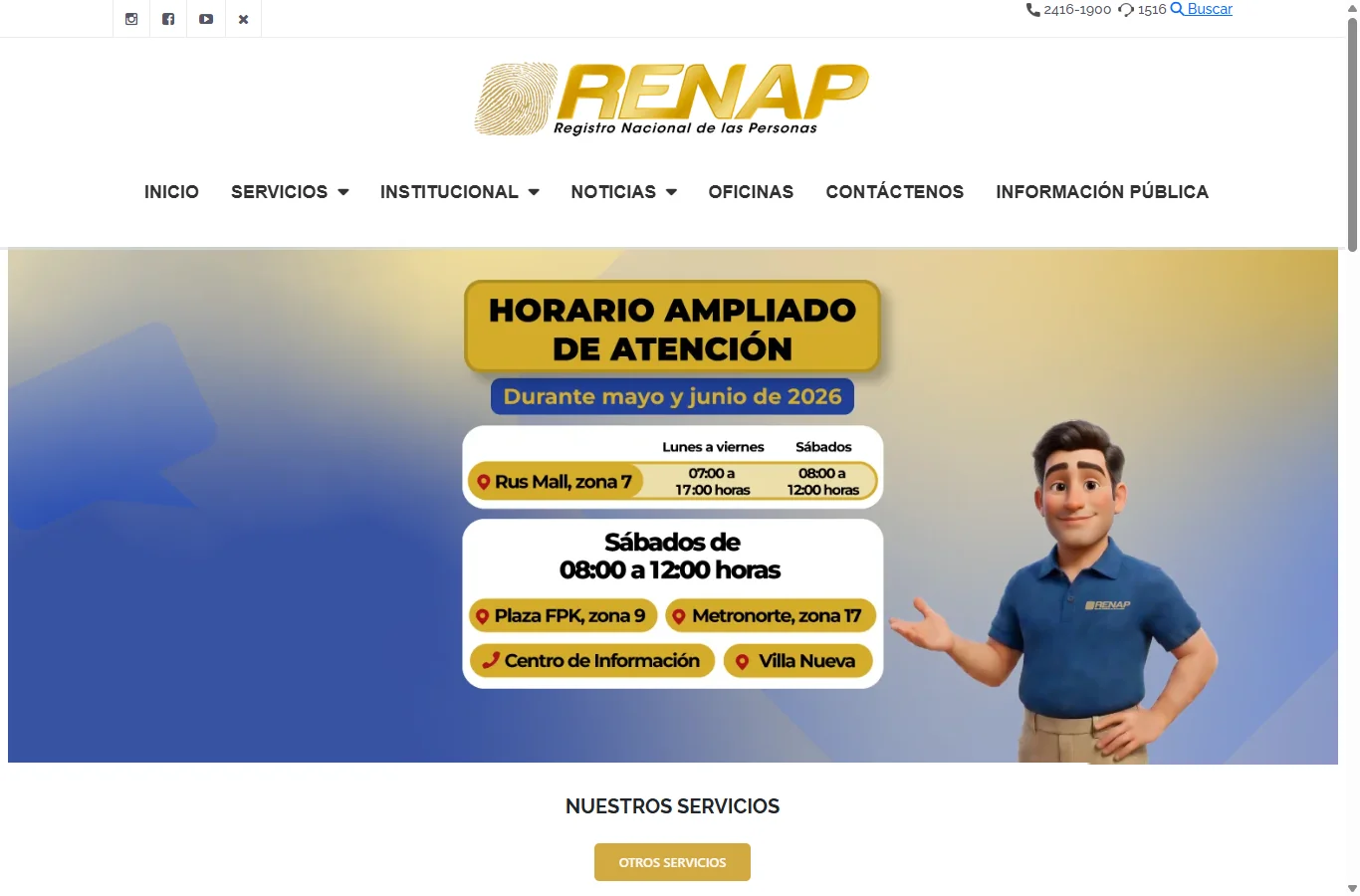
RENAP main page (renap.gob.gt). Extended-hours announcements and new sede openings are posted here — check before traveling to an office.
How to Get It
Option 1: In Person at Any RENAP Office
- Go to any RENAP office nationwide (over 340 offices across all departments)
- Present your DPI and request a birth certificate
- Pay Q15 at the office (cash avoids the 25% card surcharge)
- Receive the certificate — usually within minutes
- Request legalization of the registrar’s signature if needed for official use (Q50 additional)
Option 2: Online Through eportal.renap.gob.gt
- Visit eportal.renap.gob.gt
- Create an account or log in
- Select “Certificacion de Nacimiento”
- Enter the CUI number or personal data of the person whose certificate you need
- Pay Q15 by credit/debit card or electronic transfer — card payments add the 25% surcharge set by Art. 7 of the tariff
- Receive the certificate as a digitally signed PDF — within 1-3 business days
- Download and print — the digital version is legally valid
Option 3: At a Guatemalan Consulate (from the US)
- Visit your nearest Guatemalan consulate (see our birth abroad registration guide for locations)
- Request a birth certificate
- Pay the consular fee
- Processing time varies by consulate — typically 1-2 weeks
Processing Time
| Method | Time |
|---|---|
| In person | Minutes (same day) |
| Online (eportal) | 1-3 business days |
| Consulate | 1-2 weeks |
Types of Certificates
RENAP issues several types of certificates from birth records:
- Certificacion simple — standard birth certificate for most domestic use (Q15)
- Certificacion legalizada — the same certificate with the civil registrar’s signature legalized, needed for more formal procedures (Q50 on top of the Q15). The tariff line is the legalisation of the registrar’s signature, not a different certificate
- Requested from abroad — the same certification, ordered at a consulate, embassy, mobile consulate or electronically, is priced in dollars at US$6 (Art. 6 of the tariff). That is a place-of-request price, not a distinct “international” document
- Certificacion con firma electronica — digital certificate with electronic signature, obtained online
When You Need This Document
A current birth certificate is required for:
- DPI (first time) — must be issued within the last 6 months
- Passport application
- Civil marriage — must be issued within the last 3 months
- School enrollment
- University degree authentication
- Adoption procedures
- Insurance beneficiary claims
- Inheritance proceedings
- Most legal proceedings involving identity
Details
If your birth was never registered at RENAP, you cannot get a birth certificate — because the underlying record does not exist. This is more common than many people realize, especially in rural Guatemala where home births with midwives (comadronas) are the norm.
Signs you might not be registered:
- You have never had a DPI and were never issued a birth certificate
- RENAP returns “no record found” when you search by name
- You were born at home and your parents never went to a civil registry
What to do:
- Request a constancia negativa de inscripcion from RENAP (free) to confirm you are not registered
- Follow our late birth registration guide — the process costs just Q25 and can be done at any age
- After registration, you can immediately request your birth certificate and then apply for a DPI
If no birth date can be established at all, you may need a fe de edad (age certification) through the courts.
Details
If your child was born outside Guatemala (for example, in the United States), the birth must be registered through a Guatemalan consulate before RENAP can issue a Guatemalan birth certificate. The process is:
- Both parents appear at the nearest Guatemalan consulate with the child
- Present the US (or foreign) birth certificate, apostilled and translated to Spanish
- The consulate sends the registration to MINEX, which forwards it to RENAP
- After RENAP inscribes the birth (3-4 months), you can request a Guatemalan birth certificate
For the full process, see our guide on registering a birth abroad.
Important: Your child does not lose US citizenship by being registered as Guatemalan. Both countries allow dual nationality.
Details
Errors in birth certificates are surprisingly common — a misspelled name, wrong birth date, or incorrect parent information. These mistakes originate in the underlying birth record (partida de nacimiento), not in the certificate itself. To fix them:
- Identify the error by requesting a current certificate from RENAP
- Gather supporting evidence (baptismal record, school records, other official documents showing the correct information)
- Hire a notary to initiate a rectificacion de partida (Q1,000-Q3,000 in notary fees)
- The PGN (Procuraduria General de la Nacion) must review and approve the correction — this takes 3-8 weeks
- After correction, request a new birth certificate (Q15) with the corrected data
Do not attempt to use a certificate with errors for other procedures. It will be rejected and you will waste time and money on the dependent procedure.
From the US (Diaspora Info)
Guatemalans in the United States have multiple ways to obtain birth certificates:
- Online is the easiest — eportal.renap.gob.gt works from anywhere. The digitally signed PDF is legally valid in Guatemala
- Consulates can help — any Guatemalan consulate in the US can request and issue birth certificates, though processing is slower
- For US legal use — what makes the certification usable is the apostille from the Ministerio de Relaciones Exteriores, not a special certificate type. Ordering the certification from a consulate or electronically from abroad is billed at US$6; a family member in Guatemala can then handle the apostille
- Request a family member’s certificate — you can request anyone’s birth certificate if you have their full name and data. This is useful for handling legal matters for elderly parents or deceased relatives
- Multiple copies — if you are handling several procedures, request multiple certificates at once to save trips. Remember they expire in 6 months
Tips & Common Mistakes
Check the validity period. Different procedures have different freshness requirements. Marriage requires a certificate from the last 3 months; DPI requires 6 months. Do not request the certificate too early or it may expire before you finish your procedure.
Legalization is a separate step. A standard Q15 certificate is fine for most routine uses. But for legal proceedings, immigration applications, and use outside RENAP, you need the registrar’s signature legalized — Q50 on top of the Q15. Know which one you need before you go.
Online certificates are legally valid. Some institutions and individuals still hesitate to accept digital certificates, but the RENAP electronic certificates with digital signature carry the same legal weight as in-person certificates. If an institution rejects it, point to the verification QR code.
You can request anyone’s certificate. You do not need to be the person named on the certificate. Anyone can request a birth certificate for anyone else — useful for handling family matters or when the person is elderly, incapacitated, or abroad.
If there is an error, fix it first. If you notice a mistake in your birth certificate (wrong name spelling, incorrect date), do not try to use it for another procedure — it will get rejected. See our birth record correction guide to fix the error before proceeding.
Common Errors and Solutions
“Acta no encontrada” / “Record not found” on the online portal
RENAP digitized birth records starting around 2008. Records inscribed before that year — and especially older rural records — may not appear when you search through eportal.renap.gob.gt. Solution: (1) request the certificate in person at the RENAP office of the municipality where the birth was originally inscribed (not the office closest to where you live); (2) bring an approximate year and the parents’ full names; (3) if you live abroad, ask a family member in Guatemala to do this in person — the eportal cannot reach the physical archives.
“Datos no coinciden” / “Data mismatch” with what RENAP shows
This usually means: (1) a parent’s surname is spelled differently in the original birth record than on your DPI; (2) the birth was inscribed in a different municipality than you think; (3) there are minor errors (accents, transposed letters) in the original inscription. Solution: ask RENAP for a “consulta de inscripcion” — they can tell you exactly how the record is inscribed. If there is a real error, you will need a rectificacion de partida before requesting a corrected certificate.
Online payment fails on eportal.renap.gob.gt
The portal uses a VISA/MasterCard processor that frequently rejects US-issued cards without warning. Solutions: (1) try a Guatemalan card from a family member; (2) call your US bank to authorize the foreign transaction in advance; (3) if both fail, request the certificate at a Guatemalan consulate in the US, or have a family member request it in person at any RENAP office in Guatemala and mail it to you.
Certificate accepted but rejected at apostille window
Apostilles are issued by the Ministerio de Relaciones Exteriores in Guatemala City. RENAP’s tariff defines no “international format” certificate — the US$6 line is simply the price when the certification is ordered from abroad. What MINEX needs is a current certification carrying a signature and seal it can authenticate, which in practice means a recently issued certificate and, for some receiving institutions, one with the registrar’s signature legalized (the Q50 line). Tell the RENAP window it is for an apostille, and confirm the format before travelling to MINEX.
Certificate is current but the institution says it is “expired”
Most procedures require a certificate issued within the last 6 months, but some are stricter: marriage requires 3 months, and certain bank or insurance procedures may require 30-60 days. Always ask the receiving institution for their specific freshness requirement BEFORE ordering — and order the certificate as close to your appointment date as possible.
Related RENAP Procedures
- DPI (National ID) — requires a birth certificate issued within 6 months
- Late Birth Registration — if your birth was never registered
- Birth Record Correction — fix errors in the underlying birth record
- Birth Abroad Registration — register a foreign-born child as Guatemalan
- Age Certification (Fe de Edad) — when no birth date can be established
- Civil Marriage — requires birth certificate within 3 months
Common Questions
How much does a Guatemalan birth certificate cost?
A birth certificate (certificacion de nacimiento) costs Q15 at any RENAP office or through the online portal. Having the registrar’s signature legalized costs a further Q50. Requesting the same certification from abroad — at a consulate, embassy, mobile consulate or electronically — costs US$6. Card payments carry a 25% surcharge (Art. 7 of the tariff).
How long is a Guatemalan birth certificate valid?
For most government procedures, the birth certificate is valid for 6 months from the date of issue. Some institutions are stricter (3 months for marriage). Always check the specific requirements of the procedure you are completing.
Can I get my Guatemalan birth certificate from the United States?
Yes. You can request it online at eportal.renap.gob.gt from anywhere in the world. You can also request it at any Guatemalan consulate in the US. The online version with digital signature is legally valid.
What if my birth certificate has an error?
If there is a mistake in your name, birth date, or other information, you need a rectificacion de partida (birth record correction) before you can get a corrected certificate. See our guide on birth record correction for the full process.
Can someone else request my birth certificate for me?
Yes. Birth certificates in Guatemala are public records. Anyone with your full name and CUI number (or date of birth and parents’ names) can request a certificate on your behalf at any RENAP office or online. No power of attorney is needed.