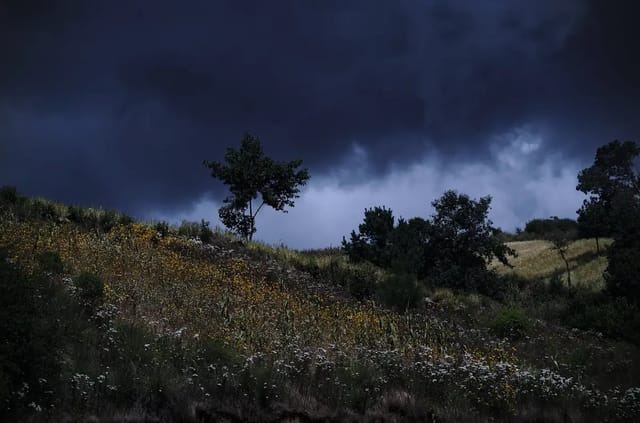
Guatemala has a dry heart. Run a line east from the capital down the Motagua Valley toward the Honduran border, and the lush green that tourists associate with the country thins out into thorn scrub, cactus, and bare brown hillsides. This is the corredor seco — the dry corridor — and it is one of the most important pieces of geography in Guatemala for anyone trying to understand the country’s food security, migration, and climate risk.
This page is the structural explainer: what the corredor seco is, exactly which departments it covers, the physical reason it is so dry, who lives there, and the recurring drought cycle that El Niño years turn into humanitarian emergencies. For the live, date-bound 2026 drought status, see the related reading and the Guatemala Weather Hub at the end.
Quick summary: The corredor seco is a semi-arid region of eastern Guatemala. The national drought strategy (ENSG 2022-2030) defines it as Baja Verapaz, El Progreso, Zacapa, Chiquimula, Jutiapa, and Jalapa, with 18 municipalities recurrently affected by drought. It is dry because the Sierra de las Minas ridge throws a rain shadow over the Motagua Valley — the driest, most arid valley in Central America, with under 500 mm of rain a year against a national range of 500-6,000 mm. Around 1.5 million people in the dry-corridor municipalities face food insecurity (World Vision GT). El Niño turns the corridor’s low rainfall into drought: NOAA has held an El Niño Advisory since June 11, 2026, and its September 10, 2026 discussion puts August’s Niño-3.4 at +1.8°C with a greater than 90% chance of a very strong event across Northern Hemisphere fall and winter 2026-27. FEWS NET projects below-average rain from June through the end of 2026.
Explore the data: The Guatemala Weather Hub shows live rainfall accumulation for 22 departments versus the 30-year normal, plus the current ENSO state pulled directly from NOAA. As each rainy season unfolds, the hub is the single best way to see whether the corredor seco departments — Zacapa, Chiquimula, El Progreso, Jutiapa — are running wet or dry compared to a normal year.
What the Corredor Seco Is
The corredor seco is a band of structurally dry, semi-arid territory that runs across eastern Guatemala and continues into Honduras, El Salvador, and Nicaragua as the Central American Dry Corridor. It is not a single line on a map but a climate zone defined by low and unreliable rainfall.
Guatemala’s authoritative domestic definition comes from the Estrategia Nacional Contra la Sequía en Guatemala (ENSG) 2022-2030 — the national drought strategy. The ENSG defines the corredor seco as “una zona semiárida, que cubre los departamentos de Baja Verapaz, El Progreso, Zacapa, Chiquimula, Jutiapa y Jalapa” — a semi-arid zone covering those six departments. The same strategy describes the corridor as an arid region with limited precipitation, “perteneciente en su mayor parte a la cuenca del Motagua” — belonging mostly to the Motagua river basin.
Within that footprint, the ENSG identifies 18 municipalities that are recurrently affected by drought, located in El Progreso, Zacapa, Chiquimula, and Jutiapa. Those four departments form the hard core of the dry corridor.
A note on scope: only part of each named department actually falls inside the dry zone. Zacapa is mostly within it (the Motagua Valley runs straight through the department), but Baja Verapaz and Jalapa are only partly dry. Because of that, there is no single clean “population of the corredor seco” figure — this page uses department-level census context and a sourced food-insecurity headcount instead.
The Corredor Seco at a Glance
| Metric | Value | Source |
|---|---|---|
| Area | ~10,200 km² (~10% of national territory) | World Vision Guatemala |
| Municipalities (traditional footprint) | 46 of 340 | World Vision Guatemala |
| Recurrently drought-hit municipalities | 18 (in El Progreso, Zacapa, Chiquimula, Jutiapa) | ENSG 2022-2030 |
| Rural poverty in corridor populations | ~70% | ENSG 2022-2030 |
| Driest valley rainfall (Motagua) | under 500 mm/year | CONAP (Sierra de las Minas) |
| National rainfall range | 500-6,000 mm/year | CONAP, via ENSG |
| Drought threshold (Jun-Aug) | under 180 mm/quarter (vs 210 mm average) | INSIVUMEH, via ENSG |
| Central American Dry Corridor population | ~10.5 million (about 60% in poverty) | FAO |
Guatemala’s administrative baseline, for reference, is 22 departments and 340 municipalities (ENSG). The corredor seco’s roughly 10,200 km² footprint — about 10% of national territory across 46 of those 340 municipalities — is the figure used by World Vision Guatemala, spanning Baja Verapaz, El Progreso, Guatemala, Zacapa, Chiquimula, Jalapa, Jutiapa, and parts of Quiché.
Why It Is So Dry: The Sierra de las Minas Rain Shadow
The corredor seco is not dry by accident. It is dry because of a mountain.
The Sierra de las Minas is a high ridge that runs east-west through eastern Guatemala. Moist air moving in from the Caribbean side rises against the northern slopes, cools, and dumps its rain there. By the time the air spills over the ridge and descends into the Motagua Valley on the southern side, it has lost most of its moisture and warms as it sinks — the classic rain-shadow mechanism.
The result, documented by CONAP (Guatemala’s protected-areas council), is a stark split across a single mountain range:
- North of the ridge (upper Polochic): humid, with rainfall that can exceed 4,000 mm a year.
- South of the ridge (Motagua Valley): very dry, with annual precipitation under 500 mm.
CONAP reports the mid-Motagua Valley as the driest, most arid valley in Central America. That is the physical engine of the corredor seco: a dry rain-shadow valley sitting at the bottom of a country whose national rainfall otherwise ranges all the way from 500 to 6,000 mm a year (CONAP, cited in the ENSG).
How Dry Is “Dry”? The INSIVUMEH Baseline
Guatemala’s meteorological institute, INSIVUMEH, has measured the semi-arid zone for decades. Using the 1975-2010 series (more than 20 years of data), the ENSG reports:
- Average June-August rainfall of 210 mm per quarter in the semi-arid area.
- A drought event is recorded when that June-August quarterly rainfall falls below 180 mm.
That is the threshold to watch. The corredor seco does not need a catastrophe to fail — it only needs the June-August quarter to drop roughly 30 mm below its already-low average. The rainy season is also interrupted twice by the canícula, the mid-summer dry spell: the ENSG notes two statistical windows, roughly July 5-15 and August 10-20, when rainfall drops for a short period. In a normal year those pauses are survivable; in an El Niño year they stretch out and the harvest fails.
Who Lives There
There is no authoritative single headcount for “the corredor seco population,” because the dry zone cuts across departments rather than filling them. What is sourced is the 2018-census population of the core departments and a regional food-insecurity estimate.
Core Departments by Population (2018 Census)
| Department | 2018 census population | In ENSG corredor seco definition? | Notes |
|---|---|---|---|
| Jutiapa | 488,395 | Yes | southeastern corridor near El Salvador |
| Chiquimula | 415,063 | Yes | ~52% women, 48% men |
| Zacapa | 245,374 | Yes | mostly within the dry Motagua Valley |
| El Progreso | 176,632 | Yes | least-populated department in Guatemala |
Sources: república.com (citing the 2018 census) for Zacapa, Chiquimula, and El Progreso; Wikipedia (ES) for Jutiapa (lower-confidence). Baja Verapaz and Jalapa are also in the ENSG definition but are omitted here because clean 2018-census totals could not be confirmed from an authoritative source.
For national context, the 2018 census put Guatemala’s population at 14.9 million (14,901,286 inhabitants per INE, cited in the ENSG; 48.5% men, 51.5% women).
The Human Story: Poverty and Food Insecurity
The numbers that matter most in the corredor seco are not population totals but vulnerability figures:
- Rural poverty in the corridor’s populations is estimated at around 70% (ENSG 2022-2030).
- About 1.5 million people in the dry-corridor municipalities live with food insecurity or need humanitarian assistance (World Vision Guatemala).
- In Chiquimula, 56% of the population suffers chronic malnutrition (World Vision Guatemala).
- Between August 2019 and June 2020, severe food insecurity in the corredor seco rose 12% (OXFAM, via World Vision Guatemala).
Zoomed out to the regional level, FAO estimates that about 10.5 million people live in the Central American Dry Corridor as a whole, roughly 60% of them in poverty. The corredor seco is, structurally, the poorest and most food-insecure part of one of the most climate-vulnerable agricultural zones in the world.
The Food-Security Cycle: IPC Classifications
The clearest way to track how the corredor seco is doing in any given season is the IPC — the Integrated Food Security Phase Classification. It runs from Phase 1 (Minimal) through Phase 2 (Stressed), Phase 3 (Crisis), Phase 4 (Emergency), to Phase 5 (Catastrophe/Famine).
The most recent IPC analysis for Guatemala paints a clear picture of a country where a large share of the population is in or near crisis, with the dry corridor at the center:
| Period | People in IPC Phase 3+ | Share of population analyzed | Source |
|---|---|---|---|
| May-Aug 2025 (current) | ~3.4 million | 19% | foodsecurityportal.org |
| Sep 2025-Jan 2026 (projected) | ~2.6 million | 14% | foodsecurityportal.org |
| Feb-Apr 2026 (projected) | ~3.0 million | 16% | foodsecurityportal.org |
A few specifics from those analyses:
- The May-Aug 2025 current period — about 3.4 million people (19%) in Phase 3+ — was around 400,000 more than the same period in 2024. 11 of the 22 departments analyzed were classified in IPC Phase 3 (Crisis), notably Alta Verapaz, Huehuetenango, and Quiché.
- The September 2025-January 2026 projection — about 2.6 million (14%) in Phase 3+ — breaks down to 2.4 million in Phase 3 and 185,000 in Phase 4.
- The February-April 2026 projection — about 3 million people (16%, roughly 1 in 6 Guatemalans) in Phase 3+ — breaks down to about 2.8 million in Phase 3 (Crisis) and over 248,000 in Phase 4 (Emergency).
FEWS NET’s February 2026 outlook is consistent: the poorest households in the Dry Corridor, parts of the Altiplano, and Alta Verapaz are in Crisis (IPC Phase 3), while the rest of the country is Stressed (Phase 2). FEWS NET also reported that subsistence farmers had “almost total losses of maize and total losses of beans” in 2025, with reserves “substantially below normal.”
Staple-Grain Prices
The corredor seco’s crisis is, at bottom, a maize-and-beans crisis. When the harvest fails there, families have to buy grain they would normally grow, and the wholesale market price becomes a household-budget question. The most recent sourced figures come from La Terminal, the main wholesale market in Guatemala City, in MAGA’s February 2026 price report.
| Grain | Q per quintal | Year-over-year change | Source |
|---|---|---|---|
| Maíz blanco, de primera | Q180.00 | +4.05% vs Feb 2025 | MAGA, Feb 2026 |
| Frijol negro, de primera | Q525.00 | −19.23% vs Feb 2025 | MAGA, Feb 2026 |
A quintal is 100 pounds (about 46 kg). At retail, maíz blanco de primera ran Q2.50 per pound in February 2026 (MAGA). These are La Terminal, Guatemala City wholesale prices — not corredor-seco farmgate prices — but they are the benchmark that flows into the cost of the food basket. (For how grain and other staples feed into household food costs, see our Guatemala food basket page.)
How El Niño Turns the Corridor Into a Crisis
The corredor seco is dry every year. What turns “dry” into “drought” is, repeatedly, El Niño.
FAO frames it precisely: the corridor’s already-reduced humidity “pasa a ser sequía cuando se manifiesta el fenómeno de El Niño” — it becomes drought when the El Niño phenomenon appears — hitting the family farmers who depend on rain-fed granos básicos. El Niño typically suppresses rainfall over Central America, and because the corredor seco has no margin to lose, it is the first place the deficit shows up as failed harvests.
For the current cycle, the signal is clear and it has strengthened through the season. NOAA’s Climate Prediction Center declared a full El Niño Advisory on June 11, 2026, and has held it since. Its current reading — the September 10, 2026 ENSO Diagnostic Discussion — puts August’s Niño-3.4 index at +1.8°C, Niño-3 at +2.5°C and the coastal Niño-1+2 at +3.4°C, with eastern-Pacific sea-surface temperature anomalies exceeding +3.0°C, a greater than 90% chance of a very strong event during Northern Hemisphere fall and winter 2026-27 — the same probability August gave — and a 75% chance of a historic event during October-December 2026, up from 69% in August (a three-month RONI value of +2.5°C or more, which would exceed every El Niño back to 1950). On June 11 the same index read +0.7°C and the very-strong probability was 63% for November-January; the July 9 issue read +1.2°C and 81%; the August 13 issue read +1.4°C for July, with Niño-1+2 at +2.9°C. Niño-4 was the one index that fell in August, to +0.1°C. The next discussion is October 8, 2026 — NOAA issues them on the second Thursday of each month. FEWS NET projects below-average rainfall from June through the end of 2026 due to the transition toward El Niño conditions, with peak food-assistance needs in the lean season concentrated in the Dry Corridor, Alta Verapaz, and the Western Highlands. The full ENSO breakdown is in our El Niño explainer; the year’s mid-summer dry spell, which lands inside the rainy season and is the first on-the-ground test, is covered in the canícula guide.
Historical Drought Episodes
The corredor seco’s modern history is a sequence of El Niño-linked droughts. The reference cases:
| Episode | What happened | Source |
|---|---|---|
| 1982-83 | Very strong El Niño (reference year) | El Niño flagship |
| 1997-98 | Very strong El Niño (reference year) | El Niño flagship |
| 2014-2016 | Regional crisis: 3.5M needed aid, 1.6M food insecure, 50-75% grain losses | FAO newsroom |
| 2018-19 | Corredor seco: 66 municipalities, 52,297 households, maize down up to 76% | ENSG 2022-2030 |
| 2026-27 | Below-average rain June-end 2026, El Niño transition | FEWS NET, Feb 2026 |
2014-2016: The Defining Recent Crisis
According to FAO, the 2015 El Niño was one of the worst on record, compounding two consecutive drought years. Across El Salvador, Guatemala, and Honduras, 3.5 million people needed humanitarian assistance and 1.6 million were moderately or severely food insecure. Vulnerable households lost 50-75% of their staple grains, and the World Food Programme assisted roughly 1 million people per year in 2014 and 2015. Guatemala’s corredor seco was among the hardest-hit areas — the event that still anchors every drought projection for the region.
2018: Government-Documented Drought
The ENSG documents the 2018 drought in hard numbers. Across 10 departments of the corredor seco, the drought affected 66 municipalities, 52,297 households, and 51,518 hectares of crops, with a loss valued at Q83,578,800. Maize harvests fell by up to 76%. It is the cleanest official record of what a bad year costs the corridor.
An Expanding Corridor
Guatemalan authorities increasingly refer to a “corredor seco ampliado” — an expanded dry corridor. The national food-security secretariat, SESAN, has described anticipatory measures for the expanded corredor seco, reflecting that the territory monitored for recurrent drought now reaches beyond the traditional core. The pattern driving the expansion is the same one tracked daily on the weather hub: repeated below-average rainfall years, amplified during El Niño.
What to Watch
The corredor seco is a slow-moving story that turns fast when a dry rainy season hits. The indicators that matter:
- June-August rainfall in the semi-arid zone. Below ~180 mm for the quarter is the INSIVUMEH drought threshold; the Weather Hub shows accumulation versus the 30-year normal for each department in real time.
- The canícula. A short mid-summer dry spell is normal; a long one in an El Niño year is the trigger for maize-harvest failure. See the canícula guide.
- IPC and FEWS NET updates. These are where corredor-seco impacts show up first in data — the Phase 3+ headcount is the cleanest single measure of how bad a given season is.
- The 2026-27 El Niño. With NOAA’s Advisory held since June 11, the September 10 discussion holding the very-strong probability above 90% and the historic-event probability for October-December now at 75%, the structural risk is elevated. The next reading lands October 8, 2026. Track it through the El Niño explainer and the live ENSO state on the hub.
Related Reading
- El Niño & La Niña in Guatemala 2026 — the full ENSO cycle, NOAA’s June 11 Advisory, and what a very-strong El Niño means for Guatemala.
- Canícula 2026 in Guatemala — the mid-summer dry spell that hits the corredor seco hardest, and how El Niño stretches it.
- Drought in Guatemala 2026 — the 2026 El Niño drought risk and the metrics to watch as the corridor dries.
- Corn and Bean Prices 2026 — what corridor crop losses do to the price of the country’s two staple grains.
- Guatemala Rainy Season 2026 — the wet season the corridor depends on, month by month.
- Hurricane Season Guatemala 2026 — the Atlantic/Pacific season and how El Niño suppresses it.
- Guatemala Food Basket Cost — how maize, beans, and other staples feed into the monthly cost of a family’s food basket.
- Guatemala Weather Hub — live ENSO state from NOAA, rainfall accumulation vs the 30-year normal for 22 departments.
Sources
- ENSG — Estrategia Nacional Contra la Sequía en Guatemala 2022-2030 (MARN / UNCCD): definition, six departments, 18 drought-recurrent municipalities, ~70% rural poverty, Motagua basin, INSIVUMEH 210/180 mm thresholds, canícula windows, national 500-6,000 mm range, 2018 drought figures, 14.9M national population — unccd.int
- FAO newsroom — El Niño’s impact on Central America’s Dry Corridor (2014-2016 figures, WFP assistance, 50-75% grain losses) — fao.org
- FAO Américas — Corredor Seco Centroamericano (regional framing; drought “when El Niño appears”) — fao.org
- NOAA Climate Prediction Center — ENSO Diagnostic Discussion, September 10, 2026 (El Niño Advisory; August Niño-3.4 +1.8°C, Niño-3 +2.5°C, Niño-1+2 +3.4°C, Niño-4 +0.1°C; greater than 90% very strong for NH fall and winter; 75% historic Oct-Dec; next discussion October 8, 2026) — cpc.ncep.noaa.gov (archive copy: enso_disc_sep2026); prior issues 13 August 2026, 9 July 2026 and 11 June 2026
- FEWS NET — Guatemala Food Security Outlook, February 2026 — fews.net
- Food Security Portal (IPC mirror) — Guatemala Acute Food Insecurity, May 2025-Apr 2026 — foodsecurityportal.org
- CONAP — 32 aniversario, Reserva de la Biósfera Sierra de las Minas (rain shadow, Motagua Valley, under 500 mm) — conap.gob.gt
- World Vision Guatemala — Agua, cambio climático y corredor seco (10,200 km², 46 municipalities, ~1.5M food insecure, Chiquimula 56% chronic malnutrition, OXFAM +12%) — worldvision.org.gt
- SESAN — CONASAN / Corredor Seco Ampliado, anticipatory measures — portal.sesan.gob.gt
- República.com — 2018 census department populations (Zacapa, Chiquimula, El Progreso) — republica.com
- MAGA — Informe de Precios Agropecuarios Mensual, Febrero 2026 (La Terminal grain prices) — precios.maga.gob.gt
Frequently Asked Questions
What is the corredor seco in Guatemala?
The corredor seco (dry corridor) is a semi-arid region of eastern Guatemala. Guatemala’s national drought strategy (ENSG 2022-2030) defines it as covering the departments of Baja Verapaz, El Progreso, Zacapa, Chiquimula, Jutiapa, and Jalapa. It is the dry, low-rainfall floor of the country’s climate — most of it sits in the cuenca del Motagua (Motagua river basin), where a rain shadow keeps the valley arid. It is part of the larger Central American Dry Corridor that runs through Honduras, El Salvador, and Nicaragua.
Which departments are in the corredor seco?
The ENSG (Guatemala’s national drought strategy) names six departments: Baja Verapaz, El Progreso, Zacapa, Chiquimula, Jutiapa, and Jalapa. Within those, the strategy identifies 18 municipalities that are recurrently affected by drought, located in El Progreso, Zacapa, Chiquimula, and Jutiapa. Only part of each department falls inside the dry zone, so the corridor is best understood as a band of territory rather than whole administrative units.
Why is the corredor seco so dry?
It is a rain-shadow effect. The Sierra de las Minas mountain ridge blocks moisture, splitting the eastern zone into a humid north (the upper Polochic, which can exceed 4,000 mm of rain a year) and a very dry south (the Motagua Valley, with under 500 mm a year). The mid-Motagua Valley is reported as the driest, most arid valley in Central America. By comparison, national rainfall in Guatemala ranges from 500 to 6,000 mm per year, and the corredor seco sits at the dry floor of that range.
How does El Niño affect the corredor seco?
El Niño typically reduces rainfall over Central America, and the corredor seco — already semi-arid — is the most exposed region. FAO describes how the corridor’s already-reduced humidity ’turns into drought when the El Niño phenomenon appears.’ For the 2026-27 event, NOAA’s Climate Prediction Center has held an El Niño Advisory since June 11, 2026, and its September 10, 2026 discussion has El Niño strengthening further — August’s Niño-3.4 index at +1.8°C and a greater than 90% chance of a very strong event across Northern Hemisphere fall and winter 2026-27, the same probability the August 13 discussion gave (the June 11 reading was +0.7°C and a 63% very-strong probability). FEWS NET projects below-average rainfall from June through the end of 2026 because of the transition toward El Niño conditions.
How many people are food insecure in the corredor seco?
World Vision Guatemala estimates that around 1.5 million people in the dry-corridor municipalities live with food insecurity or need humanitarian assistance. At the national level, the IPC analysis projects about 3 million people (roughly 1 in 6 Guatemalans, 16% of the population analyzed) in IPC Phase 3 or worse for February-April 2026. FEWS NET’s February 2026 outlook places the poorest households in the Dry Corridor, parts of the Altiplano, and Alta Verapaz in Crisis (IPC Phase 3).
What happened during the 2014-2016 drought?
It is the defining recent benchmark. According to FAO, the 2015 El Niño was one of the worst on record and compounded two consecutive drought years. Across El Salvador, Guatemala, and Honduras, 3.5 million people needed humanitarian assistance and 1.6 million were moderately or severely food insecure; vulnerable households lost 50-75% of their staple grains. The World Food Programme assisted roughly 1 million people per year in 2014 and 2015. Guatemala’s corredor seco was among the hardest-hit areas.
What crops are grown in the corredor seco and why are they at risk?
The corridor’s family farmers depend on rain-fed granos básicos — mainly maize (maíz) and beans (frijol) for subsistence. Because there is no irrigation buffer, a single dry rainy season can wipe out the harvest. During the government-documented 2018 drought, maize harvests in the corredor seco fell by up to 76%, and FEWS NET reported that subsistence farmers had ‘almost total losses of maize and total losses of beans’ in 2025, with reserves substantially below normal.
Is the corredor seco getting bigger?
Guatemalan authorities now talk about a ‘corredor seco ampliado’ (expanded dry corridor). The national food-security secretariat (SESAN) has described anticipatory measures for this expanded corridor, reflecting that the area affected by recurrent drought is being monitored beyond the traditional core of municipalities. The driver is the same one tracked on our weather hub: repeated below-average rainfall years, amplified during El Niño.