
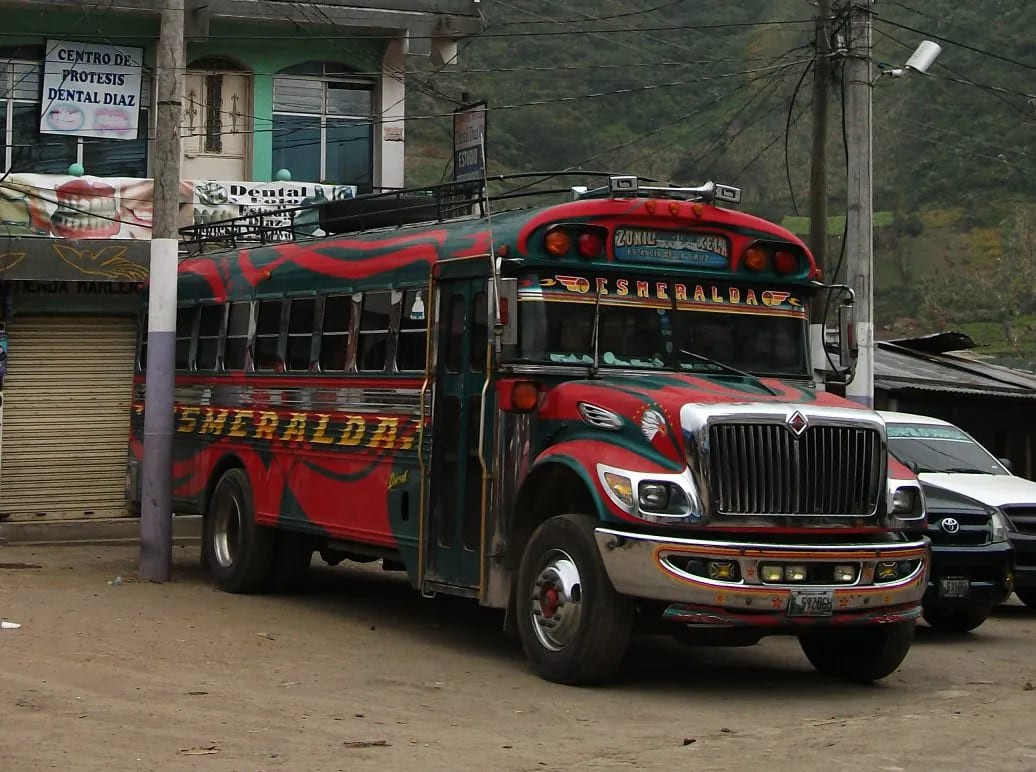
Microbus / chicken bus: Q15-Q40. No AC, no reserved seat, stops in small towns, more robbery risk.
Simple rule: Pullman if traveling with luggage, money, or at night. Chicken bus if short ride, know the route, and travel light.
To get around by road between Guatemala City and the interior, you basically have two categories of bus: the pullman (Litegua, Fuente del Norte, Pullmantur, ADN, Cristobal Colon) or the microbus / chicken bus. Price differences are large (3-5x), but so are comfort, safety, and time. This comparison tells you when each is worth it based on your route, luggage, and budget.
Quick takeaway: Pullman costs Q80-Q200 and gives you AC, reserved seat, and direct route. Microbus or chicken bus costs Q15-Q40 but is packed, no AC, stops in every village. For diaspora or tourists with luggage, pullman. For short trips or tight budget, microbus.
Side-by-Side Comparison: Pullman vs Microbus / Chicken Bus
| Feature | Pullman (Litegua, etc) | Microbus / Chicken Bus |
|---|---|---|
| Typical fare | Q80 - Q200 | Q15 - Q40 |
| Air conditioning | Yes | NO |
| Reserved seat | Yes (assigned) | NO (first come) |
| Capacity | 45-55 passengers | 25-50 (sometimes overloaded) |
| Departure frequency | 3-8 per day by route | Every 10-30 minutes |
| Intermediate stops | Few (1-3 mandatory) | Many (every village) |
| Trip time | Faster (direct) | Slower (stops) |
| Onboard bathroom | Yes (long routes) | NO |
| TV / entertainment | Yes (long routes) | NO |
| Luggage capacity | Spacious cargo hold | Limited (rooftop or inside) |
| Safety | Higher (vetted, registered) | Variable (more robbery risk) |
| Disability access | Limited but present | Almost nil |
| Payment | Ticket bought at terminal | Cash to onboard collector |
| Advance booking | Yes, recommended | No (just board and pay) |
| Wi-Fi onboard | Some premium pullmans | NO |
| Best for | Long trips, with luggage, money or at night | Short rides, no luggage, tight budget |
What is a Pullman (Premium Bus)
The pullman (sometimes called “first-class bus” or “special service”) is Guatemala’s premium interurban bus. It’s operated by formal companies with their own terminal, modern vehicles, and fixed published schedules.
Main pullman companies:
Litegua
- Routes: Guatemala City → Puerto Barrios, Rio Dulce, Chiquimula and the Atlantic Highway towns (El Estor is not on Litegua’s destination list)
- Fare: Q120-Q145 Primera Plus, Q145-Q200 Primera Clase (24 Sep 2026)
- Frequency: 12 a day to Puerto Barrios, 6 to Río Dulce (24 Sep 2026)
- Guatemala City agencies: 15 Calle 10-40, zona 1; Km 9.5 Ruta al Atlántico, zona 17; Centra Norte, Km 8.5, zona 17
- Reservations phone: 2220-7000
- See Litegua bus prices 2026
Linea Dorada — no verifiable fare in 2026
- Status: we could not verify a single published fare, timetable or terminal on 12 September 2026. lineadorada.com.gt now returns a Spanish online-casino page rather than a bus site, and Prensa Libre reported (29 November 2019) that Cristobal Colon bought the company’s Zona 1 station.
- Fare: not published. The Q120-Q200 and Q500-Q700 figures this section carried until 12 September 2026 traced to no source and have been removed.
- Use instead: for Flores/Peten, Fuente del Norte quotes live from its own booking engine (Q262.50 Clase A / Q315 Clase B on 12 September 2026); for Xela, Cristobal Colon publishes Q65 direct (guatemala.com, 6 March 2026).
Pullmantur (ADN Mobil)
- International routes: Guatemala City → San Salvador, Tegucigalpa, San Jose
- Fare: Q300-Q500 by destination country
- See Pullmantur Guatemala-El Salvador bus
Fuente del Norte (FDN)
- Routes: Guatemala City → Peten, Coban, east, Mexico
- Fare: Q70-Q150 shorter national routes; Q220-Q420 to Flores/Peten
Galgos / Transgalgos — status unverified
- Routes: unverified. Checked 12 September 2026: every candidate Galgos domain fails DNS, its Facebook page is behind a login wall, and no fare, schedule or phone number is published anywhere we could reach.
- Fare: no published fare. The 7a Avenida 19-44, Zona 1 terminal the brand is known for is today published as an Autobuses Cristobal Colon terminal (+502 2415 8989).
Others: ADN Mobil, Eastern Routes (Esquipulas), Hedman Alas (Honduras)
What is Microbus / Chicken Bus
The microbus (in urban zones, short trips) and the chicken bus (popular for long distance, repurposed school buses painted in colors) are the popular option for interurban transport.
Operating characteristics:
- No centralized company — individual operators or small cooperatives
- Pay onboard to collector — cash, no receipt
- No fixed schedule — leave when full (microbus) or based on route (chicken bus)
- Stops anywhere along the route where someone boards or exits
- Vehicle: van-type microbus (15-25 pax) or repurposed decorated school bus (“chicken bus”)
- No ticketing system — they give you small ticket or just remember verbally
Common chicken bus / microbus routes:
- Guatemala-Antigua (60-90 min, Q25 from 26 Sep 2026, Q20 before, per the Sacatepéquez extraurbano gremial as reported by Emisoras Unidas on 24 September 2026)
- Guatemala-Quetzaltenango (5-6h, Q30-Q50)
- Guatemala-Mazatenango (3-4h, Q25-Q40)
- Antigua-Panajachel via Chimaltenango (3.5-4h with 2-3 changes, Q25-Q35)
- Quetzaltenango-San Marcos (1h, Q15)
- Coban-Lanquin (no operator publishes a fare or timetable; checked 24 Sep 2026)
See chicken bus guide for history and culture.
What may they legally charge you on a chicken bus?
Almost nobody publishes this, so here it is. Extraurbano short-route fares in Guatemala are not set by the driver or the ayudante — they are regulated. The Dirección General de Transportes (DGT) sets them under Article 34 of the governing regulation, following criteria issued by the Ministerio de Comunicaciones, Infraestructura y Vivienda (CIV), and the DGT states the purpose in as many words: to avoid arbitrary charges by carriers.
The instrument is Acuerdo Ministerial No. 16-2009, issued by the CIV in January 2009, which prices a trip on cost per kilometre travelled. Article 1 sets two modes:
| Trip length | What the regulated fare is |
|---|---|
| Under 12 km | A single flat fare of Q2.00 per passenger — the same whatever the distance inside that range |
| 12 km or more | Q0.17 per kilometre. DGT’s own worked example: a 20 km trip = Q3.40 |
Two details that matter when you are arguing about change on a bus:
- The fare already includes IVA. The regulation says so explicitly — no tax may be added on top of it.
- Rounding is legal, to multiples of Q0.25. Article 2 allows it so nobody has to make change in odd fractions, so a computed Q3.40 may legitimately be charged as Q3.25 or Q3.50. It does not license rounding Q3.40 up to Q5.
Read this as the floor of the argument, not a promise. The Q2.00 / Q0.17-per-km formula is the national criterion for short extraurbano routes; individual routes also carry their own authorised tariffs, and 2026 fares quoted on this page, such as the Q25 Antigua to Guatemala City camioneta fare from 26 September 2026, sit above the formula. Since the Decreto 11-2026 fuel subsidy ended on 2 July 2026 and diesel rose sharply, fare increases have been appearing route by route — some authorised at municipal level, some simply charged. Guatemala City’s urban cap moved separately and is now indexed to the diesel price (see our Transmetro and urban fares page for the Q6.00/Q7.00 bands) — that cap is a different instrument and does not apply to extraurbano routes.
If you think you were overcharged, the DGT takes complaints directly. Its published instructions ask you to have four things ready:
- Plate number (No. de placa) of the bus
- The route where it happened
- The reason for the complaint
- Any additional comment
The complaint channel is on the DGT site under Quejas y Denuncias. Getting the plate is the part people forget — photograph it before you get off.
Sources: Dirección General de Transportes, "Así se calculan las tarifas del transporte extraurbano de rutas cortas en Guatemala" (13 April 2026), citing CIV Acuerdo Ministerial No. 16-2009, articles 1 and 2; DGT complaint requirements from dgt.gob.gt. Checked 5 August 2026. We have deliberately not published specific route fares here that we could not verify at an official source.
Comparison by Route: Pullman vs Microbus
Route 1: Guatemala City → Puerto Barrios (308 km, Atlantic)
| Service | Fare | Time | AC | Comment |
|---|---|---|---|---|
| Litegua pullman | Q120-Q200 | Not published by Litegua | Yes | Recommended |
| Chicken bus | Q25-Q40 | 7-9 hours | No | Via Estor or Morales |
| Interurban microbus | Q35-Q50 | 6-7 hours | No | Variable |
Recommendation: Litegua pullman (best ratio for long distance, safe east)
Route 2: Guatemala City → Antigua (45 km)
| Service | Fare | Time | AC | Comment |
|---|---|---|---|---|
| Chicken bus / microbus | Q25 from 26 Sep 2026 (Q20 before) | 60-90 min | No | Frequent |
| Tourist shared shuttle | USD$18 (Guatemala Transportation, GUA City/airport to Antigua, read 24 Sep 2026) | Not published | Yes | More comfortable |
| Uber | App-quoted (~Q320) | 45-60 min | Yes | Private |
Recommendation: Microbus for locals; shuttle or Uber for diaspora/tourists with luggage
Route 3: Guatemala City → Quetzaltenango (200 km)
| Service | Fare | Time | AC | Comment |
|---|---|---|---|---|
| Cristobal Colon pullman (direct) | Q65 | 4 hours | Yes | guatemala.com, 6 Mar 2026; Fuente del Norte quoted Q78.75 on its 6:30 a.m., 12 Sep 2026 |
| Chicken bus | Q30-Q50 | 5-6 hours | No | Multiple stops |
Recommendation: Pullman (4 hours vs 5-6 makes a difference)
Route 4: Guatemala City → Flores Peten (500 km)
| Service | Fare | Time | AC | Comment |
|---|---|---|---|---|
| Fuente del Norte pullman | Q262.50-Q420 | 10-11 hours | Yes | Live engine quotes 12 Sep 2026 (Clase A Q262.50, Clase B Q315; Q420 on the 9 p.m. Flores-Capital return) |
| Linea Dorada night service | No published fare (2026) | 9-10 hours | Yes | Domain now serves an online-casino page; no fare or timetable verifiable |
| Chicken bus | Q70-Q90 | 14-16 hours | No | Not recommended |
Recommendation: Pullman ALWAYS (distance + night = chicken bus bad idea)
Route 5: Quetzaltenango → San Marcos (45 km)
| Service | Fare | Time | AC | Comment |
|---|---|---|---|---|
| Chicken bus | Q15-Q20 | 60 min | No | Only practical option |
Recommendation: Chicken bus (short route, no pullman)
When Each Wins
PULLMAN wins when:
- You travel more than 100 km (comfort/price ratio improves)
- You carry large or valuable luggage (secure cargo hold)
- You travel with money, laptop, electronics (less robbery risk)
- It’s a night trip (safety)
- You travel with small children (guaranteed seat, AC)
- You’re diaspora or tourist (cultural comfort)
- You go to distant destination (Flores, Puerto Barrios) where you don’t want to arrive exhausted
- You have claustrophobia or motion sickness (assigned seat, guaranteed window)
MICROBUS / CHICKEN BUS wins when:
- Short trip (under 80 km)
- No luggage or just small backpack
- Very tight budget (Q15 vs Q120)
- You know the route and culture locally
- You’re going to a destination pullman doesn’t cover (small rural villages)
- You want authentic cultural experience (chicken bus is cultural in itself)
- Departures are very frequent (every 10-15 min vs 4-6 per day)
- You’re a local who travels frequently and knows routes and schedules
Worked Cases
Case 1: Guatemalan family visiting grandparents in Coban
Scenario: Family of 4 (dad, mom, 2 kids), leaves Friday afternoon, returns Sunday.
Recommendation: Pullman Monja Blanca Especial, the class with an onboard toilet, which matters with kids. Monja Blanca publishes no fares and no journey time (checked 24 September 2026), so ask the family price at the counter or on its WhatsApp, 46828667. Chicken bus would be cheaper but 7-8 hours with kids — not worth it. See the Guatemala City to Coban bus guide for schedules.
Case 2: Solo backpacker from Antigua to San Pedro Atitlan
Scenario: Backpacker on tight budget, going to Lake Atitlan.
Recommendation: Chicken bus Antigua → Chimaltenango (Q5) + Chimaltenango → Panajachel (Q25) + boat Panajachel → San Pedro La Laguna (fare on our Panajachel to San Pedro page; the boatmen’s Q25 published for the San Juan route does not cover the San Pedro dock). Total: Q30 in bus fares plus the boat; none of the operator pages we read gives a journey time for this combination. Vs the direct shuttle to San Pedro: USD 20-25 with Atitrans, Adrenalina Tours or Guatemala Transportation, 4 to 4.5 hours where the operator publishes a time (read 25 September 2026; see Antigua to San Pedro La Laguna). Chicken bus wins on economy.
Case 3: Diaspora with family visiting Peten
Scenario: US diaspora, family with 2 kids, going to Tikal for 5 days.
Recommendation: the Fuente del Norte 9:00 p.m. overnight Guatemala-Flores, quoted live by the operator on 12 September 2026 at Q262.50 Clase A and Q315 Clase B — a family of four is roughly Q1,050-Q1,260 one way, and they arrive in Flores rested. Chicken bus would be 14 hours with kids — nightmare. No 2026 Linea Dorada fare could be verified (checked 25 September 2026). Alternative if budget permits: the all-inclusive Tikal fly-in day tour (flight + guide + lunch + park entry) runs ~$449 USD per person; we could not verify a GUA-Flores airfare on 12 September 2026, so price the flights with the airline.
Case 4: USAC university student living in Mixco
Scenario: Daily commuter, tight budget, already knows urban routes.
Recommendation: Urban microbus Mixco-USAC (Q5-Q10 trip). No pullman alternative for daily urban use. For weekend trips to the interior, pullman if destination warrants.
Case 5: Foreign tourist with large luggage
Scenario: Two-week tourist with 70L backpack + 20kg suitcase.
Recommendation: Private tourist shuttle or pullman ALWAYS. Chicken bus with large luggage is invitation to problems (pickpocketing, stolen luggage, insufficient space).
Safety: Honest Comparison
Pullman (Litegua, Linea Dorada, etc)
- Drivers: verified commercial license, exams
- Vehicle: inspected, regular maintenance
- Passengers: registered with ticket (fingerprint in some cases)
- Onboard robberies: very rare (registered passengers, closed AC windows)
- Accidents: statistically fewer due to direct route and regulated speed
- Night risk: low
Chicken Bus / Microbus
- Drivers: variable Type C license; some don’t have it
- Vehicle: variable maintenance; many old
- Passengers: unregistered (onboard cash)
- Robberies: occur especially in packed chicken buses, frequent stops
- Accidents: more common due to over-speeding, hard braking, overloading
- Night risk: high on certain routes (South Coast, Quiche, Mexico border)
Tip: If you travel by chicken bus, carry money in two places (pocket + small bag under clothes). Don’t visibly take out your phone. Get off before villages where there’s a long stop if you’re uncomfortable.
Real Times by Route
| Route | Pullman | Chicken Bus | Difference |
|---|---|---|---|
| Guatemala-Antigua | N/A (no pullman) | 60-90 min | Chicken only |
| Guatemala-Quetzaltenango | 4 hours | 5-6 hours | 1-2 hr less |
| Guatemala-Puerto Barrios | 5-6 hours | 7-9 hours | 2-3 hr less |
| Guatemala-Flores | 9-10 hours | 14-16 hours | 5-6 hr less |
| Guatemala-Coban | 4-5 hours | 6-8 hours | 2-3 hr less |
| Antigua-Panajachel | N/A | 3.5-4 hours (2-3 changes) | Shuttle/chicken only |
Time difference comes from: fewer stops, better maintenance, more professional drivers in pullman.
How to Buy Pullman Tickets
Litegua
- At an agency: 15 Calle 10-40, zona 1, or Km 9.5 Ruta al Atlántico, zona 17, Guatemala City
- Phone: 2220-7000
- Buy day before for early morning departure
- Cash or card payment
Linea Dorada
- No terminal, phone or ticket office could be verified in 2026: lineadorada.com.gt serves an online-casino page (re-checked 25 September 2026), and the company’s Facebook page, read the same day, shows no timetable or fare. guatemala.com’s March 2026 guide to Petén buses lists only Fuente del Norte and Cristóbal Colón.
Pullmantur (ADN Mobil)
- Plaza Pradera Z10, Vista Hermosa
- Online purchase available
- International requires passport
Fuente del Norte
- Zone 1 terminal (17 calle y 9 avenida)
- Cash payment
For Diaspora
If you live in the USA and visit Guatemala:
- Pullman where one runs — the fare tables above show what the difference costs
- Litegua to Rio Dulce / Puerto Barrios — family in Atlantic coast, comfortable ride
- To Cobán or Petén: Monja Blanca to Cobán, Fuente del Norte to Flores or Cristóbal Colón to Petén; see Guatemala City to Cobán and Guatemala City to Flores and Tikal
- International Pullmantur if visiting El Salvador / Honduras from GT
- For Atitlan without pullman, recommended is shared tourist shuttle
- For short distances (Guatemala-Antigua), Uber outperforms microbus with luggage
Final Decision: Choice Matrix
| Your situation | Recommendation |
|---|---|
| 100km+ trip, with luggage | Pullman |
| Short urban trip, no luggage | Microbus |
| Diaspora visiting family | Pullman (except very short trips) |
| Tight-budget backpacker | Chicken bus if safe route, pullman if night |
| Family with small kids | Pullman ALWAYS |
| Daily-use student | Microbus / urban |
| Tourism to distant destination | Pullman + advance booking |
| Night trip | Pullman ALWAYS |
| Route without pullman (rural) | Chicken bus or microbus (only option) |
| Trip to Central America | International Pullmantur |
Related Internal Links
- Litegua Bus Prices 2026
- Pullmantur Guatemala-El Salvador Bus
- Chicken Bus Guide
- Wise vs Remitly Guatemala
- Returning to Guatemala Checklist
- Public vs Private School Guatemala
- Passport vs DPI vs Driver’s License
Analysis verified to May 14, 2026. Pullman fares per official published prices; chicken bus / microbus are observed market ranges that may vary by route, season, and operator.
Frequently Asked Questions
Which is cheaper, Litegua or chicken bus?
Chicken bus or microbus is much cheaper. For Guatemala City to Puerto Barrios: chicken bus or microbus Q25-Q40, Litegua Q120-Q200 (3-8x more expensive). The difference is justified by air conditioning, reserved seat, no stops in small towns, less robbery risk, and fewer stops. Litegua publishes no journey time for this route.
Is it safe to travel by chicken bus in Guatemala?
Statistically less safe than pullman, but most trips are incident-free. Common risks: pickpocketing on packed chicken buses, armed robberies on certain routes (especially nighttime), accidents from over-speeding. Guatemala-South Coast and Guatemala-Quiche routes have a history of more incidents. Pullman lines like Litegua have very few reported incidents.
Does Litegua have air conditioning?
Yes, Litegua buses and other standard pullmans (Fuente del Norte, Cristobal Colon, ADN Pullmantur) have air conditioning, reclining numbered seats, onboard bathrooms on long routes, and TV with movies. That’s the main reason for charging Q120-Q200 vs Q30 of the chicken bus.
Where do I buy a Litegua ticket?
Online at sistemas.litegua.com (the site has a COMPRA EN LÍNEA section and a live timetable search), or at a Litegua agency. Its agencies page (read 24 September 2026) lists three in Guatemala City: 15 Calle 10-40, zona 1 (2326-9400); Km 9.5 Ruta al Atlántico, zona 17 (2326-9500); and Centra Norte, Km 8.5 Carretera al Atlántico, zona 17. It also lists agencies in Puerto Barrios, Río Dulce, Morales, Chiquimula and other towns on its routes.
How long does the chicken bus from Guatemala City to Antigua take?
The chicken bus (microbus) Guatemala-Antigua takes 60-90 minutes depending on traffic and how many people it picks up. It costs Q25 from 26 September 2026 (Q20 before), per the fare list announced by the Sacatepéquez extraurbano gremial, reported by Emisoras Unidas on 24 September 2026. They leave very frequently (every 10-15 minutes) from central Guatemala (Terminal Zone 4 / Trebol). For tourists, shuttle service or Uber is usually recommended — takes 45-60 minutes and is more comfortable.
Which is better for tourists visiting Quetzaltenango?
Pullman, for safety and comfort. On 12 September 2026 the verifiable fares on this route were Q65 direct with Cristobal Colon (guatemala.com, 6 March 2026) and Q78.75 with Fuente del Norte on the 6:30 a.m. departure, quoted live by its own booking engine; Transportes Alamo is listed at Q90-Q120. A pullman takes 4 hours against 5-6 on a chicken bus, with a reserved seat and air conditioning. For more options see /transport/.
Where does the chicken bus depart for the interior?
Chicken buses (microbuses) for the interior depart from various terminals in Guatemala City by destination: Terminal Zone 4 (east, south coast, Antigua), Terminal CENMA Zone 12 (south coast, west), informal terminals in Zone 1 (north and east). Each departmental capital has a microbus terminal. Pullman lines like Litegua have separate terminals.
![Guatemala City to Livingston: Bus + Boat via Puerto Barrios or Río Dulce [2026]](/cdn-cgi/image/width=640,format=auto,quality=80/images/articles/og-default.webp)