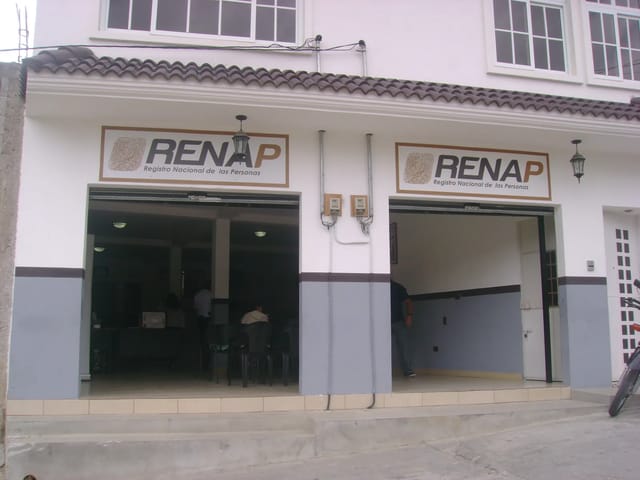
A child born in the United States to a Guatemalan mother or father is, under Article 144 of Guatemala’s Constitution, a Guatemalan of origin. Nothing has to be granted. What has to happen is paperwork: the birth must be inscribed at RENAP, Guatemala’s civil registry, before the child (or the adult the child has become) can get a Guatemalan passport or DPI. This page covers both cases: a child registered by the parents, and an adult registering themselves, which MINEX opened at consulates in February 2025.
Quick summary: Article 144 makes the children of a Guatemalan parent born abroad Guatemalans of origin, at any age. Children: the birth is reported to the Guatemalan consulate, which sends the inscription form to RENAP. Adults over 18: since 15 February 2025, per MINEX, they can do the inscription at a consulate; in Guatemala, at the Foreign Ministry’s Ventanilla 1 or four delegations (free, personal, about three months). A separate MINEX nationality resolution (listed at Q0, 3 to 6 months) followed by a RENAP inscription is the other published route. RENAP charges nothing on time and US$25 for a late inscription requested abroad.
Who qualifies
The rule, verbatim from Article 144: «Son guatemaltecos de origen, los nacidos en el territorio de la República de Guatemala, naves y aeronaves guatemaltecas y los hijos de padre o madre guatemaltecos, nacidos en el extranjero. Se exceptúan los hijos de los funcionarios diplomáticos y de quienes ejerzan cargos legalmente equiparados.» And: «A ningún guatemalteco de origen, puede privársele de su nacionalidad.»
So:
- One Guatemalan parent is enough. Article 144 says “padre o madre”.
- There is no age limit in the article. An adult born in Los Angeles in 1990 to a Guatemalan mother is in the same position as a baby born last month.
- The only exception in the article is for children of diplomats and officials in equivalent posts.
The routes, side by side
| Route | Who uses it | Where | What the official source says |
|---|---|---|---|
| Consular birth inscription | Parents of a child born abroad | The Guatemalan consulate of the country of birth | RENAP’s requirements: the notice of the birth to that consulate, and the form the Foreign Ministry’s consular service sends to RENAP |
| Adult consular inscription | People over 18 born abroad to a Guatemalan parent | Guatemalan consulates, since 15 February 2025 | Announced by MINEX (AGN, 19 February 2025) |
| Inscription at the Foreign Ministry in Guatemala | People born abroad who are in Guatemala | MINEX, Ventanilla 1 of the civil registry, or its delegations in Jutiapa, San Marcos, Huehuetenango and Quetzaltenango | «El Minex informó que este trámite es personal y gratuito y requiere un tiempo aproximado de tres meses.» (AGN) |
| MINEX nationality resolution, then RENAP | Children of Guatemalan parents; the MINEX request is filed at the Foreign Ministry’s window | MINEX, then RENAP | MINEX catalogue entry: result «Resolución de nacionalidad guatemalteca», cost Q0, «De 3 a 6 meses aproximadamente». RENAP then inscribes the person as a Guatemalan of origin on three certifications of that resolution issued within six months |
Registering a child from the US
- Contact the consulate that covers the state where the child was born. RENAP’s published requirement starts there: «Aviso del nacimiento al consulado de Guatemala del país donde haya ocurrido el mismo.» In January 2025 MINEX promoted the consular registration of US-born children as free and without an appointment («Trámite gratuito y sin cita»); ask your consulate how it schedules today. See scheduling a consulate appointment.
- Bring the documents the consulate asks for. The consular list is the one that governs; ask for it in writing. For the equivalent route at the Foreign Ministry, MINEX listed: the child’s foreign birth certificate, with a legal translation if it is not in Spanish or English; the parents’ identification (a DPI copy, or for a parent abroad a clear copy of a valid passport); and RENAP birth certificates for both parents (a foreign parent brings a legible copy of their own country’s birth certificate).
- Signatures. For that Foreign Ministry route, MINEX said: if the parents are not married, only the father’s signature is required; if they are married, either parent can sign.
- The consulate sends the form to RENAP. RENAP’s second listed requirement is the «Formulario remitido por parte del Servicio Consular del Ministerio de Relaciones Exteriores al Registro Civil de las Personas para su inscripción.»
- Afterwards, the child’s Guatemalan birth certificate can be ordered like any other: US$6 requested from abroad, Q15 in Guatemala (RENAP tariff). See Guatemalan birth certificate.
On time or late? RENAP: «Toda inscripción es gratuita si se realiza en el plazo establecido; las inscripciones fuera de los plazos, deberán pagar una tarifa de Q. 25.00, por considerarse inscripciones extemporáneas.» Abroad, the tariff’s Article 8 converts at US$1 per Q1, so a late inscription requested at a consulate is US$25. RENAP’s page does not state the deadline itself in days; ask the consulate whether yours counts as late.
Registering yourself as an adult
At a consulate in the US. MINEX announced that from 15 February 2025 children of Guatemalans born abroad who are over 18 can do the birth-inscription procedure at Guatemalan consulates (reported by the AGN on 19 February 2025). Bring the documents your consulate lists. For its own window in Guatemala, MINEX lists the parents’ RENAP birth certificates, which is the proof that your parent is registered as Guatemalan; have yours ready.
In Guatemala. If you are in Guatemala, MINEX offers the same inscription at its civil-registry window (Ventanilla 1) in Guatemala City or at its delegations in Jutiapa, San Marcos, Huehuetenango and Quetzaltenango. MINEX said it is personal, free and takes about three months. Its contact line for the civil-registry unit is 2410-0000, extensions 7001-7004, 7008-7010 and 1516 (AGN, 19 February 2025).
The nationality-resolution route. The government’s procedures catalogue lists a separate MINEX request, «Solicitud de nacionalidad guatemalteca para hijos de padres guatemaltecos», resulting in a nationality resolution: Q0, about 3 to 6 months, with the child’s recent birth certificate, the parents’ recent birth certificates and the minor’s foreign passport, presented at the Foreign Ministry’s window. The entry asks for a minor’s passport; if you are an adult, ask MINEX whether this route applies to you. RENAP then inscribes the person as a Guatemalan of origin; its requirements are three certifications of the MINEX resolution issued within the previous six months, the original and a copy of an identity document, and, for minors, the parents or legal representative.
After the inscription
| What | Detail | Where to read more |
|---|---|---|
| Guatemalan birth certificate | US$6 requested from abroad; Q15 in Guatemala | Birth certificate |
| Guatemalan passport | At a consulate, US$65 for 5 years or US$100 for 10 years (IGM’s tariff says minors can only get the 5-year passport); for minors, IGM’s requirements include the child’s current birth certificate and authorisation from the parent who is not present | Passport from the US |
| DPI | Issued by RENAP; from the US, through RENAP’s service abroad | DPI from the US |
| Land in border zones | Article 144 status matters here: under Article 123 of the Constitution, only Guatemalans of origin (or companies whose members are) may own or possess property within 15 km of the borders, except urban property and rights registered before 1 March 1956 | Constitution, Art. 123 |
| Residency for a foreign parent | Under the Migration Code (Art. 78 c) and Acuerdo IGM-016-2025 (Art. 29), foreign relatives within the legal degrees of a Guatemalan can apply for permanent residency, proving the filiation with birth certificates and meeting the other legal requirements | Residency with no waiting period |
| Voting | Registration on the electoral roll (empadronamiento) is a separate step. The TSE’s overseas-voting regulation (Acuerdo 274-2016, Art. 5, as reformed by Acuerdos 59-2026 and 242-2026) requires a valid DPI to register; a valid passport can be used only if the citizen has already registered the DPI | Voting from the US |
Before you go: a short checklist
- Which route fits: a child (consular inscription by the parents) or an adult (consular inscription since February 2025, or the Foreign Ministry in Guatemala).
- The Guatemalan parent’s proof of registration: a RENAP birth certificate or DPI.
- The US birth certificate (certified copy from the state), plus a translation if the consulate asks for one; MINEX’s list for its own window requires a legal translation only if the certificate is in a language other than Spanish or English.
- The consulate’s own written list and scheduling rules, since the consulate is the office that sends the form to RENAP.
Corrected and expanded on 24 September 2026: an earlier version of this page gave processing times, US-side cost ranges, apostille and translation requirements and consular practices that no official source cited here supports, and said the Article 123 restriction covers coastal zones (it covers the 15 km border strip). Those statements were removed or corrected. Sources, read on 24 September 2026 unless stated: Constitución Política, Arts. 123 and 144 (IDPP copy, read 23 September 2026); RENAP service pages for the consular birth inscription and the inscription of a Guatemalan of origin; RENAP services page note on free and late inscriptions and the RENAP tariff, Acuerdo de Directorio 15-2020, Art. 8 (read 23 September 2026); Agencia Guatemalteca de Noticias, 19 February 2025, reporting MINEX’s announcements and quoting its posts of 28 January and 17 February 2025; government procedures catalogue, service 2780; IGM passport portal; 22 CFR 53.1; Código de Migración Art. 78 and Acuerdo IGM-016-2025 Art. 29 (residency row; read 16 September 2026); TSE, Reglamento de Voto en el Extranjero, Acuerdo 274-2016, Art. 5 as reformed by Acuerdos 59-2026 and 242-2026 (voting row; read 30 September 2026). Re-checked 10 October 2026, when the service 2780 passport requirement was narrowed to the minor’s foreign passport, as the entry states.
Affiliate links — we earn a small commission if you buy, at no extra cost to you. We only recommend services we'd suggest to our own family.
Related pages
- Guatemalan birth certificate, and whether it expires
- Guatemalan birth certificate with apostille, from the US
- Registering a birth abroad
- Acknowledging a child in Guatemala from the USA: when the birth is already registered and a parent acknowledges the child later, by proxy or by public deed
- Dual citizenship Guatemala-USA
- Guatemalan passport from the US
- All Guatemalan consulates in the US
Frequently Asked Questions
Is my US-born child a Guatemalan citizen?
Under Article 144 of Guatemala’s Constitution, the children of a Guatemalan father or mother born abroad are Guatemalans of origin (the exception is children of diplomats and equivalent officials). The same article says no Guatemalan of origin can be deprived of that nationality. To use it, for a Guatemalan passport or a DPI, the birth has to be inscribed at RENAP.
I am an adult born in the US to a Guatemalan parent. Can I still register?
Yes. Article 144 has no age limit. According to MINEX, as reported by the Agencia Guatemalteca de Noticias on 19 February 2025, since 15 February 2025 children of Guatemalans born abroad who are over 18 can do the birth inscription at Guatemalan consulates. Adults who are in Guatemala can do it at the Foreign Ministry’s civil-registry window (Ventanilla 1) or at its delegations in Jutiapa, San Marcos, Huehuetenango and Quetzaltenango; MINEX said that procedure is personal, free and takes about three months.
How much does it cost?
RENAP states that every inscription is free when made within the legal time limit, and a late (extemporanea) one pays Q25. For requests made abroad, RENAP’s tariff (Acuerdo de Directorio 15-2020, Art. 8) charges US$1 for each quetzal, so US$25. MINEX’s nationality resolution for children of Guatemalan parents is listed at Q0 in the government’s procedures catalogue. None of those fees covers US-side documents such as a certified copy of the US birth certificate.
What documents are needed?
RENAP’s requirement for a consular birth inscription is the notice of the birth to the Guatemalan consulate of the country where it happened, plus the form the Foreign Ministry’s consular service sends to RENAP. For the route at the Foreign Ministry in Guatemala, MINEX listed the foreign birth certificate (with a legal translation if it is not in Spanish or English), the parents’ identification, and RENAP birth certificates of both parents. Ask your consulate for its list before the appointment.
Do both parents have to sign?
For the route at the Foreign Ministry, MINEX said that if the parents are not married only the father’s signature is required, and if they are married either parent can sign. The RENAP and MINEX texts cited on this page give no separate signature rule for consulates; ask yours.
Does it matter what US immigration status the Guatemalan parent has?
The requirements cited on this page (RENAP’s consular-inscription page, MINEX’s list as reported by AGN, and service 2780 on tramites.gob.gt) ask for Guatemalan documents and the child’s birth certificate; none of them asks for a US immigration document.
Does registering in Guatemala affect my child's US citizenship?
Guatemalan registration records a nationality the child already has under Article 144. How the US treats dual nationality is a US-law question; the State Department’s dual-nationality guidance is the place to check. A US citizen must use a US passport to enter and leave the United States (22 CFR 53.1), whatever other passport they hold.
💸 Sending money back to Guatemala?
Today the banks we track sell dollars at 1.4-2.5% over the Banguat rate. Wise and Remitly send at the real mid-market rate with a flat fee — and because they're funded from your US bank account or card, they're exempt from the new 2026 federal remittance tax (which does hit cash-based transfers).