
When my EEGSA bill hit Q2,000 ($258 USD) one month, I decided I was done giving the electric company my money. Five months later, I’m paying Q66/month ($8.50 USD) — a 96% drop from my typical Q1,600 (~$206 USD) bills.
Here’s exactly what I bought, what it cost, and what the data shows after 5 months of solar in Antigua Guatemala.
This isn’t a sponsored post or a solar company pitch. I paid for everything myself, imported used parts from eBay, and I’m sharing the actual numbers — receipts, EEGSA bills, and live monitoring data included.
TL;DR: A 9.92 kW solar system in Antigua cost under $11,000 and cut my EEGSA bill from Q1,605/month ($207) to Q66/month ($8.50) – a 96% reduction. Payback period: 4.6 years. The battery is critical because EEGSA charges 5x more per kWh than what export credits are worth.
Currency note: All prices shown in both Guatemalan Quetzales (Q) and US Dollars. USD conversions at ~Q7.75/$1 (Feb 2026 rate). Check the current exchange rate for today’s rate.
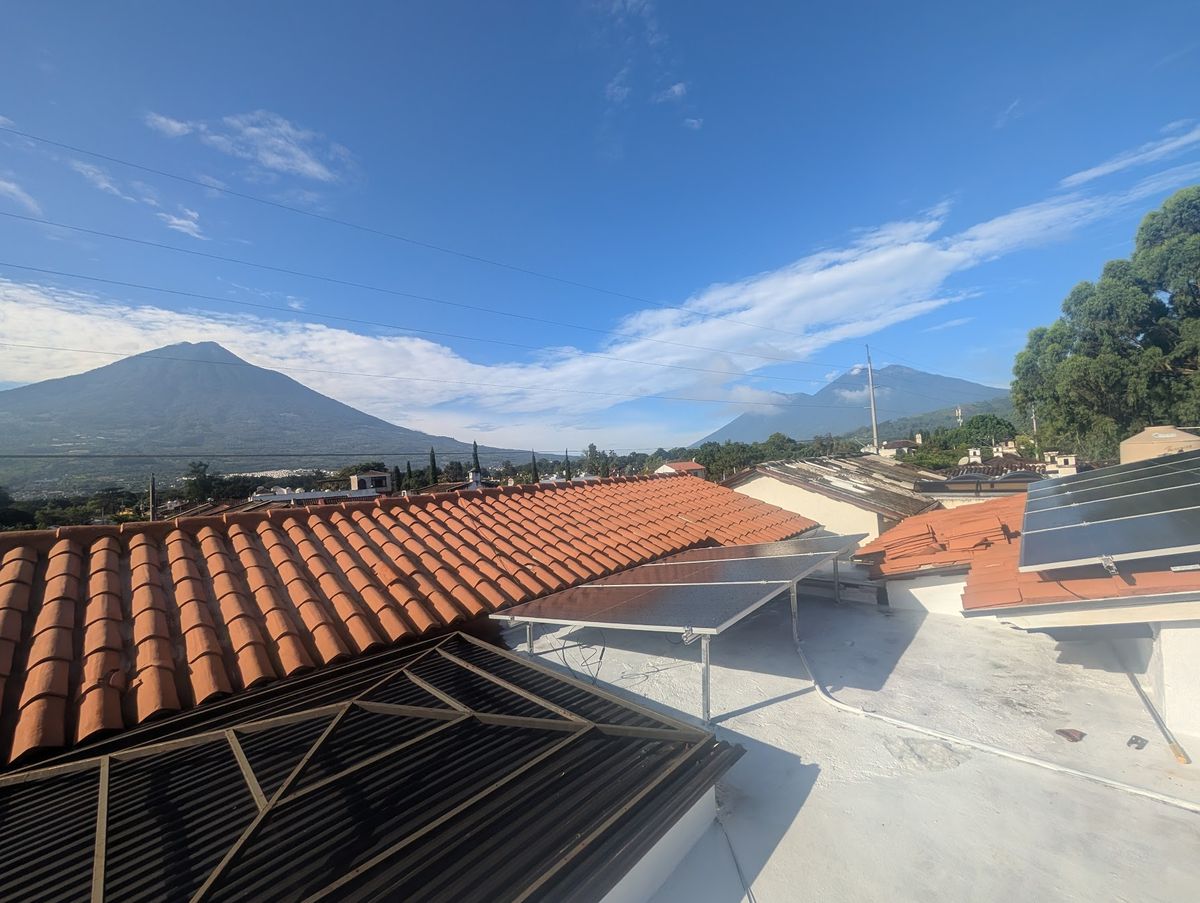
My 9.92 kW solar array in Antigua Guatemala — 16 bifacial panels with Volcán de Agua in the background.
The System: What I Bought
My setup is a 9.92 kW hybrid solar system with battery storage and panel-level optimization:
| Component | Spec | Qty |
|---|---|---|
| Solar Panels | JA Solar Bifacial 620W (JAM66D45-620/LB) | 16 |
| Inverter | Luxpowertek LXP-LBUS-12K Hybrid (12 kW) | 1 |
| Battery | Luxpowertek POWERGEM PRO 14.3 kWh Lithium | 1 |
| Optimizers | Tigo TS4-A-O (panel-level optimization) | 16 |
| Gateway | Tigo CCA Kit (monitoring + data) | 1 |
Total rated capacity: 9.92 kW (16 panels × 620W)
Why this setup:
- The Luxpowertek hybrid inverter handles both solar and battery in one unit — no separate charge controller needed. It has 3 MPPT inputs, which means it can handle panels at different angles.
- The 14.3 kWh battery keeps the house running through Guatemala’s afternoon rain storms and evening peak hours. On a normal day, I don’t touch the grid after sunset.
- The Tigo optimizers were a later add-on (more on why below). They let each panel produce independently, so one shaded panel doesn’t drag down the whole string.
16 JA Solar 620W bifacial panels on my rooftop — each with a Tigo TS4-A-O optimizer underneath.
The Total Cost: Under $11,000
Union Solar Installation (September 8, 2025)
The core system was installed by Union Solar Guatemala, a local installer based in Guatemala City.
| Item | Cost (Q) | Cost (USD) |
|---|---|---|
| 16× JA Solar 620W Bifacial Panels | Q31,104 | $4,013 |
| Luxpowertek LXP-LBUS-12K Hybrid Inverter | Q24,499 | $3,161 |
| Luxpowertek POWERGEM PRO 14.3 kWh Battery | Q15,980 | $2,062 |
| Mounting structure, cabling, protections | Q2,780 | $359 |
| Installation + commissioning | Q1,000 | $129 |
| Subtotal | Q75,363 | $9,724 |
Tigo Optimizers (October 2025, Imported from USA)
I added Tigo optimizers a month after installation. Bought used/refurbished from eBay sellers in the US and shipped them via Aeropost to Guatemala.
Why buy used on eBay? New Tigo TS4-A-O optimizers retail for $50+ each. I negotiated 16 units for $560 total ($35 each) — 30% savings. They work perfectly.
Shipment 1: CCA Gateway Kit (arrived Oct 10, 2025)
| Item | Cost (Q) | Cost (USD) |
|---|---|---|
| eBay purchase (seller: john_renstrom) | Q1,878 | $242.36 |
| Aeropost shipping (flete) | Q159.54 | $20.59 |
| Customs handling (manejo aduanal) | Q51.74 | $6.68 |
| Guarantee/return fee | Q43.03 | $5.55 |
| Delivery | Q47.43 | $6.12 |
| IVA (government import tax) | Q216.99 | $28.00 |
| Aeropost total | Q518.73 | $66.93 |
Shipment 2: 16× TS4-A-O Optimizers (arrived Oct 12, 2025)
| Item | Cost (Q) | Cost (USD) |
|---|---|---|
| eBay purchase (seller: player1111, negotiated) | Q4,340 | $560.00 |
| Aeropost shipping (flete) | Q728.18 | $93.96 |
| Customs handling (manejo aduanal) | Q102.68 | $13.25 |
| Guarantee/return fee | Q81.20 | $10.48 |
| Delivery | Q47.06 | $6.07 |
| IVA (government import tax) | Q544.24 | $70.23 |
| Aeropost total | Q1,503.36 | $194.00 |
Important: Solar equipment gets 0% arancel (import duty) in Guatemala. You still pay IVA (12% tax), but no import tariff. This is a significant benefit that isn’t well-known.
Complete System Cost
| Component | Cost (Q) | Cost (USD) |
|---|---|---|
| Union Solar installation | Q75,363 | $9,724 |
| Tigo optimizers + CCA (eBay + Aeropost) | Q8,240 | $1,063 |
| TOTAL | Q83,603 | ~$10,787 |
Under $11,000 for a system that produces 45-56 kWh per day. In the US, this would cost $20,000-30,000.
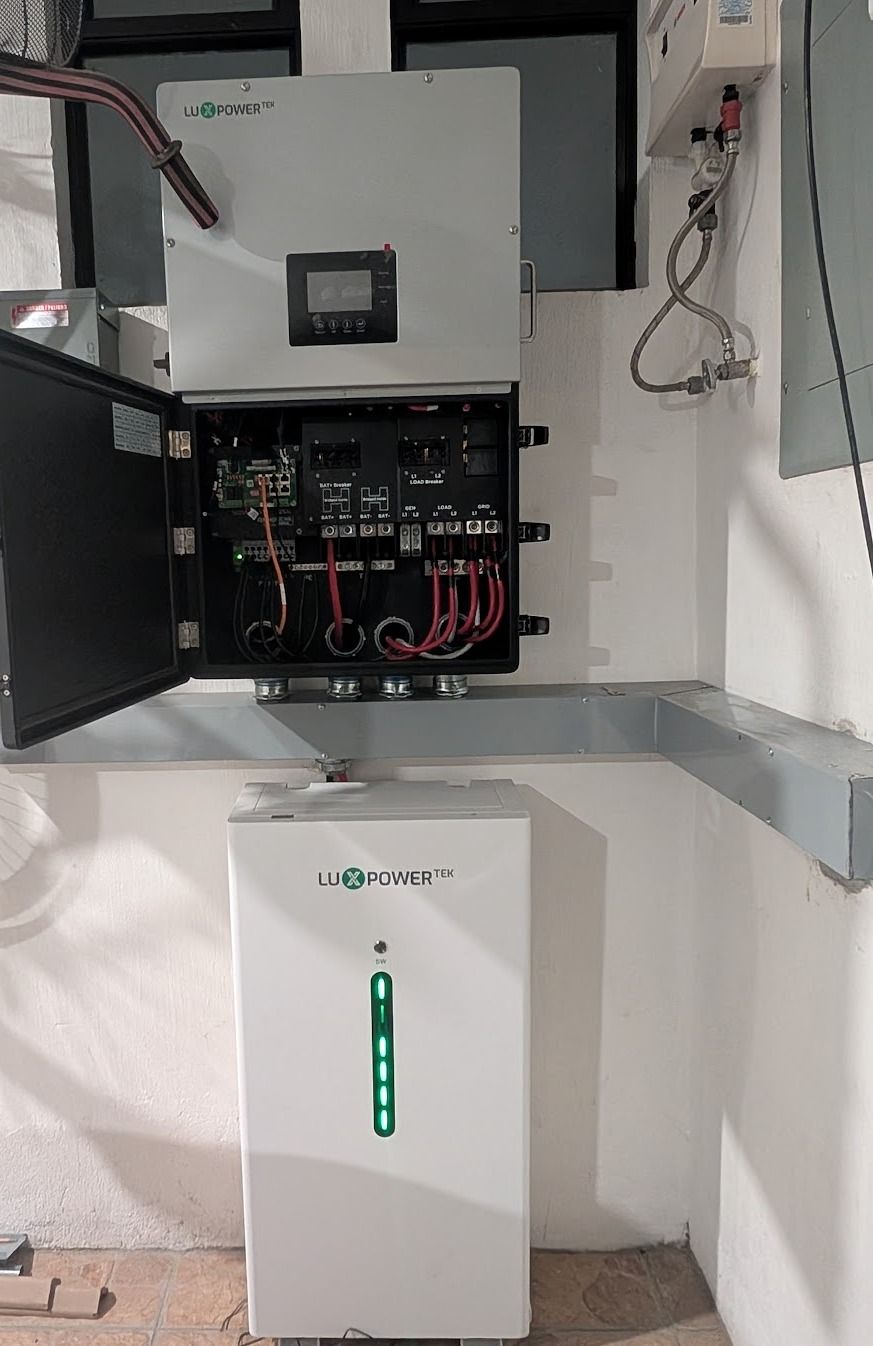
The brains of the operation: Luxpowertek 12kW hybrid inverter (top, with wiring panel open) and the 14.3 kWh POWERGEM PRO battery (bottom, green LEDs showing charge level).
The Bills: Before vs After
This is the part everyone wants to see. Here are my real EEGSA bills.
Before Solar (September 2025)
My last bill before solar was on the standard BTS (Baja Tension Simple) residential tariff:
- Consumption: 837 kWh
- Rate: Q1.509/kWh ($0.19/kWh) + fixed charges + 14% municipal tax
- Total bill: Q1,605.57 ($207 USD)
That’s a typical bill for a Guatemalan household running AC, multiple computers (I work from home), and normal appliances. Electricity is one of the larger expenses in your cost of living.
After Solar: 4 Months of Real Bills
Once EEGSA processed my autoproductor (self-producer) application and swapped my meter for a bidirectional one, my tariff changed to BTSA (Baja Tension Simple Autoproductor) — Guatemala’s net metering program.
| Month | Grid Used | Exported | Net | Bill (Q) | Bill (USD) | Savings | Credit Banked |
|---|---|---|---|---|---|---|---|
| Before (Sep) | 837 kWh | — | 837 kWh | Q1,605 | $207 | — | — |
| Nov 2025 | 244 kWh | 447 kWh | -203 kWh | Q109 | $14 | 93% | 203 kWh |
| Dec 2025 | 359 kWh | 271 kWh | +88 kWh | Q153 | $20 | 90% | 115 kWh |
| Jan 2026 | 177 kWh | 524 kWh | -347 kWh | Q84 | $11 | 95% | 462 kWh |
| Feb 2026 | 129 kWh | 514 kWh | -385 kWh | Q66 | $8.50 | 96% | 847 kWh |
Average monthly bill with solar: Q103 ($13 USD) vs Q1,605 ($207 USD) before
Average monthly savings: Q1,502 ($194 USD/month)
December was my worst month — more cloud cover, shorter days, and the rainy season tail end pushed grid consumption higher. Even so, I still saved 90%.
By February, I was exporting almost 4× more than I consumed from the grid (514 kWh exported vs 129 kWh used). My banked credit hit 847 kWh. That’s intentional — if you’re planning to add new appliances or expect higher consumption in the future, banking credits now means no bill surprise later.
How Net Metering Works in Guatemala
Guatemala’s net metering is called Generacion Distribuida Renovable (GDR). Here’s how it works in practice:
Your meter tracks two numbers:
- Entregada (Delivered) — electricity you pull from the grid
- Recibida (Received) — electricity you push back to the grid
If you export more than you consume, the excess becomes credit kWh that rolls forward to future months. In my case, I’ve banked 847 kWh of credit — that’s essentially free electricity waiting for me. If you’re thinking about future additions like a pool heater, EV charger, or running heavy appliances seasonally, oversizing your system now and banking credits is a smart strategy.
What you still pay (even with net metering):
- Cargo fijo (fixed charge): Q13.23/month ($1.71 USD) — everyone pays this, no exceptions
- Cargo por distribucion: Q0.247/kWh ($0.032/kWh) based on grid electricity consumed (not net)
- Cargo por potencia: Q0.054/kWh ($0.007/kWh) based on grid electricity consumed
- Tasa Municipal: 14% on top of everything
What you DON’T pay:
- Energia neta: Q0 — as long as your net balance is zero or negative
This means the absolute minimum monthly bill is around Q15-20 even if you use zero grid electricity. The distribution and potencia charges are based on how much you pull from the grid (entregada), so reducing nighttime consumption directly reduces your bill.
How to apply: Contact EEGSA (or your local distributor — DEOCSA/DEORSA outside Guatemala City metro). They inspect your system, swap your meter for a bidirectional one, and reclassify your tariff to BTSA. The process took about 6 weeks for me.
Why the Battery Matters More Than You Think
This is the part most solar articles skip: in Guatemala, grid electricity and export credits are NOT valued equally. The math makes batteries critical.
The rate asymmetry:
- EEGSA charges you ~Q1.20/kWh ($0.15 USD) when you pull electricity from the grid
- But when you export solar back to the grid, your credit is only worth ~Q0.25/kWh ($0.032 USD) — the distribution charge
That’s roughly a 5:1 ratio. For every kWh you export during the day and buy back at night, you lose ~Q0.95 ($0.12 USD). Over a month, that adds up fast.
What the battery does: Instead of exporting cheap and buying back expensive, the battery stores your daytime solar and powers your house at night. Every kWh the battery covers is a kWh you didn’t buy back from EEGSA at Q1.20.
My battery’s impact (estimated from bill data):
| Scenario | Nighttime Source | Monthly Grid Cost | Monthly Bill |
|---|---|---|---|
| With 14.3 kWh battery (actual) | Battery covers most of the night | ~129-244 kWh from grid | Q66-153 ($8.50-$20) |
| Without battery (estimated) | All nighttime = grid purchase | ~400-500 kWh from grid | Q350-500 ($45-$65) |
Without the battery, I’d still save money from net metering credits — but my bills would be 4-5× higher because I’d be buying back nighttime electricity at the full Q1.20/kWh rate instead of using stored solar.
Battery ROI calculation:
My battery cost Q15,980 ($2,062 USD). The estimated monthly savings from the battery alone (vs exporting and buying back) is roughly Q250-350/month ($32-$45 USD). That puts the battery payback at about 4-5 years — right in line with the rest of the system.
Beyond the savings:
- Blackout protection. Guatemala has frequent power outages, especially during afternoon storms. My neighbors lose power; I don’t notice. The 14.3 kWh battery runs my house for 6-8 hours with normal use.
- Rate protection. If EEGSA raises rates (they have historically), your stored solar becomes worth even more.
- Net metering isn’t guaranteed forever. Other countries have reduced or eliminated net metering programs. The battery makes you less dependent on the export credit system staying favorable.
Bottom line: If you’re going solar in Guatemala, don’t skip the battery to save money upfront. The rate asymmetry between what EEGSA charges you and what your exports are worth means a battery pays for itself — and protects you from outages and future rate changes.
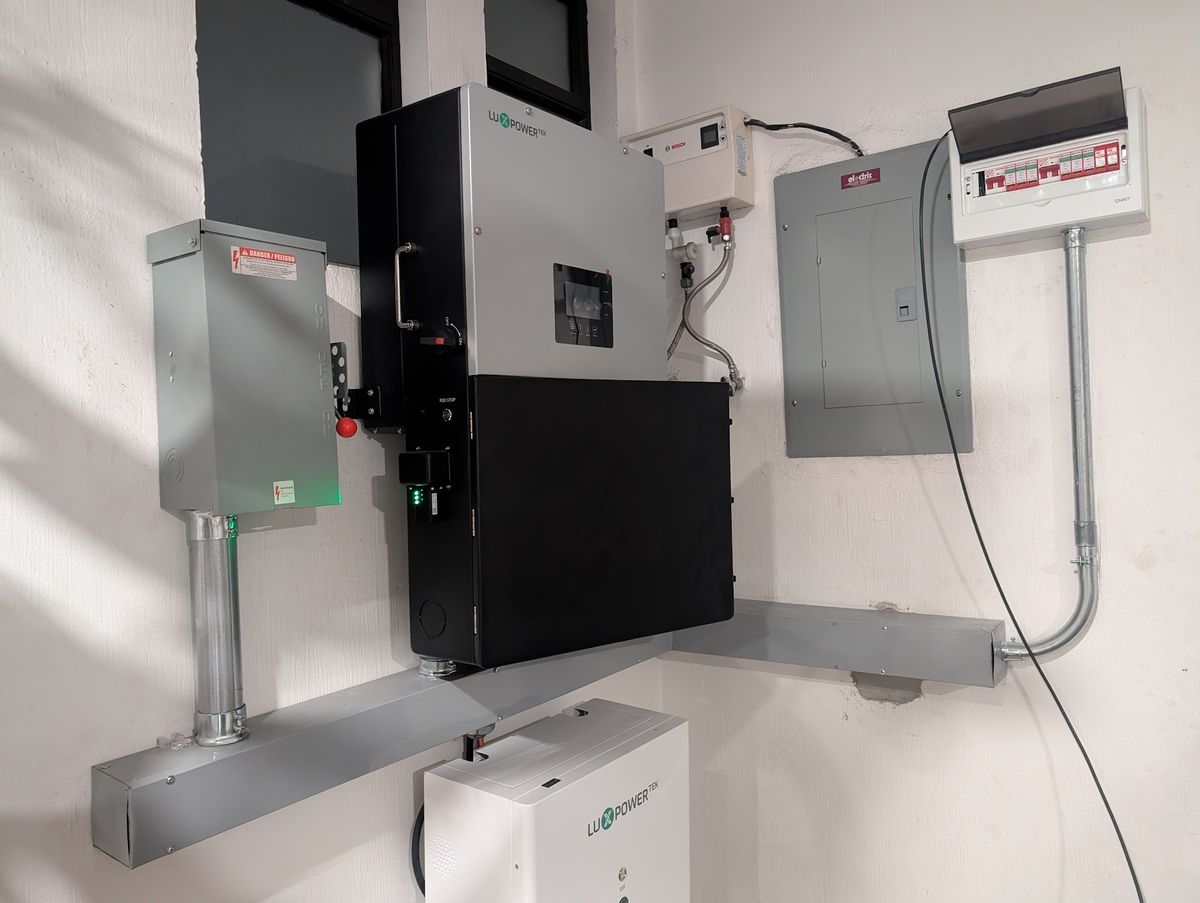
The Luxpowertek inverter and POWERGEM PRO battery mounted on the wall with breaker panels. The green LEDs on the battery indicate charge level — four bars means fully charged.
Solar Production: 5 Months of Data
I monitor my system through two platforms:
- Luxpowertek Cloud — inverter-level data (total production, battery state, grid flow)
- Tigo EI — panel-level data (individual optimizer output, reclaimed energy)
Monthly Production (from Tigo monitoring)
| Month | Production (kWh) | Days | Avg/Day | Best Day |
|---|---|---|---|---|
| Oct 2025 (partial) | 486 kWh | 11 | 44.2 kWh | 56.0 kWh |
| Nov 2025 | 1,195 kWh | 30 | 39.8 kWh | 56.2 kWh |
| Dec 2025 | 1,152 kWh | 31 | 37.2 kWh | 55.3 kWh |
| Jan 2026 | 1,520 kWh | 31 | 49.0 kWh | 57.5 kWh |
| Feb 2026 | 1,289 kWh | 23* | 56.0 kWh | 59.6 kWh |
| Total | 5,642 kWh | 126 | 44.8 kWh |
*Feb data through Feb 23 (month still in progress)
Key observations:
- Best month: January — dry season, clear skies, long days. Nearly 1,520 kWh.
- Worst month: December — rainy season tail end, more overcast days. Still 1,152 kWh.
- Daily range: 37-56 kWh/day average, with peaks touching 59.6 kWh
- February is trending strongest — averaging 56 kWh/day as dry season continues
Tigo vs Luxpowertek: The Numbers Comparison
Both platforms report lifetime production, but they disagree slightly:
| Platform | Lifetime Total | Measures |
|---|---|---|
| Tigo | 5,757 kWh (5.76 MWh) | DC power at each optimizer |
| Luxpowertek | 6,181 kWh (6.18 MWh) | PV input at inverter MPPT |
The ~424 kWh gap is because Luxpowertek has been tracking since the system was installed (September 8), while Tigo monitoring didn’t start until October 21. That’s ~43 days of solar production that only Luxpower captured.
The numbers from both platforms are consistent for the periods they overlap — within 2% of each other.
Are Tigo Optimizers Worth It?
This is a question I couldn’t find answered anywhere online when I was buying mine. So here’s my real data.
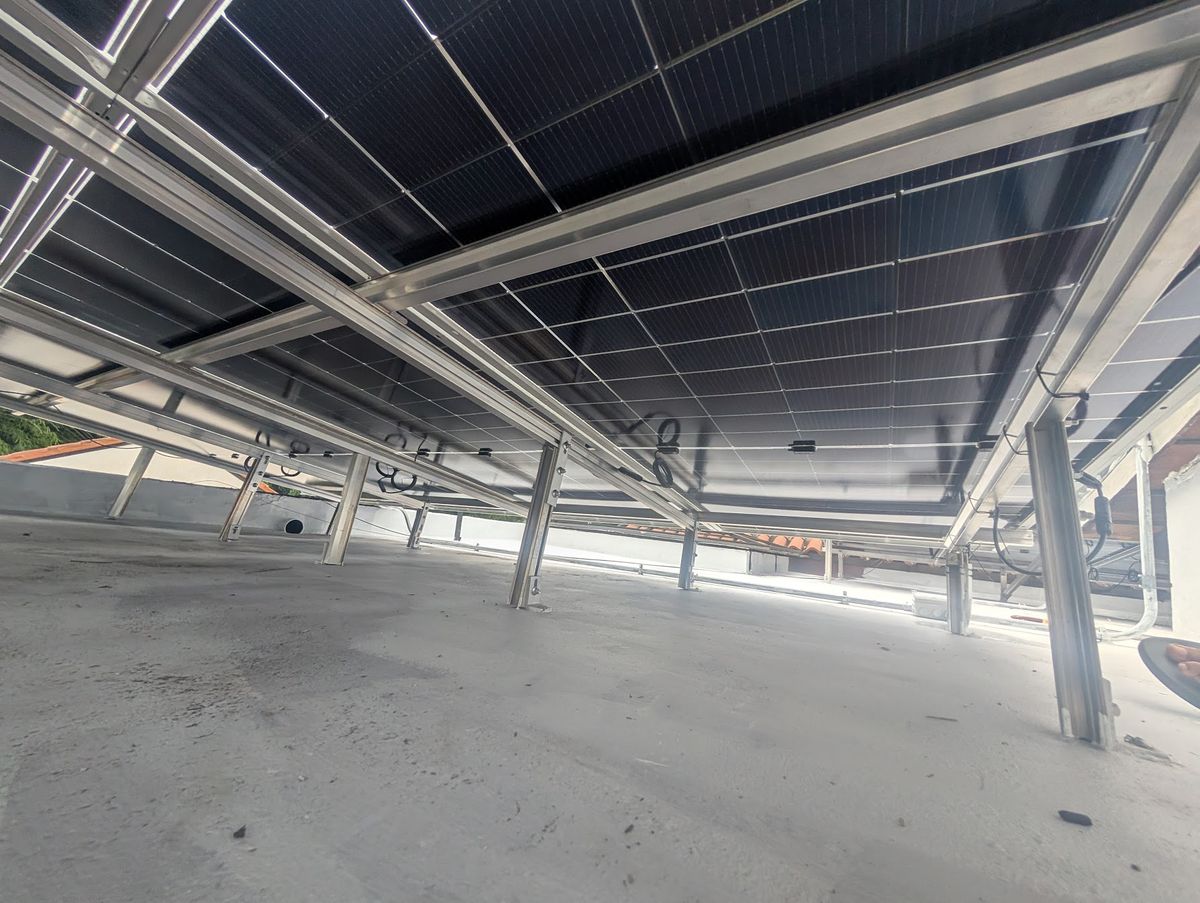
Under the panels before installing Tigo optimizers — you can see the aluminum racking, junction boxes, and panel wiring. Each optimizer clips onto the panel’s DC output.
The Honest Question: Do You Even Need Optimizers?
Before I show the Tigo data, let me be transparent about something. My JA Solar JAM66D45-620/LB panels already have 3 bypass diodes built in — standard on all modern panels. These diodes already handle partial shading at a cell-string level. If one third of a panel is shaded, the bypass diode kicks in and the other two thirds keep producing.
So the question isn’t “Do optimizers help with shading?” — it’s “How much extra do they add on top of what bypass diodes already handle?”
Tigo optimizers add three things beyond bypass diodes:
- Per-panel MPPT — each panel finds its own optimal power point independently
- String-level isolation — a weak panel doesn’t drag down other panels on the same string
- Panel-level monitoring — you see exactly which panels underperform and why
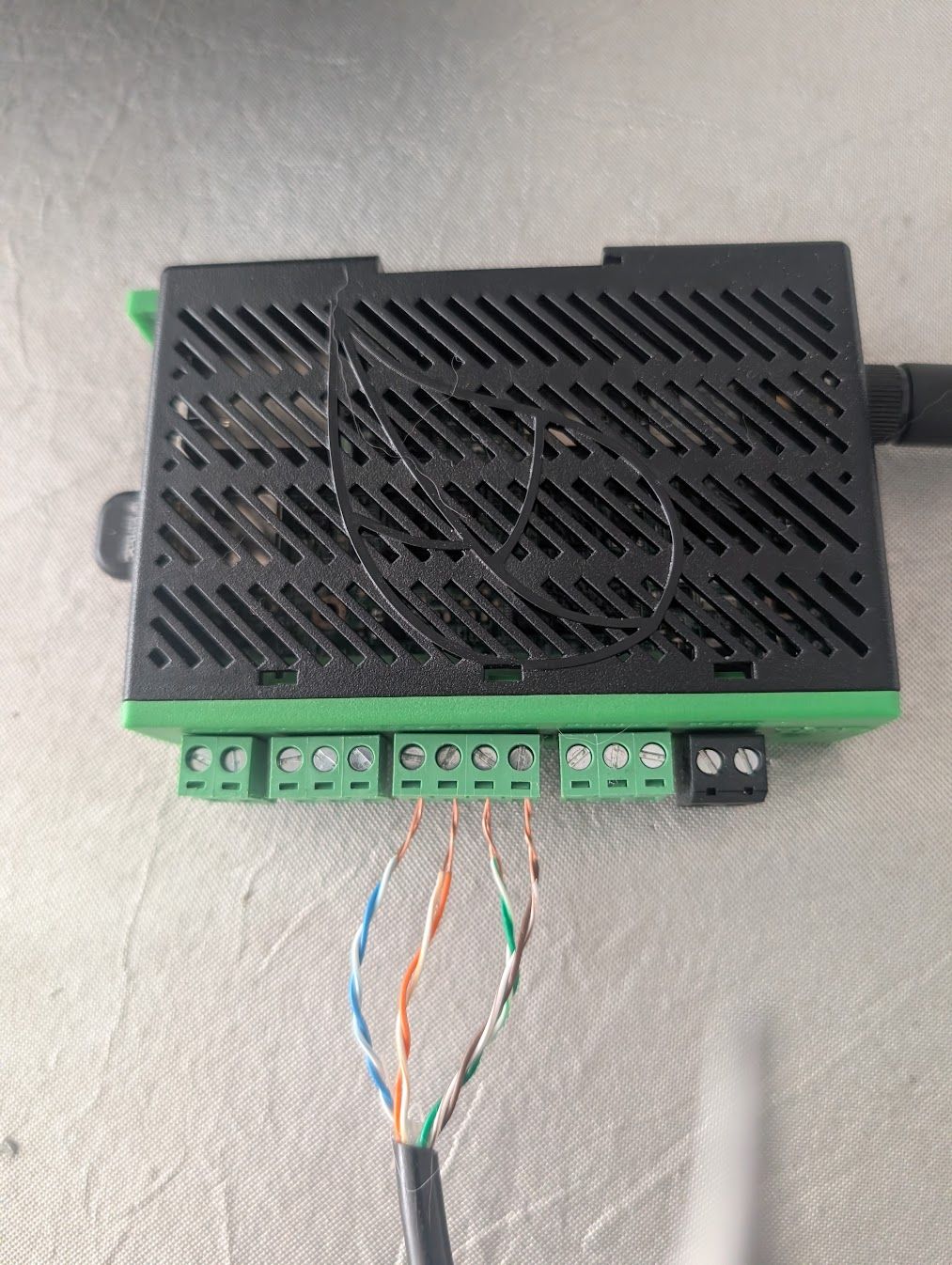
The Tigo CCA gateway that connects all 16 optimizers to the cloud. It uses a simple Ethernet cable (Cat5) to communicate with the optimizer network on the roof.
That third point turned out to be the most valuable thing for me. More on that below.
What Tigo Says It Recovered
Tigo’s monitoring shows “Reclaimed Energy” — the algorithm’s estimate of power that would have been lost without optimization. Important caveat: this is Tigo’s own calculation. There’s no way to A/B test it without removing the optimizers and comparing. Take the exact percentage with a grain of salt.
| Metric | Value |
|---|---|
| Lifetime Reclaimed Energy | 621.69 kWh |
| Reclaimed as % of Total | 10.8% |
| Today’s Reclaimed (Feb 25) | 4.80 kWh (8.6%) |
| Tigo “Income Equivalent” | $1,324.19 |
10.8% reclaimed means my 16 panels are producing like ~17.7 panels would without optimizers. That’s a meaningful gain.
Why Reclaimed Energy Matters: The Shading Problem
Without panel-level optimizers, solar panels wired in a string are limited by the weakest panel — like a chain being only as strong as its weakest link. If one panel is shaded 50%, the entire string drops ~50%.
With Tigo TS4-A-O optimizers, each panel has its own DC-DC converter. A shaded panel only affects itself.
Here’s what my system looks like at 4:30 PM when afternoon shade hits:
String B (no shade): All 8 panels producing 161-171W each — perfectly uniform.
String A (partial afternoon shade):
| Panel | Power | Impact |
|---|---|---|
| A1 | 29W | -82% (heavy shade) |
| A2 | 49W | -71% (heavy shade) |
| A5 | 30W | -82% (heavy shade) |
| A6 | 69W | -60% (partial shade) |
| A7 | 135W | -20% (approaching shade) |
| A3, A4, A8 | 152-154W | Full output |
Without Tigo, those 4 shaded panels (A1, A2, A5, A6) would drag String A’s output from ~1,000W down to ~250W. That’s 750W lost across 8 panels every afternoon.
With Tigo, only the actually shaded panels lose output. The unshaded panels on String A keep producing at full capacity. Over 5 months, that adds up to 621 kWh recovered — which at Guatemala’s electricity rate is ~Q940 ($121 USD) in saved energy.
Tigo Optimizer ROI
| Metric | Value |
|---|---|
| Total Tigo investment | Q8,240 / $1,063 USD |
| Energy reclaimed (5 months) | 621.69 kWh |
| Value of reclaimed energy | ~Q940 / $121 USD |
| Monthly reclaim rate | ~124 kWh (~Q187 / $24 USD) |
| Estimated payback | ~8-9 months |
If the reclaimed energy rate holds, the Tigo optimizers pay for themselves in under a year — entirely from recovered production that would otherwise be lost.
Tigo’s data confirmed that A1 and A5 — the two panels closest to my raised roof section — consistently underperform by 14-32%. They’re the first to catch afternoon shade as the sun moves west. Without panel-level monitoring, I’d just see lower total output and have no idea which panels were the problem or why.
Per-Panel Performance (Lifetime)
The Tigo data reveals that my 16 panels aren’t all equal:
- Top 3 performers (B3, B4, B1): ~380 kWh each — consistently full sun
- Average panels (10 panels): 350-375 kWh — slight variation is normal
- Underperformers (both sit next to my raised roof section — first to catch afternoon shade):
- A5: 304 kWh (-14% below average)
- A1: 240 kWh (-32% below average)
This is the kind of data you simply cannot get without panel-level monitoring. It’s one of the strongest arguments for adding optimizers, especially if your roof has any shading.
ROI and Payback Analysis
The Math
| Metric | Value |
|---|---|
| Total investment | Q83,603 / $10,787 USD |
| Average monthly savings | Q1,502 / $194 USD |
| Payback period | 55.7 months (~4.6 years) |
| Annual return | ~21.6% |
| 25-year value of savings | ~Q450,000 / $58,000 USD |
| Return on investment | 5.4× your money |
For context, a 4.6-year payback with 21.6% annual returns is significantly better than most investments. If you are working remotely from Guatemala as a digital nomad, reliable power is essential, and solar delivers that. The panels are warrantied for 25 years and typically last 30+. The inverter warranty is 10 years, battery is 10 years.
Conservative Scenario
Even assuming:
- 10% degradation over 25 years (panels lose efficiency slowly)
- One inverter replacement at year 12 (~Q25,000 / $3,226 USD)
- One battery replacement at year 12 (~Q16,000 / $2,065 USD)
- Electricity prices stay flat (they’ve actually been rising)
Total cost over 25 years: Q83,603 + Q41,000 = Q124,603 ($16,078 USD) Total savings over 25 years: ~Q405,000 ($52,258 USD) Net benefit: Q280,000 ($36,129 USD)
If electricity prices rise even 3% annually (which they have historically), the returns are even better.
What I’d Do Differently
After 5 months, here’s what I’ve learned:
-
I’d install Tigo optimizers from day one. I added them a month later, which meant a second round of rooftop work. If your installer can include them during initial installation, do it. The data alone is worth it.
-
Size your system for future consumption, not just current. I’m exporting way more than I consume right now — and that’s by design. Think ahead: new appliances, seasonal changes, maybe an EV charger down the road. Banked credits absorb future load increases without a bill spike. That said, if you don’t plan to increase consumption, matching production to current usage is optimal for pure ROI — remember, there’s no cash payment for excess credit in Guatemala.
-
The EEGSA autoproductor application takes time. Plan for 4-6 weeks between installation and meter swap. During that period, your system works but you’re not getting net metering credit.
-
Used Tigo optimizers from eBay work perfectly. I saved 30% buying refurbished units. Just make sure you’re buying the right model for your panel specs (TS4-A-O for the power range I needed).
-
Aeropost works for solar equipment imports. The 0% import duty on solar equipment is a real benefit. You’ll still pay IVA (12%) and Aeropost handling fees, but it’s still cheaper than buying locally in Guatemala where stock is limited and prices are higher. Read our detailed Aeropost solar import guide for step-by-step instructions, and our shipping to Guatemala guide for general courier tips.
-
Get a hybrid inverter with battery — it’s not optional. Beyond blackout protection, the battery saves real money because of EEGSA’s rate asymmetry (you pay ~Q1.20/kWh but export credits are only worth ~Q0.25/kWh). Every kWh you store and use at night instead of buying back from the grid saves you ~Q0.95. See the battery section above for the full math.
Frequently Asked Questions
How much does solar installation cost in Guatemala?
For a residential system with battery storage, expect Q50,000-100,000 ($6,500-$13,000 USD) depending on size. My 9.92 kW system with 14.3 kWh battery cost Q75,363 ($9,724 USD) from Union Solar, plus Q8,240 ($1,063 USD) for Tigo optimizers I imported separately.
Does net metering work in Guatemala?
Yes. EEGSA and the other distributors (DEOCSA, DEORSA) support net metering under the GDR program. You export excess electricity to the grid and receive kWh credit on future bills. There’s no cash payment for excess — it’s credit only.
How long is the payback period?
With my system producing ~1,300 kWh/month and saving ~Q1,500/month ($194 USD), the payback is about 4.6 years. Smaller systems without battery may pay back in 3-4 years. Your actual payback depends on your current electricity consumption and local solar conditions.
What happens during rainy season?
Guatemala’s rainy season (May-October) reduces solar production due to cloud cover, especially in the afternoons. My December data (worst month so far) still produced 1,152 kWh — enough to cover my needs with some grid supplementation. The kWh credit I’m banking during dry season (currently 847 kWh) will help offset reduced production during rainy months.
Can I install solar myself in Guatemala?
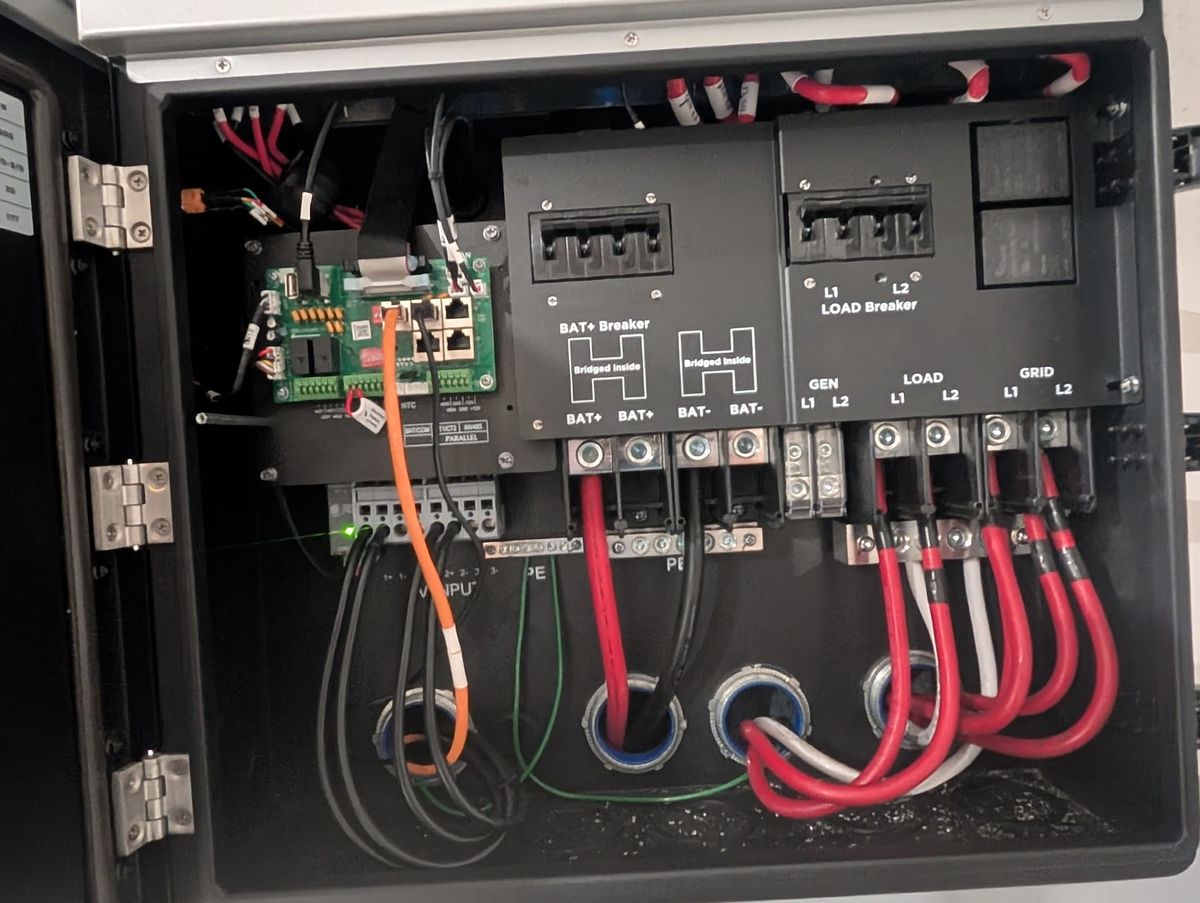
Inside the Luxpowertek inverter — BAT+ Breaker (battery), LOAD Breaker (house circuits), and GRID connections. This is the kind of wiring you want a professional handling.
Technically you could source the parts and hire an electrician, but consider this: Union Solar charged me roughly Q8,000 ($1,032 USD) for installation and commissioning on a Q75,363 system — that’s about 10% of the total cost. For that you get professional mounting, proper electrical connections, warranty coverage, and the documentation EEGSA requires for your autoproductor application. Trying to DIY the core system to save 10% isn’t worth the risk. Where you can save money is on add-ons — I bought my Tigo optimizers on eBay and installed them myself. It’s doable if you’re comfortable working on a roof with DC wiring, but you need to be extremely careful. Panels under sunlight are always live, and DC arcs don’t self-extinguish like AC. Know what you’re doing, or hire someone.
Do I need a battery for solar in Guatemala?
Yes — and it’s not just about blackout protection. EEGSA charges you ~Q1.20/kWh ($0.15 USD) for grid electricity but your solar export credits are only worth ~Q0.25/kWh ($0.032 USD). That 5:1 gap means every kWh you export during the day and buy back at night costs you ~Q0.95. The battery stores your solar and powers your house at night, avoiding that loss. My 14.3 kWh battery ($2,062 USD) saves an estimated Q250-350/month on that rate difference alone — paying for itself in about 4-5 years. Plus it keeps the lights on during Guatemala’s frequent power outages.
Is the electricity grid reliable enough for net metering?
EEGSA’s grid is generally stable in Antigua and Guatemala City. The bidirectional meter accurately tracks both directions. I’ve verified the meter readings against my inverter data — they’re consistent. The battery also means you’re not dependent on the grid during outages.