Every year, Guatemala transforms into one of the most spectacular religious celebrations on the planet. Semana Santa (Holy Week) here isn’t a quiet church observance — it’s a week-long explosion of color, incense, tradition, and community that has been running continuously since the 1500s. UNESCO has recognized Antigua Guatemala’s Semana Santa celebrations as Intangible Cultural Heritage, and once you’ve seen it, you’ll understand why.
I’ve been attending these processions my entire life. My family — like most Guatemalan families — plans the whole year around this week. What I’m sharing here isn’t tourist-brochure information. It’s what I actually know from decades of standing on those cobblestone streets, watching my neighbors lay alfombras at 3 AM, and timing my route through Antigua to catch the best processions.
TL;DR: Semana Santa 2026 runs March 29 to April 5. Viernes Santo (April 3) is the main day – arrive by 4 AM for the best alfombra viewing in Antigua. Budget Q320-1,600/day ($42-208). Book hotels 2-3 months ahead; Antigua swells from 35,000 to 300,000+ people.
Key Dates for Semana Santa 2026
Semana Santa dates shift every year because Easter follows the lunar calendar. In 2026, here’s the complete schedule:
| Date | Day | What Happens |
|---|---|---|
| March 29 | Domingo de Ramos (Palm Sunday) | Opening processions, palm frond blessings |
| March 30 | Lunes Santo | Smaller local processions |
| March 31 | Martes Santo | More local processions, alfombra preparations begin |
| April 1 | Miercoles Santo | Major evening processions start |
| April 2 | Jueves Santo (Holy Thursday) | Night vigil processions, velaciones (all-night prayer vigils) |
| April 3 | Viernes Santo (Good Friday) | THE main day — largest processions, most alfombras |
| April 4 | Sabado de Gloria (Holy Saturday) | Quieter day, some processions, burning of Judas effigies |
| April 5 | Domingo de Resurreccion (Easter Sunday) | Final celebrations, family meals |
The most important day is Viernes Santo (April 3). If you can only visit for one day, this is it. But arriving by Wednesday gives you time to see the alfombras being created and catch the buildup.
Day-by-Day Guide: What to Do Each Day
Here is how to plan your week if you have the full stretch. Even if you only have 2-3 days, this helps you prioritize.
Sunday, March 29 — Domingo de Ramos (Palm Sunday)
The week begins. Palm fronds are blessed at morning masses across the country. In Antigua, a procession departs from La Merced in the mid-morning. The streets are busy but not yet packed. This is a good day to arrive, get oriented, and walk the procession routes to plan your viewing spots for later in the week.
What to do: Attend a palm blessing at any Antigua church (free, public). Walk 5a Avenida Norte to see where alfombras will be laid. Book any remaining restaurant reservations. Withdraw cash — ATM lines get longer each day.
Monday–Tuesday, March 30–31 — Lunes and Martes Santo
Smaller, neighborhood-level processions happen in Guatemala City’s Zona 1 and outlying towns. In Antigua, the energy builds slowly. Alfombra teams start scouting their street sections and preparing materials (dyed sawdust, flowers, stencils).
What to do: Day trips to coffee farms near Antigua or nearby volcanoes — the weather is perfect (dry season, 25-28C). Visit the jade museum or ChocoMuseo in Antigua while crowds are manageable. Stock up on groceries if you are cooking — supermarkets will be mobbed by Thursday.
Wednesday, April 1 — Miercoles Santo
The first major evening processions begin. In Antigua, the La Merced and San Jose Cathedral areas come alive after dark. The smell of incense starts filling the streets. Velaciones (all-night vigils) are held at several churches where the decorated andas are displayed.
What to do: Visit velaciones after 7 PM — churches open their doors for public viewing of the decorated floats. This is an intimate, less crowded way to see the andas up close before they hit the streets. Eat an early dinner — restaurants near the Parque Central fill up fast. Set your alarm for the next morning.
Thursday, April 2 — Jueves Santo (Holy Thursday)
The intensity ramps up. Major night processions depart from San Jose Cathedral and other Antigua churches. Alfombra teams begin laying carpets for the Friday processions. Many businesses close by midday. Banks are closed — use ATMs.
What to do: Watch the evening processions from 6 PM onward. After 10 PM, walk the streets where alfombra teams are working. Bring coffee and a light jacket — temperatures drop to 12-15C after midnight. Many families welcome respectful observers and will explain their designs. This is one of the most magical parts of the whole week.
Friday, April 3 — Viernes Santo (Good Friday)
This is it. The main event. Antigua’s streets are transformed into an open-air gallery of alfombras that will be destroyed within hours as processions march over them. Over 300,000 people pack a city built for 35,000.
What to do: Be on 5a Avenida Norte by 3:30-4:00 AM. See the alfombras in their pristine state before the first processions arrive. The San Felipe de Jesus procession enters from Jocotenango around 2 AM; the Escuela de Cristo departs around 4 AM in near-darkness; La Merced’s massive procession launches around 5 AM. By mid-morning, find a cafe near Parque Central for a break — you will need it. Processions continue throughout the day and into the evening. Hydrate constantly.
Saturday, April 4 — Sabado de Gloria
The intensity drops. Some neighborhoods burn Judas effigies (stuffed figures representing Judas Iscariot, often dressed as unpopular politicians). Smaller processions continue. Many people use this day to recover.
What to do: Sleep in. Visit churches to see the aftermath. Some neighborhoods in Guatemala City’s Zona 1 hold their own Judas-burning traditions. This is a good day for a slower-paced activity like visiting archaeological sites or hot springs outside Antigua.
Sunday, April 5 — Domingo de Resurreccion (Easter Sunday)
Resurrection celebrations. Morning masses are packed. The tone shifts from somber to celebratory. Family meals are the centerpiece — fiambre (though more traditional at Dia de los Muertos) or a large family cookout. The holiday ends and Antigua begins to empty out.
What to do: Attend a morning mass if you want the full experience (arrive early for seats). Have a leisurely brunch. If you are driving back to Guatemala City, leave before noon — the RN-14 highway is a parking lot by afternoon as everyone heads home.
What Makes Guatemala’s Semana Santa Unique
The Processions
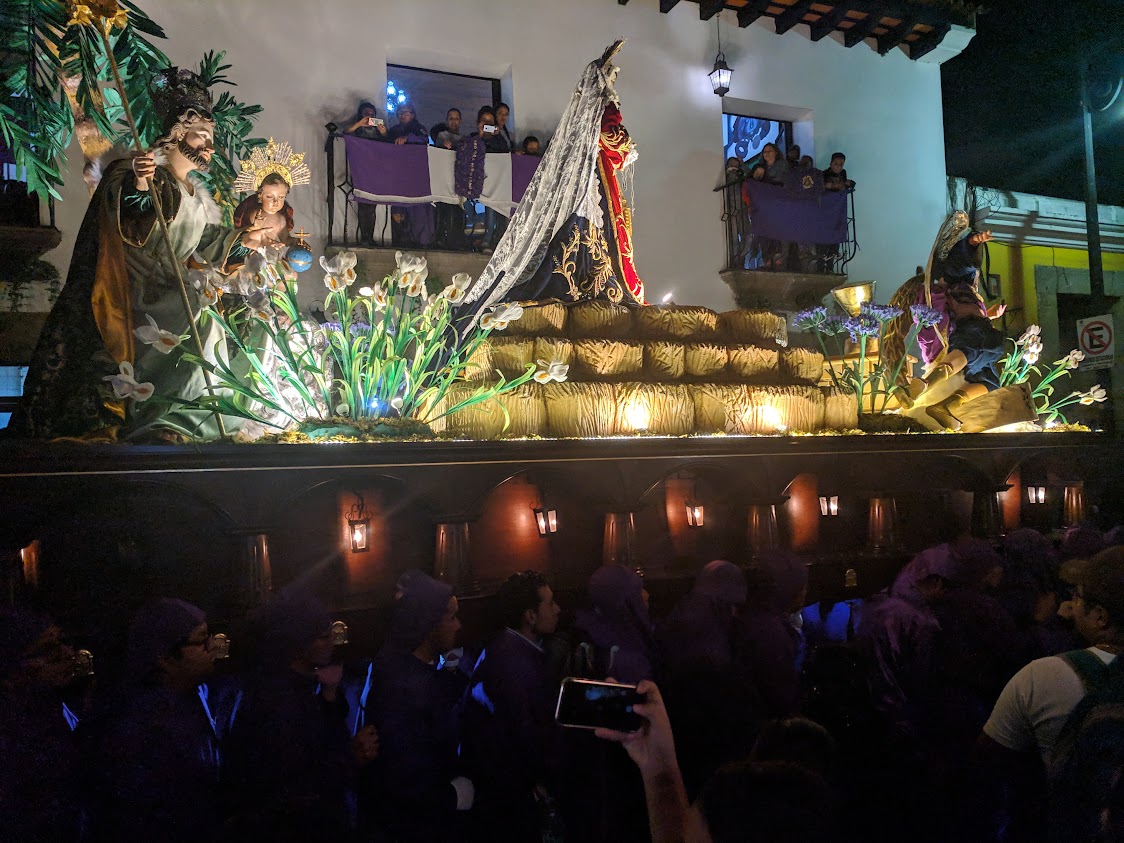
Guatemalan processions aren’t parades — they’re moving churches. Massive wooden floats called andas carry life-sized figures of Christ and the Virgin Mary through the streets. Each anda weighs between 3,000 and 7,000 pounds and is carried by teams of 40 to 120 cucuruchos (male carriers dressed in purple robes).
The carriers rotate in shifts, each team walking 2-3 blocks before handing off. Being selected as a cucurucho is an honor that families pass down through generations. My uncle has carried the same float from Escuela de Cristo for over 30 years.
Women carry smaller andas with the Virgin Mary, wearing white robes and white shoes. A marching band follows each procession playing solemn funeral marches. The incense smoke is so thick it forms a visible cloud above the procession route.
Each procession can stretch for multiple blocks and takes 8 to 14 hours to complete its circuit through town. They move incredibly slowly — about one block every 15 to 20 minutes.
The Alfombras (Sawdust Carpets)
This is what makes Guatemala’s celebration different from anywhere else in the world.
Alfombras are elaborate carpets laid directly on the cobblestone streets, made from dyed sawdust (aserrín), flowers, pine needles, fruits, and vegetables. Families, neighborhoods, and organizations spend hours — sometimes all night — creating intricate designs that stretch across the full width of the street.
Here’s the bittersweet part: these carpets are destroyed within minutes as the procession walks over them. That’s the point. They’re created as an offering — meant to be beautiful for only a few hours. There’s something profound about watching someone spend 8 hours on a work of art they know will be gone by morning.
Best times to see alfombras being made:
- Wednesday night through Thursday morning — preparations for Jueves Santo processions
- Thursday night through Friday before dawn — the most elaborate alfombras for Viernes Santo
- 3:00 AM to 6:00 AM Friday is prime time. I know it’s early, but this is when the streets are most magical: families working by lamplight, the smell of fresh pine, the quiet concentration before the chaos begins.
Best streets for alfombras in Antigua:
- 5a Avenida Norte — the longest continuous stretch of alfombras
- 1a Calle Poniente (near La Merced) — high foot traffic, some of the most elaborate designs
- Calle del Arco — photogenic with the Santa Catalina Arch as backdrop
- Around Parque Central — easy to access, always has displays
The Incense and Music
The incense isn’t subtle. Copal resin and processed incense fill the streets with a heavy, sweet smoke that you can smell from blocks away. Incense carriers (sahumadoras) walk ahead of each procession, swinging metal censers.
The funeral marches played by brass bands are haunting. They’re not hymns you’d recognize — they’re specifically composed marches unique to Guatemala’s Semana Santa tradition, some dating back centuries. You’ll hear them echoing through the streets for hours.
Antigua Guatemala: Ground Zero for Semana Santa
Antigua is THE epicenter. While every town in Guatemala celebrates Semana Santa, Antigua’s celebration is the largest, most elaborate, and most internationally recognized. About 80% of visitors who come to Guatemala specifically for Semana Santa spend most of their time here.
See Antigua on our interactive map for detailed neighborhood information.
Key Churches and Their Processions
La Merced The most iconic starting point. The yellow baroque facade of La Merced is the backdrop for many of Antigua’s most photographed alfombras. Their Viernes Santo procession is one of the largest, typically departing in the early morning hours.
San Jose Cathedral (Catedral) Located on the Parque Central. The cathedral’s processions are among the oldest in Antigua. The Jueves Santo evening procession from here draws enormous crowds.
Escuela de Cristo A smaller church with one of the most emotional processions. The anda from Escuela de Cristo is considered one of the finest in Antigua. Their evening procession on Viernes Santo is deeply moving.
San Francisco el Grande Home to the tomb of Hermano Pedro de San Jose de Betancur, Guatemala’s only saint. Their processions have a special significance. The church itself is worth visiting any day — and it’s free. Check our 40+ free things to do in Guatemala for more ideas.
San Felipe de Jesus (Jocotenango) Just north of Antigua proper. Their early-morning Viernes Santo procession enters Antigua from the north and is one of the first to hit the streets.
Approximate Procession Schedule (Viernes Santo — April 3)
Times are approximate and shift every year. Processions leave when they’re ready, not on a strict clock.
| Time | Church/Procession | Notes |
|---|---|---|
| 2:00 AM | San Felipe de Jesus | One of the earliest, enters from Jocotenango |
| 4:00 AM | Escuela de Cristo | Pre-dawn departure, deeply atmospheric |
| 5:00 AM | La Merced | The big one — huge crowds, elaborate alfombras |
| 6:00 AM | San Jose Cathedral | Departs from Parque Central |
| 7:00 AM | San Francisco | Later departure, less crowded at start |
| Various | Smaller hermandades | Multiple smaller processions throughout the day |
Pro tip: The best strategy is to position yourself on 5a Avenida Norte around 4:00 AM. You’ll see the alfombras in their pristine state and watch the first processions roll through. By mid-morning, the streets are packed and you’re standing 5 rows deep.
For a detailed hour-by-hour breakdown of the entire day, see our Viernes Santo Antigua guide — it covers every procession from 2 AM through after dark.
Beyond Antigua: Other Celebrations Worth Seeing
Guatemala City
The capital’s processions are massive but less touristy. The Zona 1 Centro Historico processions can rival Antigua in scale. Key churches include:
- Iglesia de Santo Domingo (Zona 1) — one of the longest procession routes in the country
- Iglesia de la Recoleccion (Zona 1) — famous for its enormous Viernes Santo anda
- Iglesia del Cerrito del Carmen — the oldest church in Guatemala City
Guatemala City processions tend to be more neighborhood-focused. Locals line their own streets. It’s less of a tourist spectacle and more of a genuine community event. If you want to see how regular Guatemalans actually experience Semana Santa, this is where.
Quetzaltenango (Xela)
Guatemala’s second city has its own impressive Semana Santa with less tourist infrastructure but equal devotion. The cold highland air (Xela sits at 2,333 meters) adds a different atmosphere — you’ll see breath mist mixing with incense smoke. Key events:
- Processions through the neoclassical downtown around Parque Central
- Fewer international tourists means more authentic local atmosphere
- The Huelga de Dolores university student protest parade (a separate tradition, typically the Friday before Semana Santa) adds political satire to the mix
Lake Atitlan
Santiago Atitlan has one of the most unique Semana Santa celebrations in the country. The Tz’utujil Maya community blends Catholic traditions with indigenous spiritual practices. The figure of Maximon (also called Rilaj Maam), a syncretic folk saint, plays a central role in the celebrations. This is unlike anything you’ll see elsewhere.
Other lakeside towns — Panajachel, San Pedro La Laguna, San Juan La Laguna — have smaller but charming processions. The backdrop of the lake and volcanoes makes them incredibly photogenic. See our complete Lake Atitlan towns guide for details on each village.
Livingston
On the Caribbean coast, the Garifuna community celebrates Semana Santa with a distinct Afro-Caribbean flavor. Drumming, unique procession styles, and seafood-based Lenten dishes make this a completely different experience. It’s harder to get to (boat only from Rio Dulce or Puerto Barrios) but worth the trip if you want something truly unique.
Practical Information: Costs and Logistics
Budget Planning
Prices in Antigua increase significantly during Semana Santa. Book early — 2 to 3 months in advance is recommended.
Prices verified February 2026. See our exchange rates page for today’s USD/GTQ rate.
| Item | Budget | Mid-Range | Luxury |
|---|---|---|---|
| Hotel (Antigua, per night) | Q200-400 ($26-52) | Q600-1,200 ($78-156) | Q2,000+ ($260+) |
| Meals per day | Q80-150 ($10-20) | Q200-400 ($26-52) | Q500+ ($65+) |
| Transport from GC | Q25 bus ($3.25) | Q80 shuttle ($10.40) | Q400+ private ($52+) |
| Bottled water (per day) | Q15-25 ($2-3) | Q15-25 ($2-3) | Included |
| Souvenirs/crafts | Q50-200 ($7-26) | Q200-500 ($26-65) | Q500+ ($65+) |
Total estimated daily cost:
- Budget traveler: Q320-600/day ($42-78)
- Mid-range: Q900-1,600/day ($117-208)
- Luxury: Q3,000+/day ($390+)
Check the current exchange rate on our exchange rates page — as of February 2026 it’s approximately Q7.72 per US dollar. If you’re sending money ahead of your trip, our remittance comparison helps you get the best exchange rate. For a full breakdown of daily expenses, see our cost of living guide.
Hotel Prices by Area (Semana Santa 2026)
Antigua hotel prices during Semana Santa are 2-3x normal rates. Here is what to expect:
| Area | Budget | Mid-Range | Luxury | Walk to Parque? |
|---|---|---|---|---|
| Antigua center (within 3 blocks of Parque Central) | Q400-600/night ($52-78) | Q1,000-2,000/night ($130-260) | Q3,000-5,000/night ($390-650) | Yes, 5 min |
| Antigua edges (5-10 blocks from center) | Q250-400/night ($33-52) | Q600-1,000/night ($78-130) | Q1,500-2,500/night ($195-325) | Yes, 10-15 min |
| Jocotenango (north of Antigua) | Q200-350/night ($26-45) | Q400-800/night ($52-104) | Q1,000-1,800/night ($130-234) | 15-20 min walk |
| San Pedro Las Huertas / Ciudad Vieja | Q150-300/night ($19-39) | Q350-700/night ($45-91) | Q800-1,500/night ($104-195) | Tuk-tuk needed |
| Guatemala City (Z10) | Q300-500/night ($39-65) | Q600-1,200/night ($78-156) | Q1,500-3,000/night ($195-390) | 45 min drive |
Booking tips:
- Book by January for Semana Santa. Antigua has limited hotel inventory and the best places sell out months in advance. By March, you are looking at leftovers.
- Jocotenango is the best value. Five minutes north of Antigua, significantly cheaper, and processions actually pass through it (San Felipe de Jesus is based there). Many locals stay here and walk into Antigua.
- San Pedro Las Huertas and Ciudad Vieja are also close alternatives with lower rates and local character.
- Airbnb options exist but also book up fast. Check for cancellation policies — some hosts raise prices after initial booking.
- Staying in Guatemala City and day-tripping is viable but means fighting traffic. The RN-14 highway can take 2+ hours during Semana Santa peak days. Leave Guatemala City before 5 AM to reach Antigua for dawn processions.
- For current costs across all of Guatemala, check our full cost of living guide.
What to Bring
- Comfortable walking shoes — you will walk a LOT on uneven cobblestones. Forget heels or sandals.
- Sunscreen and hat — March/April is the dry season. It gets hot by mid-morning (up to 28-30°C / 82-86°F).
- Water bottle — stay hydrated. Multiple street vendors sell water, but bring your own refillable.
- Camera with good low-light capability — the best moments happen before dawn and after sunset.
- Small backpack (not purse or dangling bag) — see safety section below.
- Light jacket — early mornings are cool (12-15°C / 54-59°F), especially at 3 AM.
- Cash — many street vendors and smaller restaurants in Antigua don’t accept cards. ATMs exist but lines get long. See our banking guide for which banks have the best ATM coverage.
Best Viewing Strategy
- Wednesday: Arrive and get oriented. Walk the procession routes to understand the layout. Check alfombra locations.
- Thursday evening: Watch the velaciones (prayer vigils). Some churches open their doors for public viewing of the decorated andas the night before.
- Friday 3:00 AM: Get to 5a Avenida Norte. Watch alfombras being finished. Stay for the first processions at dawn.
- Friday morning through afternoon: Move between procession routes. Take breaks at cafes around Parque Central.
- Saturday: Rest day. Visit churches, explore markets, or take a day trip — consider hiking a nearby volcano or visiting a coffee farm. The Sabado de Gloria burning of Judas effigies happens in some neighborhoods.
Traditional Food During Semana Santa
Semana Santa has its own menu. Meat is traditionally avoided on Fridays during Lent, and the week itself has specific dishes:
Must-Try Foods
- Torrejas — Sweet bread slices soaked in honey syrup, sometimes flavored with cinnamon and rum. This is THE Semana Santa dessert. Every family has their own recipe. Street vendors sell them everywhere during the week.
- Garbanzos en mole — Chickpeas in a rich, slightly sweet mole sauce. A Lenten staple since meat is traditionally avoided.
- Curtido — Pickled vegetables (beets, green beans, carrots) in vinegar. Served cold as a side dish or eaten alone. Refreshing in the heat.
- Bacalao a la vizcaina — Salt cod in tomato sauce, a Spanish colonial legacy. More common in traditional households.
- Molletes — Sweet banana-stuffed bread rolls with custard cream. Found in bakeries throughout Antigua.
- Ayote en dulce — Squash cooked in panela (unrefined cane sugar) syrup. A comfort food.
- Enchiladas guatemaltecas — Not the Mexican kind. These are tostadas topped with beet-dyed curtido, ground beef, egg, and cheese. Available year-round but especially popular during Semana Santa street markets. For more on Guatemalan cuisine, see our food guide.
- Atol de elote — Hot sweet corn drink. Perfect for those cold 3 AM alfombra watching sessions.
What to Drink
- Atol de elote — hot sweet corn drink, perfect at 3 AM while watching alfombras being made. Sold by women with thermoses on almost every corner. Q5-10 ($0.65-1.30).
- Rosa de Jamaica — cold hibiscus tea, the standard refreshment when the sun comes out. Q5-10.
- Horchata — rice and cinnamon drink, sweet and filling. Q5-10.
- Avoid alcohol on procession routes. It is considered disrespectful. Save it for the restaurants and bars after the processions pass.
Where to Eat in Antigua
- Street food stalls line the procession routes. Safe and delicious. Look for stalls with high turnover — high turnover means fresh food. Budget Q30-60 per meal ($4-8).
- Mercado de Antigua — the local market has cheap, authentic food. Go upstairs for the comedores (food stalls). Comida corriente for Q25-35 ($3.25-4.55).
- Restaurants around Parque Central — tourist-priced but convenient. Expect Q100-300 per person for a sit-down meal. Reserve ahead for dinner on Thursday and Friday.
- Bakeries — Stock up on molletes and torrejas at the panaderias. Every bakery in Antigua produces extra during Semana Santa.
- For a local experience, follow where the cucuruchos eat between shifts. Those hole-in-the-wall places serve the best food.
- For more on Guatemalan cuisine beyond Semana Santa, see our complete food guide and current market prices.
Safety During Semana Santa
Antigua is generally one of the safest cities in Guatemala, especially in the central historic area where processions happen. That said, Semana Santa draws massive crowds, and wherever there are crowds, pickpockets follow.
Practical Safety Tips
-
Carry a small, zippered backpack worn on your front in dense crowds. Not a dangling purse, not a phone in your back pocket.
-
Leave expensive jewelry at your hotel. Don’t give anyone a reason to notice you.
-
Keep cash in multiple places — some in your wallet, some in a separate pocket. If you get pickpocketed, you won’t lose everything.
-
Stay with the crowd at night. The streets around processions are well-lit and full of people. Side streets a few blocks away can be dark and empty.
-
Watch for your phone. The #1 stolen item. Use a wrist strap or keep it in a zippered pocket when not actively taking photos.
-
Antigua has tourist police (POLITUR). They patrol procession routes and are generally helpful. Don’t hesitate to approach them.
-
Stay hydrated. The combination of crowds, incense smoke, sun, and walking can lead to dehydration fast.
-
Beware of tuk-tuk overcharging. During Semana Santa, some tuk-tuk drivers in Antigua charge Q50-100 for rides that normally cost Q10-20. Agree on the price before getting in, or use Uber if it is available.
-
Traffic accidents increase. More cars, more pedestrians, more alcohol. If you are driving, be extra cautious on the RN-14 highway and Antigua’s narrow streets. Pedestrians have right of way during processions.
-
Medical note: The nearest hospitals to Antigua are Hospital Nacional Pedro de Bethancourt in Antigua (public, basic) and private clinics in Guatemala City’s Zona 10. For serious emergencies, the 45-minute drive to Guatemala City private hospitals (Herrera Llerandi, Centro Medico) is the standard. Save 122 (Bomberos) and 128 (Cruz Roja) in your phone.
For a detailed safety breakdown by zone and department, read our Guatemala safety guide.
Getting to Antigua During Semana Santa
Transportation is one of the biggest logistical challenges of the week. Antigua is a small colonial city with narrow streets, no parking lots, and 300,000+ visitors. Plan your travel carefully.
From Guatemala City (La Aurora Airport)
Most international visitors arrive at La Aurora International Airport (GUA) in Guatemala City.
| Option | Normal Cost | Semana Santa Cost | Normal Time | Semana Santa Time |
|---|---|---|---|---|
| Chicken bus | Q25 ($3) | Q25-30 ($3-4) | 1-1.5 hrs | 2-3 hrs |
| Shuttle | Q80 ($10) | Q100-150 ($13-20) | 45 min-1 hr | 1.5-2.5 hrs |
| Private transfer | Q250-400 ($33-52) | Q400-600 ($52-78) | 40-50 min | 1-2.5 hrs |
| Uber/InDriver | Q150-250 ($20-33) | Q200-350 ($26-45) | 40-50 min | 1-2.5 hrs |
The RN-14 bottleneck: The single highway from Guatemala City to Antigua becomes a parking lot during Semana Santa, especially on Wednesday afternoon, Thursday, and Friday morning. The key windows:
- Best time to travel: Before 6 AM or after 8 PM. If you want to arrive for Viernes Santo dawn, leave Guatemala City by 2:30-3:00 AM.
- Worst time to travel: Wednesday 2-7 PM (everyone arriving), Friday 3-8 PM (some people leaving), Sunday noon-6 PM (mass exodus).
- Alternative route: Some drivers take the longer route via Palin and Escuintla to avoid the main highway. Ask your Uber driver — some know this route and it can save 30-60 minutes during peak traffic.
Parking in Antigua: Forget it. Street parking does not exist during Semana Santa. If you drive, park at one of the paid lots on the outskirts of town (Q50-100/day) and walk in. Many procession routes block vehicle access to the center entirely from Thursday through Saturday. Use a tuk-tuk within Antigua (Q10-20 per ride) or simply walk — the town is small.
From Lake Atitlan
- Shuttle services: Q80-150 ($10-20), about 3 hours via Panamerican Highway. Book at least 2 days in advance during Semana Santa — shuttles sell out.
- Public bus: Q30-50 ($4-7), requires a transfer at Chimaltenango. Allow 4+ hours (longer during the holiday).
- Book shuttles at any travel agency in Panajachel or San Pedro.
- Pro tip: Some travelers base themselves at Lake Atitlan (cheaper hotels, less crowded) and day-trip to Antigua for Viernes Santo only. This works if you take an early shuttle.
From Quetzaltenango (Xela)
- Shuttle: Q150-250 ($20-33), about 4 hours.
- Public bus: Q40-60 ($5-8), via Chimaltenango or Los Encuentros. Allow 5+ hours.
- Xela has its own excellent Semana Santa celebrations — consider staying put and visiting Antigua another time.
Check our transportation guide for more detailed route information and current prices. You will need a local phone plan for Uber and Google Maps — see our guide to Tigo vs Claro for the best options.
Frequently Asked Questions
When is Semana Santa 2026?
Semana Santa 2026 runs from Sunday, March 29 (Palm Sunday) through Sunday, April 5 (Easter Sunday). The most important day is Friday, April 3 (Viernes Santo/Good Friday), when the largest processions and most elaborate alfombras take place in Antigua Guatemala.
Is Semana Santa a good time to visit Guatemala?
Absolutely — it’s considered THE best cultural event of the year. The weather is dry and warm (March-April is peak dry season). The energy is incredible. Just book accommodation well in advance and be prepared for crowds, especially in Antigua.
How crowded is Antigua during Semana Santa?
Very. Antigua’s normal population of about 35,000 swells to over 300,000 during Semana Santa week. Streets along procession routes become standing-room-only by mid-morning on Viernes Santo. Early morning (before 6 AM) is the best time for both smaller crowds and the best alfombra viewing.
Can I see alfombras being made?
Yes. Alfombra creation is public and happens right on the streets. The best time to watch is Thursday night through early Friday morning (roughly 10 PM to 6 AM). Families and groups work through the night, and most are happy to have respectful observers. Just don’t step on the carpets, and ask before photographing close-up.
What’s the best day to visit?
Viernes Santo (Good Friday, April 3) is the main event. But if you can come for 3-4 days (Wednesday through Saturday), you’ll see the full arc — the preparation, the climax, and the aftermath. Thursday night into Friday dawn is perhaps the most magical 12-hour window.
Do I need to be Catholic to attend?
No. The processions are public events on public streets. Everyone is welcome regardless of religion. Guatemalans take pride in sharing their traditions. Just be respectful — don’t block processions, step on alfombras, or treat it as a theme park.
Are banks and businesses closed during Semana Santa?
Yes. Semana Santa is a national holiday period. Banks close from Thursday through Sunday (some close the whole week). Many businesses close from Wednesday or Thursday through the following Monday. ATMs work but lines are long. Bring enough cash before Thursday.
What about the rest of Guatemala? Does everything shut down?
Basically yes. Semana Santa is Guatemala’s biggest holiday — bigger than Christmas in terms of closures. All government offices close. Most private businesses close Thursday through Sunday at minimum. Buses still run but on reduced schedules. Grocery stores in Guatemala City typically stay open with reduced hours.
Planning Your Trip: Quick Checklist
- Book hotel in Antigua by January (or earlier)
- Check current exchange rates for budget planning
- Download offline map of Antigua (Google Maps allows offline downloads)
- Pack comfortable walking shoes, sunscreen, hat, light jacket
- Withdraw enough cash before Thursday (ATMs will be busy)
- Charge camera/phone batteries — you’ll use them all day
- Set alarm for 3:00 AM on Friday (trust me, it’s worth it)
- Review our safety guide before arrival
- Check transportation options from your location
Final Thoughts
Semana Santa in Guatemala is one of those experiences that changes your understanding of what cultural celebration can be. It’s not a museum exhibit or a curated tourist experience — it’s a living tradition that involves an entire country. The devotion of the cucuruchos who carry those massive floats for hours, the artistry of the alfombras that will exist for only minutes, the sound of funeral marches echoing through 500-year-old streets at 4 AM — there’s nothing quite like it.
As a Guatemalan, I’m biased. But I’ve traveled enough to know that this is genuinely world-class. Come see it for yourself.
Planning a trip to Guatemala? Explore our interactive map for detailed information on every department, safety ratings, cost of living, and more.
Keep Reading
- 112 Things to Do in Guatemala – Volcanoes, ruins, markets, and more. Plan what to do before and after Semana Santa.
- Sacatepequez Department – Everything about Antigua’s department: safety, cost of living, attractions, and local data.
- Viernes Santo Hour-by-Hour Guide – Detailed breakdown of every procession on Good Friday from 2 AM through after dark.
- Safety Guide – Crime data, zone rankings, and practical security tips from a Guatemalan native.
- Cost of Living in Guatemala – Budget your trip with real prices for hotels, food, and transport.
- Coffee Tours Near Antigua – Fill your non-procession days with farm visits and tastings.
- Hiking Volcanoes – Acatenango and Pacaya are both accessible from Antigua.
- Phone Plans – Get a local SIM for maps, Uber, and sharing photos. Q100 ($13) for 25 GB.
![Viernes Santo Antigua 2026: Hour-by-Hour Procession Guide [Maps & Times]](/images/photos/semana-santa-2.jpg)
![Viernes Santo Antigua 2026: Guia Hora por Hora de Procesiones [Horarios y Rutas]](/images/articles/semana-santa-alfombra.jpg)