![Getting Around Guatemala: Shuttles, Buses & Uber [2026]](/images/articles/rio-dulce.jpg)
Guatemala does not have a metro system, passenger trains, or a network of well-maintained highways. What it does have is a chaotic, surprisingly effective patchwork of buses, boats, ride-hailing apps, shuttles, tuk-tuks, and domestic flights that will get you virtually anywhere in the country — if you know how the system works.
I grew up navigating this system. I have ridden chicken buses through highland switchbacks, taken overnight Pullman services to Flores, and grabbed Ubers across Guatemala City more times than I can count. This guide covers every transport option available in 2026, with real prices and honest safety advice.
TL;DR: Uber is the best option in Guatemala City (Q25-40 from the airport). Pullman buses connect cities for Q50-700. Chicken buses cover rural routes for Q3-50. TAG Airlines flies to Flores in 1 hour vs 9 by bus. Budget Q400-770/month ($50-100) for comfortable expat transport.
At a Glance: Transport Options and When to Use Them
| Transport | Best For | Cost Range | Safety | Comfort |
|---|---|---|---|---|
| Uber / InDriver | Guatemala City, Antigua | Q20–350 ($2.60–$45) | High | High |
| Pullman bus | Long-distance between cities | Q50–700 ($6.50–$91) | Good | Good |
| Tourist shuttle | Antigua-Atitlan, popular routes | Q60–600 ($7.80–$78) | Good | Good |
| Chicken bus | Short hops, rural areas | Q3–50 ($0.39–$6.50) | Low–Moderate | Low |
| TAG Airlines | Guatemala City to Flores | Q800–1,800 ($104–$233) | High | Good |
| Tuk-tuk | Small towns, short distances | Q5–15 ($0.65–$1.95) | Moderate | Low |
| Lake Atitlan lancha | Between lakeside towns | Q25–35 ($3.25–$4.55) | Moderate | Moderate |
| Car rental | Road trips, flexibility | Q350–800/day ($45–$104) | Your control | High |
Prices verified February 2026. See our exchange rates page for today’s USD/GTQ rate.
Uber and InDriver: The Easy Option
If you are in Guatemala City, Uber is your best friend. It is safe, reliable, cheap, and available 24/7. This is how most expats and middle-class Guatemalans get around the capital.
Uber in Guatemala
Uber has been operating in Guatemala City since 2017 and has a large driver pool. Coverage in Antigua is more limited but growing.
| Route | Fare (GTQ) | Fare (USD) |
|---|---|---|
| Zona 10 to Zona 1 | Q30–50 | $3.90–$6.50 |
| Zona 10 to La Aurora Airport | Q25–40 | $3.25–$5.20 |
| Guatemala City to Antigua | Q200–350 | $25.90–$45.35 |
| Within Antigua center | Q25–45 | $3.25–$5.85 |
Key tips:
- You can pay with cash or card. Many drivers prefer cash.
- Surge pricing kicks in during rain (which is every afternoon May through October) and rush hour. Expect 1.5–3x normal fares.
- Always confirm the driver’s name and plate number before getting in.
- Spanish is not required — the app handles communication — but it helps.
InDriver
InDriver (sometimes written inDrive) lets you propose your own fare and the driver accepts or counters. It is available in Guatemala City and Quetzaltenango. Fares can be cheaper than Uber during surge periods because there is no algorithm-driven pricing. The trade-off is a smaller driver pool and less reliability.
Getting from La Aurora Airport
The airport is in Zone 13 of Guatemala City, close to the upscale zones. Your options, ranked by recommendation:
- Uber (best option): Q25–40 ($3.25–$5.20) to Zona 10. Walk outside the arrivals hall, request on the app, and meet the driver at the designated pickup area.
- Airport taxi (fine but pricier): Official taxis at the booth inside arrivals charge Q80–120 ($10–$15) to Zona 10. Fixed rates, safe, but 2–3x the Uber price.
- Hotel pickup: Many hotels in Zona 10 and Antigua offer airport transfers for $25–60.
- Public bus: Technically possible but not recommended with luggage, especially at night.
Pullman Buses: The Backbone of Long-Distance Travel
Pullman buses are Guatemala’s equivalent of Greyhound, but cheaper and with more frequent departures. These are full-size coaches with assigned seating, air conditioning, and luggage compartments. They are the safest and most comfortable way to travel between cities.
Major Bus Companies and Routes
| Company | Route | Price (GTQ) | Price (USD) | Duration | Departures |
|---|---|---|---|---|---|
| Litegua | GC – Puerto Barrios | Q80–100 | $10–$13 | 5 hrs | Every 30 min |
| Litegua | GC – Rio Dulce | Q80–110 | $10–$14 | 5.5 hrs | 6 daily |
| Litegua | GC – Esquipulas | Q60–80 | $8–$10 | 4.5 hrs | Hourly |
| Fuente del Norte | GC – Flores (Peten) | Q220–380 | $28–$49 | 9 hrs | 6–8 daily |
| Fuente del Norte | GC – Coban | Q80–120 | $10–$16 | 4.5 hrs | Hourly |
| Linea Dorada | GC – Flores (luxury) | Q500–700 | $65–$91 | 9 hrs | 2–3 daily |
| Linea Dorada | GC – Melchor de Mencos (Belize) | Q550–750 | $71–$97 | 10.5 hrs | 1–2 daily |
| ADN / Alamo | GC – Quetzaltenango (Xela) | Q90–120 | $12–$16 | 4 hrs | Hourly |
| ADN / Alamo | GC – Huehuetenango | Q100–130 | $13–$17 | 5 hrs | 4–6 daily |
| Monja Blanca | GC – Coban | Q80–110 | $10–$14 | 4.5 hrs | Every 30 min |
| Monja Blanca | GC – Salama | Q50–70 | $6.50–$9 | 3 hrs | Hourly |
| Galgos | GC – Tapachula (Mexico border) | Q120–180 | $16–$23 | 6 hrs | 4–5 daily |
| Galgos | GC – Xela (via Pacific) | Q80–110 | $10–$14 | 4 hrs | 3–4 daily |
| Rebuli | GC – Antigua | Q20–30 | $2.60–$3.90 | 1 hr | Every 15 min |
Pullman Tips
- Buy tickets at the terminal or online when available. Litegua and Fuente del Norte have websites.
- Buses have strong AC. Bring a jacket or hoodie, even in the tropics.
- Most terminals are in Zona 1 of Guatemala City. This area can be rough — take an Uber to and from the terminal.
- Overnight buses to Flores save you a hotel night. The Fuente del Norte service departs around 9–10pm and arrives at 6am. The Linea Dorada luxury option is worth the premium for a 9-hour ride — reclining seats, meals, and movies.
- Keep valuables in your carry-on, not in overhead compartments or the luggage hold.
- Holiday periods (Semana Santa, Christmas, long weekends) mean sold-out buses. Book in advance.
Linea Dorada: Guatemala’s Best Bus
If you are going to Flores/Tikal and have the budget, Linea Dorada is the clear choice. Wide reclining seats with footrests, meal service, personal entertainment screens, and generally better-maintained buses. At Q500–700 ($65–$91), it costs more than Fuente del Norte’s standard service (Q220–380), but for a 9-hour overnight ride, the difference in comfort is massive.
Tourist Shuttles: Convenient but Pricey
Tourist shuttles are shared minivans that run between popular destinations. They are more comfortable and safer than chicken buses, include hotel pickup, and are easy to book. The trade-off is that they cost 3–5x more than public transport.
Popular Shuttle Routes
| Route | Price (GTQ) | Price (USD) | Duration | Notes |
|---|---|---|---|---|
| Antigua – Panajachel (Lake Atitlan) | Q100–150 | $13–$19 | 2.5 hrs | Multiple daily, 7–8am departures |
| Antigua – Guatemala City | Q80–120 | $10–$16 | 1 hr | On demand |
| Antigua – Semuc Champey (via Lanquin) | Q250–400 | $32–$52 | 9 hrs | Very long, consider 2-day tour |
| GC – Flores/Tikal | Q400–600 | $52–$78 | 9.5 hrs | Fly instead if budget allows |
| Panajachel – Xela | Q120–200 | $16–$26 | 3 hrs | Beautiful mountain scenery |
| Antigua – Monterrico (beach) | Q100–180 | $13–$23 | 2.5 hrs | Popular weekend trip |
| Flores – Tikal | Q60–100 | $8–$13 | 1.25 hrs | 4:30am shuttle for sunrise |
How to Book Shuttles
- In Antigua: Walk into any tour agency on 5a Avenida. There are dozens. Compare prices — they vary.
- Online: GuateGo (guatego.com) and GetYourGuide aggregate shuttle options.
- Through your hotel: Most hostels and hotels can arrange shuttles. Expect a small markup.
- Book the day before. Same-day is usually fine outside of holidays, but why risk it?
Shuttle Booking Services
The two most reliable shuttle aggregators are:
- GuateGo: Online booking platform covering most popular routes. Prices are transparent and you can compare options.
- Adrenalina Tours: Based in Antigua. Reliable and well-established for shuttle and tour bookings.
Chicken Buses (Camionetas): The Iconic Guatemala Experience
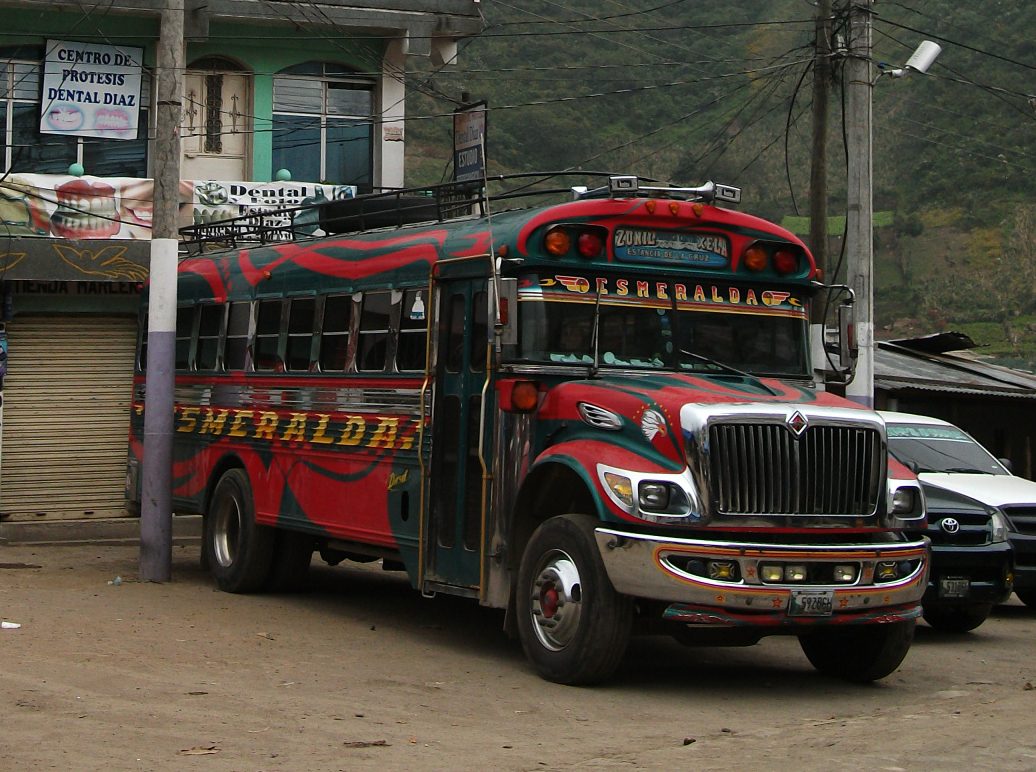
No guide to Guatemala transportation is complete without chicken buses. These are retired US school buses, shipped south, repainted in wild colors, modified with louder engines, and put into service covering every road in the country. Guatemalans call them “camionetas” or “extraurbanos.”
They are cheap. They are everywhere. They are an experience.
Chicken Bus Prices
| Trip Type | Price (GTQ) | Price (USD) | Example |
|---|---|---|---|
| Short (under 30 min) | Q3–10 | $0.39–$1.30 | Within a city or to a nearby town |
| Medium (1–2 hours) | Q10–25 | $1.30–$3.25 | Between cities in same department |
| Long (2–4 hours) | Q20–50 | $2.60–$6.50 | Cross-department routes |
How Chicken Buses Work
- There is no schedule. Buses leave when they are full. More departures in the early morning (5–8am) and afternoon (2–5pm).
- You pay on the bus. The ayudante (helper) hangs off the back door, shouts the destination, loads luggage on the roof, and collects fares during the ride.
- There are no assigned seats. It is first come, first served. Three people per bench seat is standard. Four is common.
- To stop, yell “parada!” or knock on the ceiling. The bus will stop (mostly) wherever you need.
- Major hubs: CENMA (Zona 12, Guatemala City) serves most southern and western routes. Various terminals in Zona 1 serve northern routes. Terminal Minerva (Zona 3, Quetzaltenango) serves the western highlands.
Chicken Bus Safety
I will be honest: chicken buses are not the safest option.
- For short daytime trips between nearby towns, they are fine. Thousands of Guatemalans ride them daily without incident.
- For long distances, use Pullman buses instead. Chicken buses are overcrowded, the drivers are often reckless (they are paid by the trip, not the hour), and highway accidents happen.
- At night in Guatemala City, avoid them entirely. Robberies on city bus routes have been a persistent problem.
- Keep your bag on your lap or between your feet. Do not put it on the overhead rack.
- Sit near the front if possible. Less bumpy, easier to exit, and closer to the driver.
That said, for short hops during the day in tourist areas — say, getting from Panajachel to Solola, or between villages around Lake Atitlan — chicken buses are a perfectly viable and incredibly cheap option.
Domestic Flights: TAG Airlines
Guatemala’s only significant domestic airline is TAG Airlines, operating small turboprop aircraft (ATR 42/72 and Let 410) out of La Aurora International Airport in Guatemala City.
TAG Routes and Prices
| Route | Price (GTQ) | Price (USD) | Duration | Frequency |
|---|---|---|---|---|
| Guatemala City – Flores | Q1,200–1,800 | $155–$233 | 1 hr | 2–3 daily |
| Guatemala City – Quetzaltenango | Q900–1,400 | $117–$181 | 30 min | Seasonal/limited |
| Guatemala City – Coban | Q800–1,200 | $104–$155 | 30 min | Limited schedule |
Why You Should Fly to Flores
The Guatemala City to Flores route is the only one I strongly recommend booking. The bus alternative is 9 hours on winding roads. The flight is 1 hour. If you are visiting Tikal (and you should), the flight saves you an entire travel day each way. At $155–$233 one-way, it is not cheap, but the value in saved time is enormous.
Booking tips:
- Book directly at tag.com.gt for the best prices.
- Small planes have a 20kg luggage limit. Pack accordingly.
- Flights can be cancelled due to weather (especially during rainy season). Always have a backup plan.
- The Guatemala City and Quetzaltenango route is not always available. Check the current schedule before planning around it.
Tuk-Tuks (Mototaxis)
Three-wheeled motorcycle taxis are the standard local transport in smaller cities and towns. They are everywhere in Panajachel, Flores, Coban, and most rural towns. They are not available in Guatemala City center (traffic makes them suicidal).
Tuk-Tuk Prices
Short trips: Q5–15 ($0.65–$1.95). Rarely more than Q20 for any trip within town.
Rules of Engagement
- Agree on the price before you get in. There are no meters. If you do not agree on a price, you will pay whatever the driver decides, and the “gringo tax” is real.
- Short trips only. These are for getting around a town, not for highway travel.
- They are fun but not exactly safe. No seatbelts, no doors, and drivers weave through traffic. Keep your arms inside.
Lake Atitlan Boats (Lanchas)
Lake Atitlan’s lakeside towns are connected by small motorboats called lanchas. Some towns — like Jaibalito and Santa Cruz La Laguna — have no road access at all. Lanchas are not optional; they are the only way to get there.
Public Lancha Routes and Prices
| Route | Price per Person (GTQ) | Price (USD) | Duration |
|---|---|---|---|
| Panajachel – San Pedro La Laguna | Q25–35 | $3.25–$4.55 | 30 min |
| Panajachel – San Juan La Laguna | Q25–35 | $3.25–$4.55 | 35 min |
| Panajachel – San Marcos La Laguna | Q25–35 | $3.25–$4.55 | 25 min |
| Panajachel – Santiago Atitlan | Q25–35 | $3.25–$4.55 | 40 min |
| Panajachel – Santa Cruz La Laguna | Q25–35 | $3.25–$4.55 | 15 min |
| Panajachel – Jaibalito | Q25–35 | $3.25–$4.55 | 20 min |
Public lanchas run roughly every 20–30 minutes from 6am to 5pm from the main dock in Panajachel (Tzanjuyu). Private lanchas cost Q200–500 ($26–$65) per boat and can be negotiated at the dock.
Lancha Safety Tips
- Last boats leave around 5pm. Miss it and you are sleeping in whatever town you are in.
- Afternoon winds (Xocomil) make the lake choppy, especially after 1pm. Morning crossings are smoother and drier.
- Ask for a life jacket. They should be available but often are not stowed in visible places.
- Sit toward the back to stay drier on choppy days. The bow catches every wave.
Car Rental and Driving
Renting a car gives you maximum flexibility, but driving in Guatemala requires some mental preparation.
Car Rental Costs
Expect Q350–800 per day ($45–$104) depending on vehicle type. Major agencies (Budget, Hertz, Avis) operate at La Aurora Airport. Local agencies are cheaper but check reviews carefully.
Requirements:
- Valid driver’s license from your home country (international permit recommended but not always required)
- Credit card for the deposit
- Insurance (mandatory — do not skip it)
- Minimum age 21–25 depending on the company
Driving Conditions
- Main highways (CA-1 through CA-14) are generally fine. Two to four lanes, paved, marked.
- Secondary roads deteriorate quickly. Potholes, unmarked speed bumps (tumulos), and unpaved sections are common.
- Mountain roads are steep, winding, and narrow. Expect slow trucks, blind curves, and occasional rockfall.
- Guatemala City traffic is legendarily bad. Rush hour (7–9am, 5–7pm) can turn a 10km drive into 90 minutes.
- Gas stations are common along main routes. Premium fuel costs around Q40–45 per gallon ($5.20–$5.85).
- Drive during daylight. Road conditions, unmarked hazards, and security all favor daytime travel.
Should You Rent?
Rent a car if you want to explore off-the-beaten-path areas at your own pace — the road from Guatemala City to Rio Dulce, the Pacific coast loop, or the highland villages around Xela. For detailed road conditions, insurance, and driving tips, see our driving in Guatemala guide. For getting between major tourist destinations (Antigua, Atitlan, Flores/Tikal), shuttles and flights are usually easier and cheaper when you factor in gas, insurance, and the stress of navigating unknown roads.
Crossing into Neighboring Countries
Guatemala shares borders with Mexico, Belize, Honduras, and El Salvador. Here are the main crossing points:
| Border | Main Crossing | Getting There | Notes |
|---|---|---|---|
| Mexico | Tecun Uman / La Mesilla | Galgos bus to Tapachula (Q120–180, 6 hrs) | Most common for border runs |
| Belize | Melchor de Mencos | Linea Dorada from GC (Q550–750, 10.5 hrs) | Via Flores |
| Honduras | Agua Caliente / El Florido | Bus from Chiquimula (2–3 hrs) | El Florido for Copan ruins |
| El Salvador | Valle Nuevo / Pedro de Alvarado | Bus from GC (3–4 hrs) | CA-1 highway |
For CA-4 visa runs (resetting your 90-day stay), the Mexico border at either Tecun Uman or La Mesilla is the most popular option. Leave Guatemala, get stamped out, cross into Mexico, get stamped in, turn around, and cross back. Budget a full day.
The Cost Summary
Here is what you should budget for transportation per month, depending on your lifestyle:
| Lifestyle | Monthly Transport Budget | How |
|---|---|---|
| Budget local | Q120–230 ($15–$30) | Chicken buses and walking |
| Comfortable expat | Q400–770 ($50–$100) | Uber in GC, shuttles between cities |
| Road tripper | Q1,550–3,100 ($200–$400) | Car rental for weekend trips |
| Frequent flier | Q3,100–5,000+ ($400–$650+) | Monthly TAG flights + Uber |
For most expats living in Guatemala City and making occasional trips to Antigua or Atitlan, budgeting Q400–770 per month ($50–$100) for transport is realistic and comfortable. See our cost of living breakdown for how transport fits into your overall monthly budget.
Practical Tips That Will Save You Headaches
- Download Google Maps offline. It shows bus routes in Guatemala City and works for navigation even without signal.
- Always carry small bills. Q10 and Q20 notes. Bus drivers and tuk-tuk drivers often do not have change for a Q100.
- Book holiday travel early. Semana Santa (Holy Week), Christmas, and long weekends mean sold-out buses and inflated shuttle prices.
- Learn these phrases: “Parada, por favor” (stop, please), “Cuanto cuesta?” (how much?), “A donde va?” (where does it go?).
- Uber from the airport, not a taxi. You will save Q40–80 on your very first ride.
- Night travel between cities is fine on Pullman buses but avoid chicken buses and walking in bus terminal areas after dark.
- The GC-Flores flight is worth every quetzal. Saving 8 hours each way is worth Q2,400–3,600 in your time.
Getting Around Specific Destinations
Guatemala City
- Uber for everything. Transmetro (city bus rapid transit) exists along certain corridors and costs Q1, but it is crowded and confusing for newcomers.
Antigua
- Walking covers most of the historic center. Uber for trips outside town. Tuk-tuks for lazy days. Shuttles to the airport or Panajachel.
Lake Atitlan
- Lanchas between lakeside towns. Tuk-tuks within towns. Chicken buses for Panajachel to Solola and surrounding areas. Shuttles to Antigua or Xela.
Flores/Tikal
- TAG Airlines from GC. Tuk-tuks in Flores/Santa Elena. Shuttle to Tikal for the ruins. Fuente del Norte or Linea Dorada bus if flying is not in the budget.
Quetzaltenango (Xela)
- Local buses and tuk-tuks within the city. ADN/Alamo or Galgos Pullman bus from GC. InDriver available.
All prices current as of February 2026 at an exchange rate of approximately Q7.72 per USD. Prices fluctuate by season and demand. For real-time exchange rates, check the exchange rate tracker. For cost of living context, see the full Guatemala cost breakdown.
![Best Places for Remote Workers in Guatemala [2026 Ranked]](/images/photos/guatemala-city-skyline-zona10.jpg)