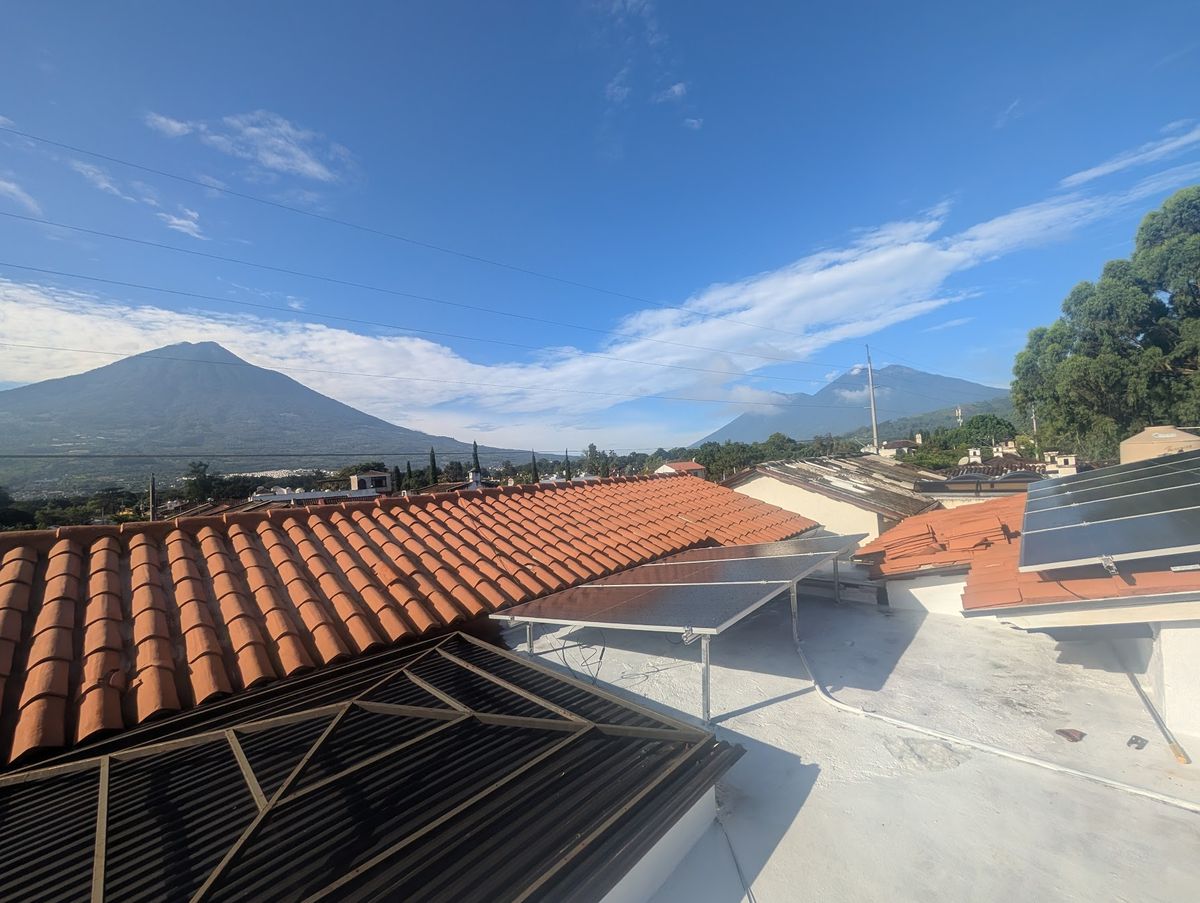
I added 16 Tigo TS4-A-O optimizers to my solar system a month after installation. Bought them used on eBay, shipped them to Guatemala, and installed them myself on a Saturday. Five months later, I have enough data to answer the question everyone asks: are panel-level optimizers actually worth the money?
The short answer is yes — but not for the reason Tigo’s marketing wants you to believe.
This is a follow-up to my full system breakdown and cost analysis, which covers the complete 9.92 kW system, bills, and ROI. This article focuses specifically on the optimizers.
This article targets anyone considering Tigo optimizers, regardless of location. The data, installation process, and eBay buying advice applies globally. Guatemala-specific details (shipping, import taxes) are clearly labeled.
TL;DR: I bought 16 used Tigo TS4-A-O optimizers on eBay for $560 ($35 each). After 5 months, Tigo reports 10.8% reclaimed energy (621 kWh). Realistic net gain over bypass diodes is probably 5-8%. The real win is per-panel monitoring – I discovered one panel producing 32% below average.
What Tigo Optimizers Actually Do
Before the data, a quick explainer for people who aren’t sure what these things are.
The problem they solve: In a standard string inverter setup, solar panels are wired in series — like old Christmas lights. If one panel underperforms (shade, dirt, a bird sitting on it), it drags down every other panel in that string. Your best panel can only produce as much as your worst panel allows.
What the TS4-A-O does: Each optimizer is a small DC-DC converter that clips onto an individual panel’s MC4 connectors. It adds per-panel Maximum Power Point Tracking (MPPT), which means each panel operates at its own optimal voltage and current regardless of what the other panels are doing.
Three things you get:
- String isolation — a shaded panel only affects itself, not the entire string
- Per-panel MPPT — each panel finds its own maximum power point independently
- Per-panel monitoring — you can see exactly what each panel produces in the Tigo EI cloud platform
That third one — monitoring — turned out to be the most valuable feature for me, and I didn’t expect that going in.
The Honest Question: Bypass Diodes vs. Optimizers
Here’s something the solar optimizer marketing never mentions: your panels already have built-in shade protection.
Modern panels — mine are JA Solar JAM66D45-620/LB 620W bifacials — have 3 bypass diodes built into each panel. These diodes split the panel into three cell-string sections. If one section gets shaded, its bypass diode activates and routes current around it. The other two sections keep producing normally.
So the real question isn’t “do optimizers help with shading?” It’s “how much extra do they add beyond what bypass diodes already handle?”
Where bypass diodes fall short:
- They operate in binary — the shaded section is either fully bypassed (producing zero) or fully active. There’s no “partial output” from a partially shaded section.
- They don’t help when shade covers parts of multiple sections across a panel.
- They don’t prevent one underperforming panel from limiting the entire string.
What optimizers add on top:
- True per-panel independence — the string-level voltage mismatch problem goes away entirely.
- More granular power extraction from partially shaded conditions.
- The ability to actually see which panels underperform and why.
My honest take: Tigo’s “reclaimed energy” number (I’ll show it below) almost certainly includes some energy that bypass diodes would have recovered on their own. The 10.8% reclaimed figure is real, but treat it as an upper bound of the optimizer’s contribution, not a precise measurement of energy you’d have lost without them.
My Setup and What I Bought
| Component | Detail |
|---|---|
| Panels | 16x JA Solar JAM66D45-620/LB 620W Bifacial |
| Total capacity | 9.92 kW |
| String configuration | 2 strings of 8 panels |
| Inverter | Luxpowertek LXP-LBUS-12K 12kW Hybrid (3 MPPT inputs) |
| Optimizers | 16x Tigo TS4-A-O (handles panels up to 700W) |
| Gateway | Tigo CCA Kit (WiFi connection to Tigo EI cloud) |
| Location | Antigua Guatemala (14.5°N, ~1,530m elevation) |
The optimizers were added one month after the initial installation. The base system (panels, inverter, battery) was installed by a local solar company. The optimizers I added myself.
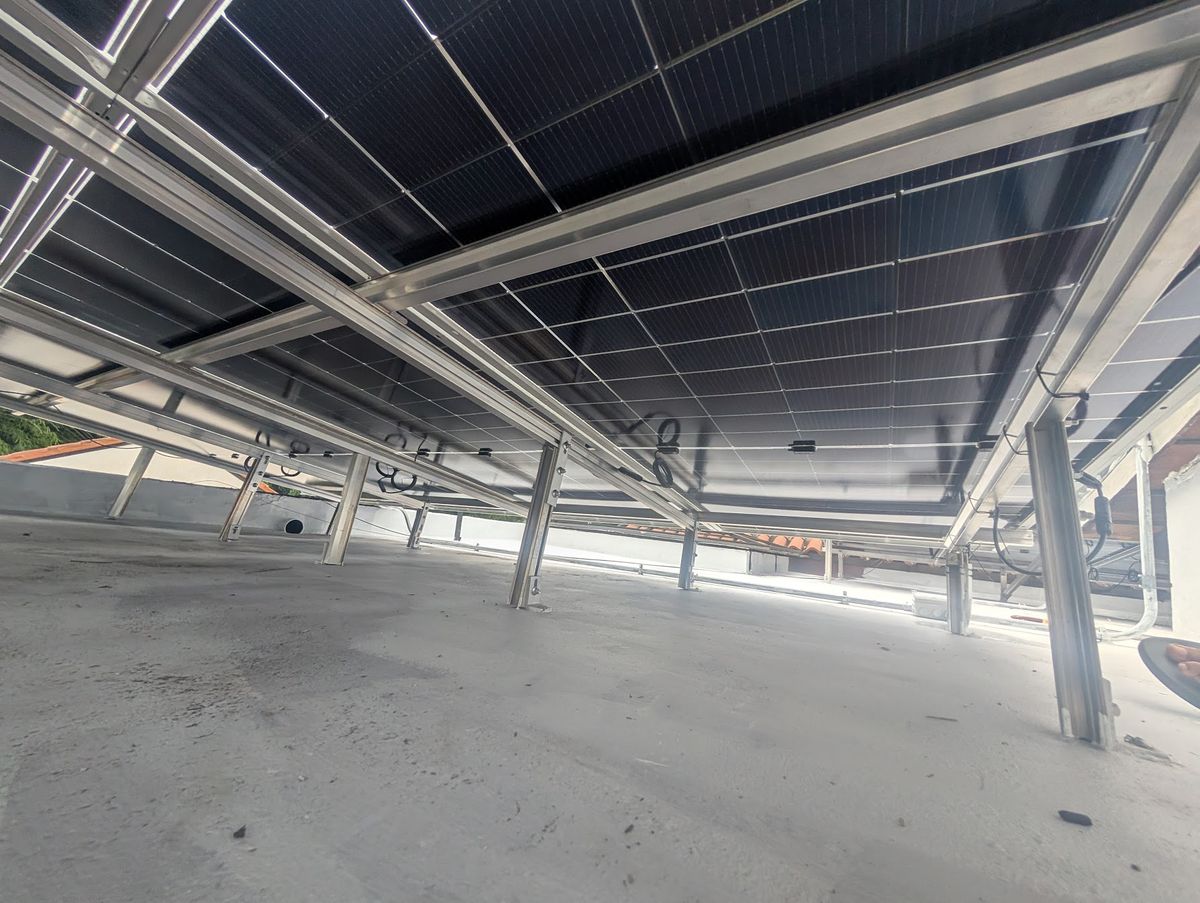
Under the panels before installing optimizers — junction boxes and MC4 connectors are visible. Each Tigo optimizer clips onto a panel’s DC output cables.
Buying Used on eBay: A Guide
New Tigo TS4-A-O optimizers retail for $50+ each. For 16 panels, that’s $800+ before shipping. I paid $560 for all 16 — $35 each — by buying used on eBay.
Where the Used Units Come From
Large solar farms regularly decommission and upgrade equipment. When a commercial installation swaps out panels or optimizers, the old units end up on eBay in bulk lots. These are typically functional units pulled from working systems, not defective returns.
How I Bought Mine
The optimizers (16 units):
| Detail | Info |
|---|---|
| eBay seller | player1111 |
| Listed price | Higher than $560 (I negotiated) |
| Final price | $560 ($35/unit) |
| Savings vs. new | ~30% |
The CCA Gateway Kit:
| Detail | Info |
|---|---|
| eBay seller | john_renstrom |
| Price | $242.36 |
| Notes | Essential for monitoring — don’t skip this |
Tips for Buying Used Tigo Optimizers
- Search “Tigo TS4-A-O” on eBay. Filter by “Used” and “Buy It Now” for the best deals.
- Look for bulk lots. Individual units are usually $40-45 each. Lots of 10-20 drop to $30-35.
- Negotiate. Sellers with large inventory are motivated. Send an offer below the listed price. Worst case they counter.
- Check the wattage rating. The TS4-A-O handles panels up to ~700W. If you have panels over that, you need a different model.
- Don’t skip the CCA Gateway. Without it, you get the electrical benefits (string isolation, per-panel MPPT) but no monitoring. The monitoring is half the value.
- Check seller ratings and return policies. Used electronics on eBay are generally reliable, but you want a seller with a return policy in case a unit is dead on arrival.
What About Risk?
In 5 months, all 16 of my used units have worked flawlessly. Zero failures. These devices are solid-state electronics with no moving parts — they either work or they don’t, and they tend to last a long time.
That said, if one fails, you lose optimization on that single panel, not the whole system. The string continues to function. It’s a graceful degradation, not a catastrophic failure.
The Full Cost Breakdown
Here’s every dollar I spent on the optimizer setup. This includes importing to Guatemala — your costs will be simpler if you’re in the US.
Equipment (eBay)
| Item | Cost (USD) |
|---|---|
| 16x Tigo TS4-A-O Optimizers | $560.00 |
| 1x Tigo CCA Gateway Kit | $242.36 |
| Equipment subtotal | $802.36 |
Shipping & Import (Guatemala-specific)
| Item | Cost (USD) |
|---|---|
| Aeropost shipping (2 shipments) | $260.93 |
| IVA (12% import tax) | $98.23 |
| Import duty (solar equipment) | $0.00 |
| Shipping subtotal | $359.16 |
Note for Guatemala buyers: Solar equipment gets 0% arancel (import duty). You still pay IVA (12%), but no tariff. This isn’t well-known. More details in my full solar article, and see our step-by-step Aeropost import guide for the exact shipping process and real invoice numbers.
Total Investment
| Cost (USD) | Cost (GTQ) | |
|---|---|---|
| Total all-in | $1,063 | Q8,240 |
| Per panel | $66 | Q515 |
If you’re in the US and buying domestically, your total for the same setup would be roughly $802 — just the eBay equipment cost, no international shipping.
Installing Them Myself
I installed all 16 optimizers and the CCA gateway myself. I did not use my solar installer for this part.
How Hard Is It?
Mechanically: Easy. Each optimizer has MC4 connectors that plug directly into the panel’s existing output cables. It’s plug-and-play. Disconnect the panel’s MC4 from the string cable, plug the optimizer in between, reconnect. Repeat 16 times.
Electrically: This is where it gets serious. Solar panels under sunlight are always live. There is no off switch. You are working with DC voltages that can exceed 400V in a string configuration.
Safety Warnings (Read This)
- DC arcs do not self-extinguish. Unlike AC, which crosses zero 120 times per second and can extinguish an arc at zero-crossing, DC current is continuous. If you create an arc by pulling a connector apart under load, it can sustain itself and cause a fire.
- Never disconnect MC4 connectors under load. Either work early morning/late evening when production is minimal, or cover panels with opaque material.
- Wear insulated gloves. This is not optional.
- Don’t work on a wet roof. Guatemala’s afternoon rain is predictable — work in the morning.
Time Required
The full installation — 16 optimizers plus the CCA gateway wiring and WiFi setup — took about half a day. Most of that time was spent on the roof carefully routing cables, not the actual connections.
The CCA Gateway
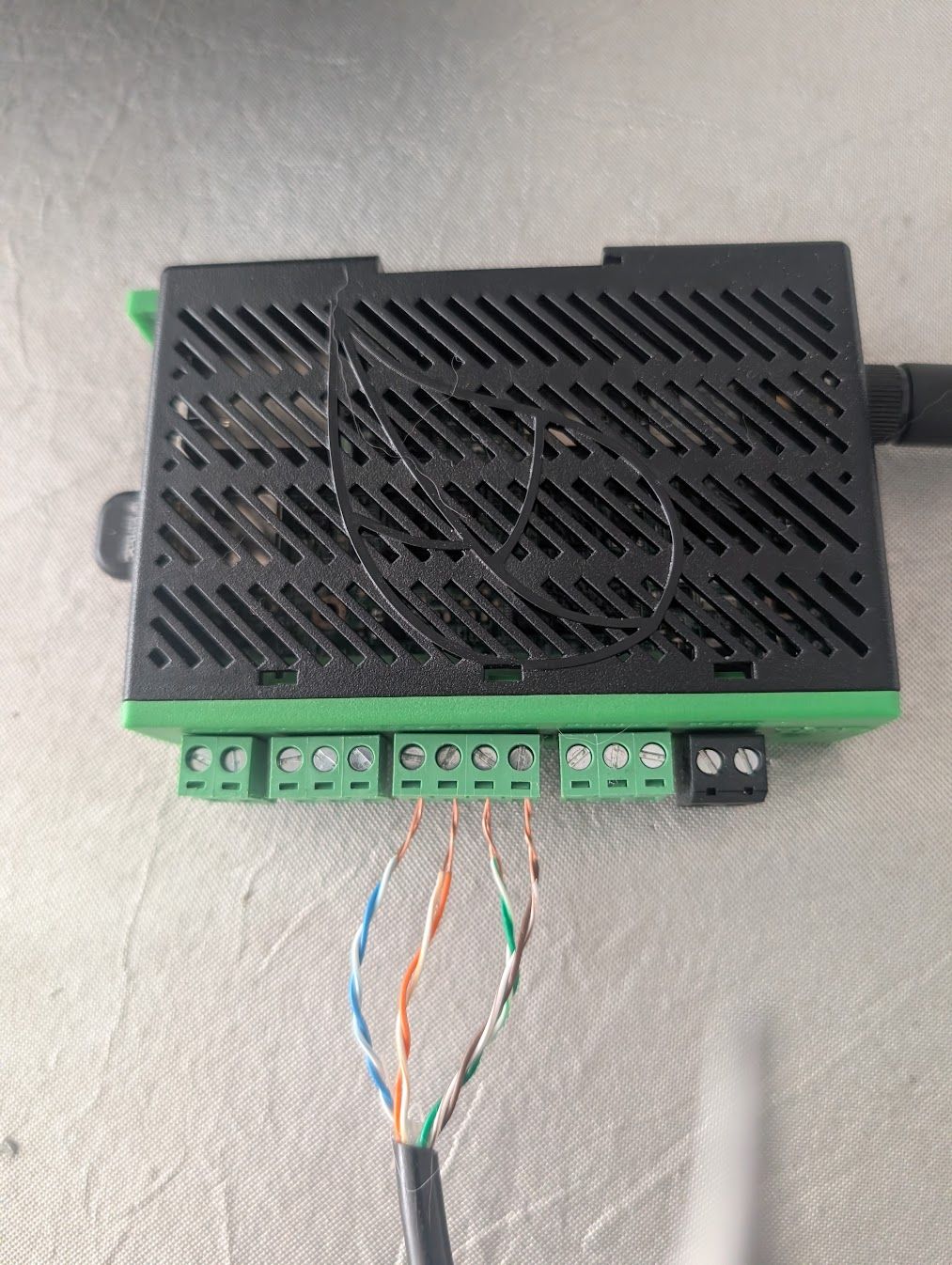
The Tigo CCA gateway — connects to optimizers via a Cat5 Ethernet cable and pushes data to the Tigo EI cloud over WiFi.
The gateway connects to one optimizer per string via a dedicated data cable, then connects to your home WiFi. Once online, it discovers all the optimizers automatically and starts pushing data to the Tigo EI cloud platform. Setup took about 20 minutes including the app configuration.
The Data: 5 Months of Reclaimed Energy
All 16 panels with Tigo optimizers installed — each producing independently regardless of what its neighbors are doing.
Here’s what Tigo’s monitoring shows after 5 months of operation (October 21, 2025 through February 25, 2026).
Data current as of February 25, 2026. See our exchange rates page for today’s USD/GTQ rate.
Headline Numbers
| Metric | Value |
|---|---|
| Total production (Tigo-reported) | 5,757 kWh |
| Reclaimed energy | 621.69 kWh |
| Reclaimed percentage | 10.8% |
| Tigo’s “income equivalent” | $1,324.19 |
| Today’s reclaimed (Feb 25) | 4.80 kWh (8.6% of daily production) |
Monthly Breakdown
| Month | Est. Reclaimed (kWh) | Notes |
|---|---|---|
| Oct (11 days) | ~53 | System online Oct 21 |
| Nov | ~131 | Full month, rainy season tail end |
| Dec | ~126 | Drier, shorter days |
| Jan | ~167 | Best month — dry season, long sunny days |
| Feb (25 days) | ~144 | On pace for ~170+ full month |
| Total | 621.69 |
The Caveat You Need to Hear
Tigo defines “reclaimed energy” as the difference between what the system actually produced and what it would have produced without optimizers. This is a modeled estimate, not a direct measurement.
Problems with this number:
- It assumes without optimizers, each string would be limited to the worst-performing panel’s output. In reality, bypass diodes mitigate some of that.
- The model doesn’t know your specific shading pattern — it’s inferring based on voltage/current mismatch data.
- Tigo has a financial incentive to make this number look impressive — it justifies their product.
My take: The 10.8% figure is probably an overestimate of the net optimizer contribution. The real added value over bypass diodes alone is likely in the 5-8% range. But even at 5%, that’s meaningful energy over the life of the system.
And as I’ll show next, the monitoring value alone might be worth the entire investment.
Per-Panel Monitoring: The Hidden Value
This is what I didn’t expect to matter so much.
After 5 months, the lifetime production data immediately reveals which panels underperform and by how much:
Lifetime Production per Panel (Oct 21, 2025 - Feb 25, 2026)
| Panel | Lifetime kWh | % vs Average | Notes |
|---|---|---|---|
| B3 | 382 | +8% | Best performer |
| B4 | 376 | +7% | |
| B1 | 375 | +6% | |
| A6 | 374 | +6% | |
| B2 | 372 | +5% | |
| B5 | 372 | +5% | |
| A7 | 370 | +5% | |
| A3 | 369 | +4% | |
| A2 | 366 | +4% | |
| B6 | 362 | +2% | |
| B7 | 354 | 0% (avg) | |
| A8 | 353 | 0% | |
| B8 | 349 | -1% | |
| A4 | 327 | -8% | |
| A5 | 303 | -14% | Afternoon shade |
| A1 | 240 | -32% | Worst — earliest afternoon shade |
What the Data Tells Me
A1 is producing 32% less than the average panel. A5 is 14% below. Without per-panel monitoring, I would never have known this. The inverter-level data from my Luxpowertek just shows total string output — it can’t tell me which panel is the problem.
The cause: A1 and A5 are the two panels closest to a raised roof section to the west. As the sun moves west in the afternoon, that roof section casts a shadow that hits A1 first, then A5, then gradually reaches other panels. By the time the shade clears (sunset), those panels have lost 2-3 hours of peak-ish production every single day.
What I can do with this information:
- I now know the exact shading pattern on my roof, confirmed by months of data
- If I add more panels in the future, I know exactly where NOT to put them
- I could potentially adjust mounting angles or add a small shade barrier
- I can calculate the precise production cost of that raised roof section (A1 loses ~114 kWh over 5 months vs. the best panel)
Without optimizers, I would have just thought “String A produces less than String B” and never known why.
Real-Time Shading Data: A 4:30 PM Snapshot
Here’s a real snapshot from a February afternoon at 4:30 PM, when the western shade hits String A:
String A (Partial Shade from Raised Roof)
| Panel | Power (W) | Drop from Peak |
|---|---|---|
| A1 | 29W | -82% |
| A2 | 49W | -71% |
| A5 | 30W | -82% |
| A6 | 69W | -60% |
| A7 | 135W | -20% |
| A3 | 152W | Full output |
| A4 | 153W | Full output |
| A8 | 154W | Full output |
String B (No Shade)
| Panel | Power (W) | Drop from Peak |
|---|---|---|
| B1-B8 | 161-171W | Full output (uniform) |
What This Means
Without optimizers: The entire String A would be limited by A1’s 29W output. All 8 panels — including the unshaded A3, A4, A8 producing 152-154W — would be dragged down to roughly 29W each. That’s a string-level loss of about 1,000W in this snapshot.
With optimizers: Only the 4 shaded panels lose output (total loss: ~540W). The 4 unshaded panels on String A keep producing at full capacity. String B is completely unaffected in both scenarios.
Net savings in this single snapshot: roughly 460W of production preserved. Over an hour of afternoon shade, that’s nearly 0.5 kWh saved. Every day.
This is the optimizer doing exactly what it’s designed to do. When I see this data, I don’t question whether the investment was worth it.
ROI: Did They Pay for Themselves?
Let’s do the math.
The Numbers
| Metric | Value |
|---|---|
| Total investment | $1,063 |
| Total reclaimed energy (5 months) | 621.69 kWh |
| Monthly average reclaimed | ~124 kWh |
| Local electricity rate | ~$0.19/kWh (Q1.50/kWh at current exchange rate) |
| Monthly value of reclaimed energy | ~$24/month |
| Recovered so far (5 months) | ~$121 |
| Estimated payback period | ~44 months (~3.7 years) |
Payback Scenarios
| Scenario | Monthly Value | Payback |
|---|---|---|
| Conservative (5% real reclaimed, not 10.8%) | ~$11/month | ~8 years |
| Tigo’s reported rate (10.8% reclaimed) | ~$24/month | ~3.7 years |
| US electricity rates ($0.16/kWh avg) | ~$20/month | ~3.3 years (equipment only, $802) |
| California rates ($0.30/kWh) | ~$37/month | ~1.8 years (equipment only) |
The payback timeline depends heavily on your local electricity rate and how much shading you actually have. In a high-rate market like California, used optimizers on a shaded array pay for themselves in under 2 years. In a low-rate market with no shading, the financial case is weaker.
The Intangible Value
The ROI calculation above only counts “reclaimed energy.” It doesn’t account for:
- Early problem detection. If a panel develops a fault, I’ll see it in the per-panel data immediately. Without monitoring, a failed panel could underperform for months before you notice your bills creeping up.
- Warranty claims. Per-panel production data is evidence. If a panel degrades faster than its warranty curve, you have the data to prove it.
- System optimization. I now know my exact shading pattern, best-performing panel positions, and seasonal production trends at the individual panel level.
- Peace of mind. I can check my phone and see exactly what each panel is doing right now. For $1,063 on a $10,787 system, that’s a reasonable addition.
The Verdict
If you have shading: Optimizers are a clear win. Even partial afternoon shade on a few panels costs you significant production without them. My data proves this conclusively — that 4:30 PM snapshot shows the difference in stark terms.
If you have zero shading: The financial case is weaker, but per-panel monitoring still has real value for fault detection and system optimization. Whether that’s worth $35-50 per panel depends on how much you care about data.
If you buy used on eBay: The value proposition improves dramatically. At $35/panel instead of $50+, the payback timeline shortens by 30%.
If you’re on a tight budget: Skip the optimizers and spend the money on an extra panel or two instead. You’ll get more total production. Optimizers are an optimization (literally) — they’re a refinement, not a foundation.
My honest assessment after 5 months:
I’d buy them again. Not because of the reclaimed energy (which is nice but somewhat inflated by Tigo’s modeling). I’d buy them again because of the monitoring. Discovering that A1 was producing 32% below average — and knowing exactly why — is worth more to me than the reclaimed kWh.
The optimizers turned my solar system from a black box that produces “some amount of electricity” into an observable, measurable, diagnosable system where I understand every panel’s contribution. For someone who likes data, that’s hard to put a price on.
This is Part 2 of my Guatemala solar series. Read Part 1: Going Solar in Guatemala — Real Costs, Real Bills, 5 Months of Data for the full system breakdown, EEGSA bill comparisons, and net metering details.
FAQ
Are Tigo TS4-A-O optimizers compatible with my panels?
The TS4-A-O is rated for panels up to approximately 700W. Check Tigo’s compatibility list for your specific panel model, but most standard residential and commercial panels (400W-650W) are supported. My JA Solar 620W bifacials work perfectly with them.
Do I need the CCA Gateway, or can I just use the optimizers?
You can use the optimizers without the gateway — you’ll still get the electrical benefits (per-panel MPPT, string isolation). But without the gateway, you get zero monitoring data. No per-panel production, no reclaimed energy tracking, no fault detection. I strongly recommend the gateway. It’s half the value of the system.
Can I install Tigo optimizers myself?
Yes, but only if you’re comfortable working with live DC electrical systems. The mechanical installation is plug-and-play (MC4 connectors). The danger is that solar panels under sunlight are always energized. DC arcs don’t self-extinguish like AC arcs. If you’re not experienced with electrical work, hire an electrician or your solar installer. It’s not worth the risk.
Is buying used optimizers on eBay safe?
In my experience, yes. I bought 16 used units and all 16 have worked perfectly for 5 months. These are solid-state devices with no moving parts — they tend to be very reliable. Buy from sellers with good ratings and return policies. The used market exists because large solar farms regularly decommission equipment during upgrades, not because the units are defective.
How much energy do Tigo optimizers actually reclaim?
Tigo reports 10.8% reclaimed energy on my system after 5 months. However, this number likely overstates the optimizer’s net contribution because it doesn’t account for what bypass diodes (built into all modern panels) would have recovered independently. A more realistic estimate of the optimizer’s added value beyond bypass diodes is probably 5-8%. The exact figure depends heavily on your specific shading situation.
Are optimizers worth it if I have no shade at all?
The financial case is weaker without shading. You’ll still get some benefit from per-panel MPPT (panels with slightly different characteristics or soiling can be optimized individually), but the reclaimed energy will be much lower — likely 2-4% instead of 10%+. The main remaining value is per-panel monitoring for fault detection and system diagnostics. If you’re budget-conscious and have an unshaded array, extra panels are a better investment.