![Viernes Santo Antigua 2026: Hour-by-Hour Procession Guide [Maps & Times]](/images/photos/semana-santa-2.jpg)
I have stood on 5a Avenida Norte at 3 AM more times than I can count. My shoes are always wrong. My coffee is always cold by 4 AM. And every single year, when the first anda rounds the corner from La Merced with the incense rolling ahead of it and the band hitting the first notes of the march, I forget all of that.
Viernes Santo in Antigua is the single most spectacular day of Guatemala’s year. Over 300,000 people pack a town built for 35,000. Processions that weigh three tons crawl through streets covered in carpets that took all night to build and will be gone in minutes. It sounds chaotic because it is. But it works, and it has worked since the 1500s.
This guide is the one I write for friends who are coming for the first time. Not the history lesson – you can read that in our complete Semana Santa overview. This is the practical, hour-by-hour plan for Viernes Santo, April 3, 2026.
Quick version: Be on 5a Avenida Norte by 4 AM. Watch alfombras being finished. First procession passes around 5 AM. Stay until mid-morning, then retreat to a cafe. Return for afternoon processions or rest. Bring comfortable shoes, cash, water, and patience.
The Night Before: Thursday into Friday
Viernes Santo does not start on Friday morning. It starts Thursday night.
By 10 PM on Jueves Santo, the streets of Antigua transform into open-air workshops. Families stake out their section of street – sometimes the same section their family has claimed for decades – and begin laying alfombras. The materials are already piled along the edges: bags of dyed sawdust in twenty colors, buckets of flowers, bundles of pine needles, carved wooden stencils passed down through generations.
What you will see between 10 PM and 2 AM:
The framework goes down first. Wooden molds and string lines mark the edges. Then the base layer of plain sawdust or pine needles. Then the colored sawdust, applied through stencils with a precision that would impress any graphic designer. Flowers are placed last – roses, chrysanthemums, bougainvillea petals arranged into borders and accents.
Some alfombras take 3-4 hours. The elaborate ones take 8 or more. Entire extended families work together. Children sift sawdust. Grandmothers arrange flowers. Teenagers handle the geometric stencils. There is an intensity to it – quiet concentration, the occasional argument about color placement, thermoses of coffee being passed around.
Where to watch alfombra-making:
- 5a Avenida Norte – the main procession artery. Walk its full length (about 6 blocks) to see dozens of alfombras in various stages.
- 1a Calle Poniente near La Merced – some of the most ambitious designs happen here because they know they will be photographed.
- Calle del Arco – the Santa Catalina Arch provides a frame for both alfombras and photos.
- Calzada Santa Lucia – less crowded, locals making alfombras without the tourist audience.
Etiquette: Walk on the sidewalks, not on the alfombras. Do not touch the sawdust. Do not step over them. Ask before photographing people close-up. Most families are happy to explain what they are doing if you show genuine interest. A “que bonito” (how beautiful) goes a long way.
Hour-by-Hour: Viernes Santo, April 3, 2026
These times are approximate. Processions leave when they leave. Antigua runs on tradition, not train schedules. But this is the general rhythm based on years of attending.
2:00 AM – San Felipe de Jesus (Jocotenango)
The first procession of Viernes Santo departs from Jocotenango, just north of Antigua. It enters Antigua through the north end and is one of the smaller processions, but there is something about seeing it arrive in the dark, the candlelight reflecting off the purple robes of the cucuruchos, that sets the tone for the entire day.
Where to see it: If you are already on 5a Avenida watching alfombras, you will hear it before you see it. The band arrives first, then the incense, then the glow of candles.
3:00 - 4:00 AM – The Golden Hour
This is my favorite time. The alfombras are either just finished or in their final stages. The streets are full but not packed. The air is cool – 12 to 15 degrees Celsius – and smells like pine needles, fresh sawdust, and copal incense from nearby velaciones (prayer vigils).
What to do: Walk the full length of 5a Avenida Norte slowly. Stop at each alfombra. This is the only time you will see them intact. By 6 AM, the first processions will begin destroying them. Take photos, but also just look. Some of these designs represent months of planning and a full night of execution, and they will exist for less time than it takes to fly from Houston to Guatemala City.
Buy an atol de elote (hot corn drink, Q5-10) from one of the street vendors who set up along the procession route at this hour. It is sweet, warm, and exactly what you need at 3 AM on a cool Antigua morning.
4:00 AM – Escuela de Cristo Departs
Escuela de Cristo is a small church on the south side of Antigua, but its Viernes Santo procession punches above its weight. The anda is considered one of the most finely carved in the city. The procession departs in near-total darkness, lit only by candles and the occasional streetlamp.
Why it matters: The contrast between the pre-dawn quiet and the weight of this procession – 40 to 60 men carrying a float that weighs over a ton – is something you feel physically. The cobblestones shake slightly as it passes.
Best viewing: Along 6a Calle Oriente as it departs, or wait on 5a Avenida Norte where it will pass later.
5:00 AM – La Merced Departs (The Big One)
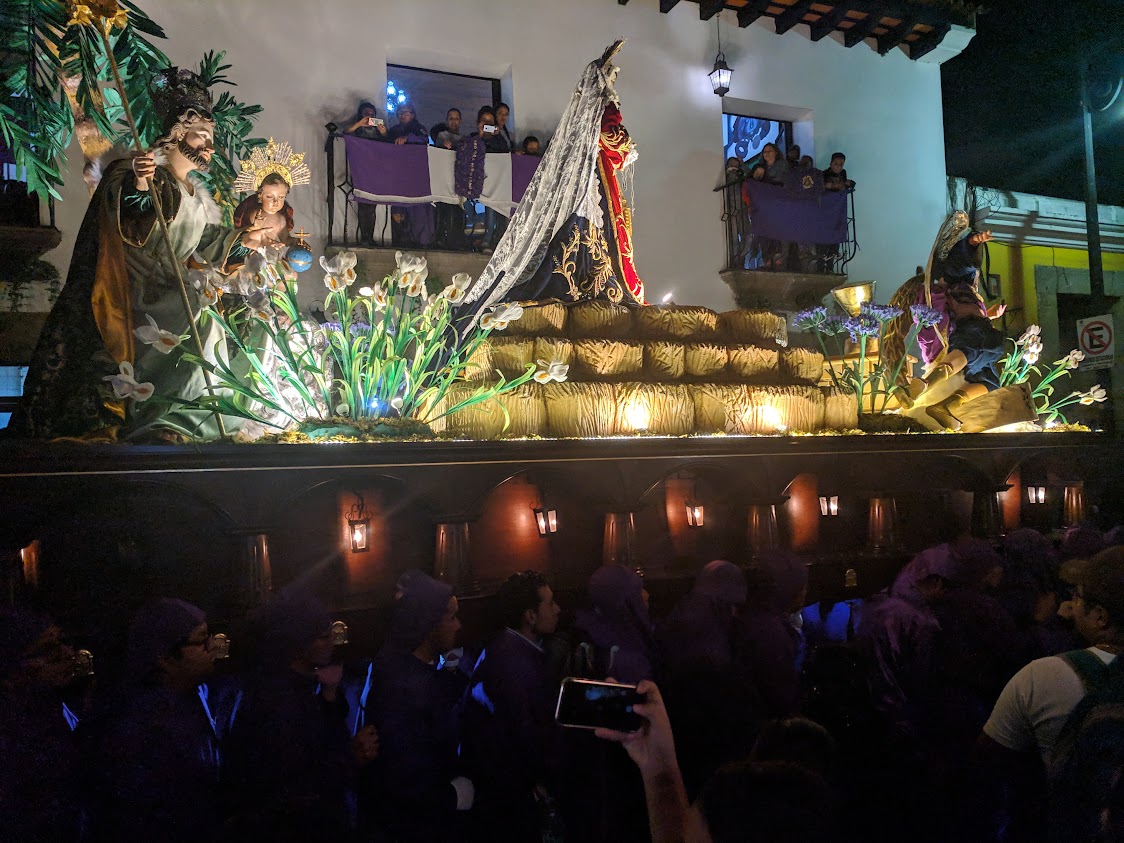
La Merced’s Viernes Santo procession is the one everyone comes to see. The yellow baroque facade of La Merced is the most photographed church in Antigua, and their anda is one of the largest – carried by up to 120 cucuruchos in rotation.
The scene: By 5 AM, the streets around La Merced are packed. The church doors open, incense pours out, and the anda emerges into the street. The crowd goes silent for a moment. Then the band hits the first notes of the funeral march and it begins.
Best viewing spots for La Merced:
- In front of La Merced itself – arrive by 4:15 AM to get a spot near the church doors. This is where you see the anda emerge.
- 1a Calle Poniente heading east – the first alfombras the procession will cross. Standing here lets you watch the moment of destruction: hours of work crushed under sandaled feet in seconds.
- 5a Avenida Norte near the Arch – if you cannot get close to La Merced, this is the next best option. The procession will pass through here later in the morning.
6:00 AM – Cathedral / San Jose Departs
The Cathedral procession departs from the Parque Central. It is one of the oldest processions in Antigua and follows a route through the central streets. By this time, the light is changing – the sky goes from black to deep blue to the first hints of gold. The alfombras, which looked ethereal under lamplight, now reveal their full color.
What changes at dawn: The crowds multiply. By 6 AM, the side streets that were empty at 3 AM are now full of families, tour groups, and vendors. The atmosphere shifts from contemplative to festival-like. This is not worse – it is different. The energy of 300,000 people sharing a tradition is its own experience.
7:00 AM – San Francisco Departs
San Francisco el Grande, home to the tomb of Hermano Pedro (Guatemala’s only saint), sends its procession later. This means the initial crowds are thinner. If you missed the early departures, this is a good one to catch from the start.
7:00 AM - 12:00 PM – Multiple Processions Overlap
From mid-morning onward, multiple processions are moving through Antigua simultaneously. The streets become a maze of purple robes, brass bands, and incense clouds. Some streets are impassable. Navigation requires flexibility.
Strategy: Pick a spot with good visibility – a second-floor cafe balcony if you can find one (reserve the day before), or a corner where two procession routes intersect. Let the processions come to you rather than chasing them.
Eat now. The comedores around Mercado de Antigua serve breakfast and almuerzo starting at 6 AM. A plate of eggs, beans, cheese, tortillas, and coffee runs Q20-35 (~$2.60-4.55). Eat a real meal before the midday crowds make everything harder. See our food guide for what to order.
12:00 PM - 3:00 PM – The Crush
This is peak density. Every tourist, every Guatemalan family, every vendor, and every procession is on the streets simultaneously. Movement is slow. Temperatures hit 28-30 degrees Celsius. The incense smoke thickens. Dehydration is a real risk.
My honest advice: If you have been out since 3 or 4 AM, take a break. Go back to your hotel. Nap. Shower. Hydrate. The processions will still be going at 4 PM. You do not need to be on the street for 16 consecutive hours.
If you stay out, find shade. Buy water from the vendors (Q5-10 for a bottle). Position yourself near a side street so you can exit the crowd if needed.
3:00 PM - 7:00 PM – The Afternoon Arc
The processions continue but the crowds thin slightly as day-trippers head back to Guatemala City. The light turns golden. The energy shifts from frenetic to something more reflective. Some of the smaller processions – the ones from neighborhood churches you have never heard of – pass through with genuine, unselfconscious devotion. These are often the most moving moments of the day.
The alfombras are gone now. The streets are covered in a thick layer of crushed sawdust, trampled flowers, and pine needles. It smells incredible – a mix of vegetation, incense residue, and hot stone. This carpet of debris is oddly beautiful.
After Dark
Some processions continue into the evening. The candlelight returns. The crowds are smaller. The mood is intimate. If you only have energy for two windows of the day, do 3-6 AM and then 6-8 PM. You will see Viernes Santo at its most atmospheric.
What It Costs
You can experience Viernes Santo for almost nothing. The processions are free. The alfombras are free. Standing on the street is free.
| Item | Cost (GTQ) | Cost (USD) |
|---|---|---|
| Atol de elote from vendor | Q5-10 | $0.65-1.30 |
| Street tostada or chuchito | Q5-15 | $0.65-2.00 |
| Almuerzo at comedor | Q25-35 | $3.25-4.55 |
| Water bottles (buy several) | Q5-10 each | $0.65-1.30 |
| Uber from GC (if day-tripping) | Q150-250 | $20-33 |
| Hotel in Antigua (if available) | Q400-2,000+ | $52-260+ |
Check today’s rate on our exchange rate page. For full budget planning, see our cost of living guide.
Getting There and Back
From Guatemala City
If you cannot find (or afford) a hotel in Antigua, day-tripping from Guatemala City is absolutely viable. Many Guatemalans do this.
- Leave GC by 1-2 AM to arrive for the alfombra-making and early processions. Yes, 1 AM. Uber works at this hour and the highway is empty.
- Return after the midday crush (2-4 PM) or stay until dark (7-9 PM).
- Expect double the usual travel time during peak hours (11 AM - 2 PM). The RN-14 becomes a parking lot.
Parking
If you drive, park outside the historic center. Antigua’s cobblestone streets are closed to traffic during Viernes Santo. Park in Jocotenango or along the highway approach and walk in (15-20 minutes).
Safety Reminders
Antigua during Semana Santa is safe, but 300,000 people in a small colonial town means pickpockets are active.
- Phone in a front zippered pocket, not in your hand or back pocket
- Small backpack worn on front in dense crowds
- Cash split between pockets – do not carry everything in one wallet
- Stay hydrated – dehydration causes more problems than crime
- POLITUR (tourist police) patrol all procession routes
For the full safety picture, read our Guatemala safety guide.
If You Miss Viernes Santo
Jueves Santo (Thursday, April 2) has its own processions – smaller but still spectacular. The Thursday night velaciones (prayer vigils) at churches with open doors are worth seeing. And Thursday night through Friday dawn is when the alfombras are made, which many people (including me) consider more magical than the processions themselves.
Sabado de Gloria (Saturday, April 4) is quieter. Some neighborhoods burn Judas effigies. It is a good day to see Antigua without the crushing crowds while the Semana Santa energy is still lingering.
For the full week-by-week breakdown, read our complete Semana Santa 2026 guide.
This guide is updated annually. Procession times are based on historical patterns and may shift. For real-time updates during Semana Santa week, follow local Antigua Facebook groups and check with your hotel. Explore Antigua and all of Guatemala on our interactive map.
![Viernes Santo Antigua 2026: Guia Hora por Hora de Procesiones [Horarios y Rutas]](/images/articles/semana-santa-alfombra.jpg)