Within Xela: walking handles most of Zona 1, tuk-tuks (Q5–25) handle everything else, Uber works in Zona 1 but is patchy in outer zones. Out of Xela: chicken buses from the Mercado Minerva terminal cover the entire western highlands (Zunil, San Andrés Xecul, Lake Atitlán via Los Encuentros, Huehuetenango), shuttles book through Spanish schools and tour operators handle Antigua and the airport. You can survive without a car in Zona 1. Outer zones and frequent day-trip travelers benefit from owning one.
Transport Mode Comparison
| Mode | Best For | Cost | Coverage | Difficulty |
|---|---|---|---|---|
| Walking | Zona 1 daily life | Free | Excellent in Zona 1 | Easy (altitude) |
| Tuk-tuk | Everything else within city | Q5–25 | Citywide | Easy |
| Uber | Airport, late night, luggage | Q15–80 | Strong Zona 1, weak elsewhere | Easy |
| Taxi (street) | Backup when Uber slow | Q20–80 | Citywide | Easy |
| Chicken bus | Day trips, intercity | Q5–60 | Western highlands | Moderate |
| Shuttle (private) | Antigua, Atitlán, airport | $20–50 | Tourist routes | Easy |
| Personal car | Outer zones, frequent travel | Variable | Anywhere | Moderate |
Walking the City
Xela’s Zona 1 is genuinely walkable — flat colonial grid, sidewalks (in better condition than most Guatemalan cities), block sizes calibrated to pedestrian use. From the Parque Centro América you can reach almost any point in Zona 1 within 10-15 minutes on foot. The cathedral, the Mercado La Democracia, the Pasaje Enriquez, every reputable Spanish school, dozens of cafés and restaurants, three banks with ATMs — all on the walking grid.
The altitude factor: Xela sits at 2,330 meters (7,650 feet). Newcomers often feel mildly winded the first 3-7 days, especially walking uphill or up stairs. This is normal and usually adjusts within a week. Drink more water than feels necessary, slow your pace the first few days, and avoid heavy alcohol the first 48 hours.
Walking outside Zona 1: The terrain starts changing. Walking from Zona 1 to Zona 3 takes 25-35 minutes through a mostly-flat commercial corridor. Walking to Zona 8 or Zona 9 involves uphill grades that newcomers find tiring. Walking to Cerro El Baúl is uphill the whole way (about 30-40 minutes). Walking down to the Mercado Minerva and bus terminal is fine; walking back up is the workout.
Sidewalk hazards: Standard Guatemalan-city issues — uneven paving, occasional missing manhole covers, vendor stalls that block sidewalks during market hours. Watch your footing especially in older Zona 1 streets and during rainy season when stones can be slippery.
Safety: Walking Zona 1 during daylight hours is generally safe and pleasant. After 9-10 PM, take a tuk-tuk for trips longer than 5 minutes especially if you’re alone. The bus terminal area at Mercado Minerva is the highest-petty-theft area in Xela; avoid walking there alone with a backpack at night.
Tuk-Tuks — The City Workhorse
Tuk-tuks (called “moto-taxis” officially, “tuk-tuks” colloquially) are Xela’s default in-city transport for anything beyond walking distance. Three-wheeled, two-stroke, bright colors, drivers who know every street. They run from roughly 6 AM to midnight in Zona 1 and 6 AM to 9 PM in outer zones.
Typical fares (one way):
- Within Zona 1: Q5-10 (~$0.65-1.30)
- Zona 1 to Zona 3: Q15-20
- Zona 1 to Zona 8 or Zona 9: Q15-25
- Zona 1 to bus terminal (Mercado Minerva): Q10-15
- Zona 1 to Cerro El Baúl: Q15-20
How to use:
- Flag one on any street. Most drivers will pull over immediately.
- Tell the driver where you’re going BEFORE you get in: “Cuánto a [destination]?”
- Negotiate if the quote seems high (rare, but possible at night or with luggage).
- Climb in, hold on (the suspension is theatrical).
- Pay cash on arrival. No tipping expected — round up to the nearest Q5 if you want.
Late-night tuk-tuks: After 10 PM, fewer tuk-tuks circulate but some still work the Zona 1 nightlife corridor. If you can’t flag one, walk to the Pasaje Enriquez or the Parque Centro América and wait — that’s where they queue.
Safety: Tuk-tuks are generally safe. The driver-passenger interaction is normal. The biggest risk is opportunistic phone-snatching at red lights — keep your phone in your pocket, not in your hand, when stopped.
Uber and Street Taxis
Uber works in Xela but is meaningfully thinner than in Guatemala City or Antigua. Coverage is strongest in Zona 1 during daytime and evening hours; you’ll often wait 8-15 minutes for a car in Zona 6, 8, 9 or after 10 PM in any zone. Fares are Q15-25 for short trips within the city, Q40-80 for trips to outer zones or the bus terminal. Worth using for:
- Trips to/from La Aurora airport in Guatemala City (~Q1,200-1,800; Uber is rarely worth it for this — book a shuttle or private transfer instead)
- Late-night trips when tuk-tuks are scarce
- Any trip with luggage (tuk-tuks struggle with more than one suitcase)
- Bad-weather days when you don’t want to wait outside
Street taxis are the fallback when Uber is slow. Yellow taxis circulate in Zona 1 and queue at the Parque Centro América. Negotiate the fare BEFORE getting in — Q20-50 for in-city trips, Q60-100 for trips to outer zones. Cash only.
InDriver (now inDrive) publishes no Guatemalan city list, so check whether your Xela address appears in the app (inDrive help page, read 24 September 2026).
Chicken Buses (Camionetas)
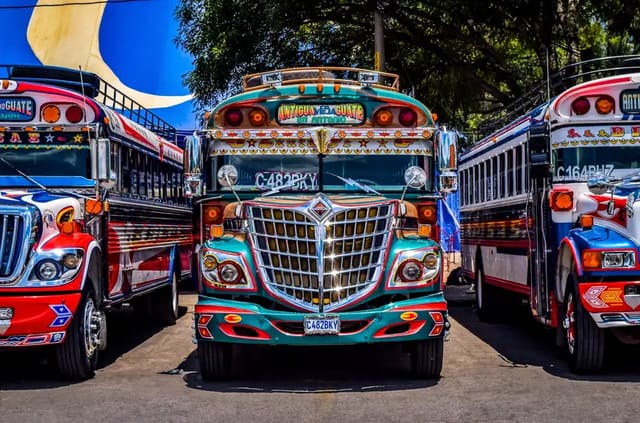
Xela’s main bus terminal is at Mercado Minerva on the western edge of Zona 1. From there, camionetas (chicken buses — repurposed US school buses painted in vivid colors) run to most points in western Guatemala.
How chicken buses work:
- Walk to the Mercado Minerva terminal (Q10-15 tuk-tuk from Parque Centro América).
- Find your destination — drivers and ayudantes (helpers) shout the route names: “ZUNIL ZUNIL”, “SAN ANDRÉS SAN ANDRÉS”, “LOS ENCUENTROS LOS ENCUENTROS”, etc.
- Climb on. Buses leave when full, not on a schedule. Wait time is usually 5-20 minutes.
- Pay the ayudante on board (he walks down the aisle collecting fares). Have small bills — Q5, Q10, Q20.
- Tell the ayudante where you’re getting off; he’ll signal the driver.
Common routes from Xela:
| Destination | Fare | Time | Frequency |
|---|---|---|---|
| Zunil (for Fuentes Georginas) | Q5–10 | 30 min | Every 15 min |
| San Andrés Xecul | Q10–15 | 35 min | Every 20–30 min |
| Almolonga | Q5–10 | 20 min | Every 15 min |
| San Martín Sacatepéquez (for Chicabal) | Q15–25 | 45 min | Every 30–60 min |
| Cuatro Caminos (junction) | Q10–15 | 35 min | Every 10–15 min |
| Huehuetenango | Q30–45 | 2 hours | Every 30–60 min |
| Los Encuentros (for Atitlán) | Q35–50 | 2.5 hours | Every 30 min |
| Panajachel via shuttle | Q150 | 3 hours | 2× daily |
| Guatemala City (Pullman) | Q60–100 | 4 hours | Hourly |
For Lake Atitlán: Chicken bus to Los Encuentros (the major junction), transfer to a Panajachel-bound bus (Q15-25). Total Q50-75 each way; total time 3-4 hours. Direct shuttles are faster and more comfortable for $20-30/person.
Pullman buses (long-distance coaches with assigned seats) run from a separate terminal near Zona 3 to Guatemala City. More comfortable, more reliable schedule, slightly more expensive (Q60-100 vs Q40-60 chicken bus). Líneas Dorada, Línea Quiché, and Marquensita are the main operators on the Xela-Guatemala City route.
Safety on chicken buses: Generally safe during daylight hours on the major intercity routes. Keep valuables (passport, phone, wallet) on your body, not in a backpack on the floor. Pickpocketing happens when the bus is crowded. Avoid late-night rural routes — armed robbery on rural buses, while rare, has happened.
Shuttles to Antigua, Atitlán, and the Airport
For tourists and Spanish-school students, shuttles are the standard way to move between Xela and the major destinations. Book through your Spanish school, a Xela tour operator (Adrenalina Tours, Quetzaltrekkers, Altiplano Tours), or hostel front desks.
Standard routes from Xela:
| Route | Cost | Time | Frequency |
|---|---|---|---|
| Xela → Antigua | $25–35 | 4–4.5 hours | 1–2× daily |
| Xela → Panajachel (Lake Atitlán) | $20–30 | 2.5–3 hours | 1–2× daily |
| Xela → Guatemala City airport | $30–45 | 4–4.5 hours | 1–2× daily |
| Xela → San Pedro La Laguna | $25–35 | 3–3.5 hours | 1× daily |
| Xela → Huehuetenango | $20–30 | 2–2.5 hours | On request |
Shuttles are minivans (10-15 passengers), typically pick up at hostels or central locations. Faster than chicken bus combinations, more comfortable, no transfer required. The cost is 2-4× higher than chicken buses but saves 1-3 hours and the navigation hassle.
Booking: Book at least 24 hours ahead during high season (December-April, mid-June through August). During low season (May, September-November) walk-in same-day is usually fine.
Day-Trip Transport Strategies
Fuentes Georginas (most common day trip): Chicken bus to Zunil (Q5-10, 30 min), pickup-truck taxi from Zunil to the hot springs (Q15-20). Total round trip Q40-80 by public transit, plus Q60-80 entry. Or organized Spanish-school trip Q100-200 all-in. Or private taxi/shuttle Q200-350.
Volcán Chicabal: Chicken bus to San Martín Sacatepéquez (Q15-25, 45 min), then walk or hire local guide at trailhead. Or organized Spanish-school trip Q100-200 with guide.
San Andrés Xecul + Almolonga combo: Chicken bus to San Andrés Xecul (Q10-15, 35 min), then back to Cuatro Caminos junction, transfer to Almolonga (Q5-10, 15 min), then back to Xela. Total Q40-60 in fares, full half-day. Or guided tour $20-30/person.
Lake Atitlán day trip: Best done as an overnight or weekend trip rather than a day trip. If you must do it as a day: 6 AM departure shuttle, 4-5 hours one-way, you arrive at Pana around 10:30 AM with about 4-5 hours before you need to leave. Tight.
Volcán Santa María dawn summit: Pre-arranged with guide service the night before (typical 1 AM departure). Guide picks you up; round-trip transport included in the $25-50 guide fee.
Driving Yourself
In Xela city: More relaxed than Guatemala City but the bus terminal area, Mercado Minerva, and the streets around the Parque Centro América during market hours are chaotic. Tuk-tuks dart, vendors block lanes, parking is scarce in Zona 1. Newer drivers find Zona 3 easier than Zona 1.
Parking:
- Zona 1: Street parking with limited paid lots ($30-60/mo for assigned space). Some Zona 1 colonial homes have no garage.
- Zona 3: Most apartment buildings include parking. Mall lots are abundant.
- Zona 8/9: Driveways and garages standard.
On highways: The CA-1 connecting Xela to Cuatro Caminos and onward is decent two-lane road, occasionally three-lane on hills for passing. The road to Lake Atitlán via Los Encuentros has serious switchbacks and slow trucks; allow 30-50% more time than a similar US distance suggests. Avoid driving rural roads at night when possible.
Fuel: Gas stations are common in Zona 3 and along the highways. Prices similar to elsewhere in Guatemala (around Q33-38/gallon for regular as of mid-2026).
See our cost-of-living guide for car-ownership budget breakdown and our gas prices tracker for current fuel costs.
From the Airport (Guatemala City) to Xela
Direct shuttle: $25-40 per person, 4-4.5 hours. Several operators run daily; book through your Spanish school, hostel, or a tour operator. This is the default for most newcomers.
Private transfer: Q800-1,400 ($100-180) for the vehicle (1-4 passengers). 4 hours. Best for groups, families, or travelers with significant luggage.
Chicken bus combination: Q40-60 total via Pullman to Quetzaltenango, then chicken bus or tuk-tuk in Xela. 5-6 hours total. Only for travelers comfortable with multiple transfers and basic Spanish.
Direct flight to Xela’s small airport: Service has been sporadic over recent years. As of 2026 it’s not reliable enough to plan around — confirm current schedules at booking time.
Arrival timing: Most flights from the US arrive at La Aurora between 8 PM and 11 PM. Direct shuttles typically depart 10-11 PM and arrive Xela 2-4 AM — uncomfortable but workable. Daytime flights arriving by 4 PM allow a same-day shuttle to Xela arriving by 9 PM.
Frequently Asked Questions
Do I need a car in Xela?
If you live in Zona 1, no — walking and tuk-tuks cover daily life. If you live in Zona 8, Zona 9, or commute outside the city regularly, yes. A car is also useful for day trips to Fuentes Georginas, San Andrés Xecul, and Lake Atitlán though chicken buses cover these routes inexpensively. Driving in Xela itself is more relaxed than Guatemala City but the bus terminal and Mercado Minerva areas are chaotic.
How much is a tuk-tuk in Xela?
Within Zona 1: Q5–10 per ride (about $0.65–1.30). Zona 1 to Zona 3: Q15–20. Zona 1 to Zona 8 or Zona 9: Q15–25. Zona 1 to the bus terminal: Q10–15. Tuk-tuks are everywhere — flag one on any street. Drivers expect a fare quote before you get in; ask “Cuánto a [destination]?”. Pay in cash. No tipping expected.
Does Uber work in Xela?
Uber works in Xela but coverage is meaningfully thinner than Guatemala City and Antigua. You’ll often wait 8–15 minutes for a car, especially in Zona 6, 8, 9 or after 10 PM. In Zona 1 during peak hours (lunch, evening) Uber works reliably. For most short trips within the city, tuk-tuks are faster and cheaper. Use Uber for trips to/from the airport, longer trips after dark, or when you have luggage.
How do I get from Guatemala City airport to Xela?
Three options: (1) Direct shuttle from the airport to Xela — book through your Spanish school or a Xela tour operator, $25–40 per person, 4–4.5 hours. (2) Chicken bus combination via Cuatro Caminos — Q40–60 total, 5–6 hours, only for travelers comfortable with multiple transfers and Spanish. (3) Private transfer Q800–1,400 ($100–180) for groups, 4 hours. Most newcomers take option 1. Direct flights to Xela’s small airport exist but service is sporadic.
How do chicken buses work in Xela?
Xela’s main bus terminal is at Mercado Minerva on the western edge of Zona 1. Camionetas (chicken buses) run from there to most points in western Guatemala — Zunil, San Andrés Xecul, Almolonga, Huehuetenango, Cuatro Caminos (the major junction for onward connections), and the Lake Atitlán towns via Los Encuentros. Pay the ayudante (helper) on board, not at the terminal. Fares are Q5–30 depending on distance. Buses leave when full, not on a schedule.
Is Xela walkable?
Zona 1 is highly walkable — flat grid, well-paved sidewalks, blocks short enough that 10–15 minutes covers most daily destinations. The terrain starts climbing once you leave Zona 1 (Cerro El Baúl, Zona 8) and descending toward the bus terminal. Sidewalks in Zona 3 are functional but more car-oriented. The biggest walking challenge is altitude (2,330m) — newcomers often feel slightly winded the first 3–7 days, especially walking uphill.
Related Xela Resources
- Things to Do in Xela — Fuentes Georginas, Volcán Chicabal, day trips
- Best Restaurants in Xela — Where to eat after your day-trip return
- Where to Live in Xela — Zone-by-zone walkability ratings
- Driving in Guatemala — Wider Guatemala driving guide
![Getting Around Guatemala: Complete Transport Guide [2026]](/cdn-cgi/image/width=640,format=auto,quality=80/images/articles/rio-dulce.webp)