If you have one day in Xela: Fuentes Georginas in the morning, Parque Centro América and Pasaje Enriquez in the late afternoon, Salón Tecún for dinner. If you have two days: add Volcán Chicabal hike or San Andrés Xecul. If you have three or more: add a Spanish-school morning, a cooking class, and either Cerro El Baúl for sunset or a chicken-bus day trip to Almolonga or Zunil markets. Xela's biggest activity is the city itself — the pace is slower and the scene more local than Antigua, and walking it for two days is a real activity in itself.
The Top Activities Table
| # | Activity | Type | Cost | Time | Difficulty |
|---|---|---|---|---|---|
| 1 | Fuentes Georginas | Hot springs / Day trip | Q60–80 entry + transit | 4–5 hours | Easy |
| 2 | Volcán Chicabal | Sacred crater-lake hike | Q75 foreigners / Q20 nationals (reported 2025) + guide $15–25 | 4–5 hours | Moderate |
| 3 | Parque Centro América | Colonial central park | Free | 1–2 hours | Easy |
| 4 | San Andrés Xecul Church | Cultural / Photo stop | Free + transit Q15 | 2–3 hours | Easy |
| 5 | Cerro El Baúl | Sunset lookout hill | Free | 1.5–2 hours | Easy-moderate |
| 6 | Volcán Santa María | Dawn-summit hike | Guide $25–50 | 10–12 hours | Hard |
| 7 | Volcán Santiaguito viewpoint | Active volcano viewing | Q15 + guide optional | 3–4 hours | Moderate |
| 8 | Almolonga Market | Indigenous market | Free + transit Q5–15 | 3–4 hours | Easy |
| 9 | Zunil Market + Maximón | Cultural / Religious site | Q5 + transit Q15 | 3–4 hours | Easy |
| 10 | Casa de la Cultura | Museum | Free / Q5 | 1–1.5 hours | Easy |
| 11 | Museo de Arte de Quetzaltenango | Art museum | Q15–25 | 1–2 hours | Easy |
| 12 | Salón Tecún + Pasaje Enriquez | Nightlife / Bar | Q60–150 | Evening | Easy |
| 13 | Mercado La Democracia | Market food + shopping | Free | 1–2 hours | Easy |
| 14 | Mercado Minerva | Larger market | Free | 1–2 hours | Easy |
| 15 | Spanish school cooking class | Cultural / Cooking | Q150–250 | 3–4 hours | Easy |
| 16 | Laguna de Chicabal alone (no climb) | Easier hike option | Q20 + guide | 3 hours | Easy-moderate |
| 17 | Termas Xelapán hot pools | Hot springs (smaller) | Q40–60 | 2–3 hours | Easy |
| 18 | Day trip to Atitlán | Lake day trip | Q100–250 transport | Full day | Easy |
| 19 | Day trip to Huehuetenango | City day trip | Q40–80 transport | Full day | Easy |
| 20 | Tikal day-flight (advanced) | Mayan ruins | Flight + tour ~$300 | Full day | Easy |
Fuentes Georginas — The Default Day Trip
The Fuentes Georginas are natural sulfur hot springs at 2,900 meters elevation in the cloud forest above Zunil, about 8 km south of Xela. They are Xela’s signature day trip and the activity almost every Spanish school recommends to first-week students.
The setup is a series of stone-walled pools fed by a hot spring under the Volcán Zunil. The water comes out hot enough that the staff blends in cold mountain water to keep the largest pool around 38-40°C (100-104°F). Smaller pools higher up the path are hotter (42-44°C). The whole complex is set in genuine cloud forest — moss-covered pines, daily afternoon mist, the smell of sulfur.
Getting there: Chicken bus from the Xela bus terminal to Zunil (Q5-10, 30 minutes), then a pickup-truck taxi from the Zunil town square up the mountain to the hot springs (Q15-20 each way). Total round-trip Q40-80 by public transit. Private taxi or Spanish-school shuttle Q200-350 round trip from Xela. Most Spanish schools run organized trips for Q100-150 per person including transport and entry.
Cost on-site: Q60-80 entry for non-residents (rates change; Guatemalan residents with DPI get a lower rate). Open daily roughly 8 AM-6 PM.
What to bring: Towel, swimsuit, change of clothes (the air at 2,900m is cold even when the water is hot — you will be cold getting out). Snacks, water — there is a small cafetería on-site but the prices are tourist-tier. Cash only.
Best timing: Early morning (8-10 AM) is least crowded and the cloud forest is most atmospheric. Saturdays and Sundays bring Guatemalan family crowds — go on a weekday if you can.
Volcán Chicabal — The Sacred-Lagoon Hike
Volcán Chicabal is a smaller, lower, dormant volcano (2,712m) about 30 km southwest of Xela, near the village of San Martín Sacatepéquez. The summit holds a near-perfectly-round crater lake — Laguna de Chicabal — that is one of the most important Maya sacred sites in western Guatemala. Mam-Maya communities perform ceremonies here regularly, and large gatherings happen on the May 3 Cruz Festival.
The hike: From San Martín Sacatepéquez (the trailhead village; Q15-25 by chicken bus from Xela), the trail climbs about 600 meters over 2-2.5 km to the crater rim. From the rim, a steep set of wooden stairs descends 150 meters to the lagoon shore. Most hikers spend 30-60 minutes at the lagoon and then climb back out. Total round trip from San Martín: 4-5 hours of walking plus rest. Well-marked trail; some sections muddy in rainy season.
Difficulty: Moderate. The elevation makes it harder than the distance suggests. Most reasonably-fit adults manage it; not suitable for very young children or anyone with knee problems on the descent.
Guide or no guide? You technically don’t need a guide. Most Spanish schools run Chicabal trips for Q100-200 per person including transport and a guide. Solo hikers can chicken-bus to San Martín and find a local guide at the trailhead for Q50-100. The reason to take a guide isn’t navigation — it’s that the lagoon is sacred and a guide can explain the cultural significance, point out ceremony sites, and ensure visitors behave appropriately when ceremonies are in progress.
Important: Avoid the May 3 Cruz Festival day unless you are specifically going for the cultural experience and have a guide who is welcomed by the community. The lagoon is closed to casual tourists for several days around May 3.
Best timing: Early morning, dry season (November-April). The lagoon is clearest in the morning before clouds roll in.
Parque Centro América and the Colonial Core
The Parque Centro América is the heart of Xela. A full city block bounded by the Catedral del Espíritu Santo on the east, the Pasaje Enriquez and the Municipalidad on the west, and the Casa de la Cultura on the south. The park has ornamental fountains, marimba performances on weekends, and the kind of slow-paced bench-sitting culture that Xela does better than Guatemala City.
What to see in the immediate vicinity (15-minute walk):
- Catedral del Espíritu Santo — Xela’s main cathedral. Free entry. The exterior facade is the photo-op; the interior is more austere than the colonial cathedrals of Antigua.
- Casa de la Cultura — Free regional history museum on the south side of the park. Photos of 19th-century Xela, indigenous textile displays, the second-floor terrace has good park views.
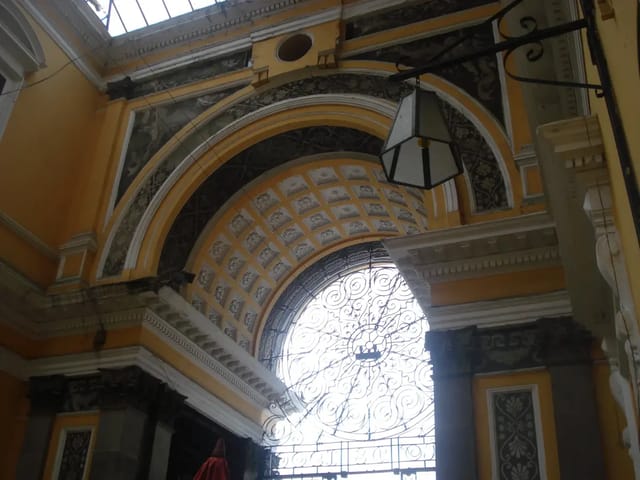
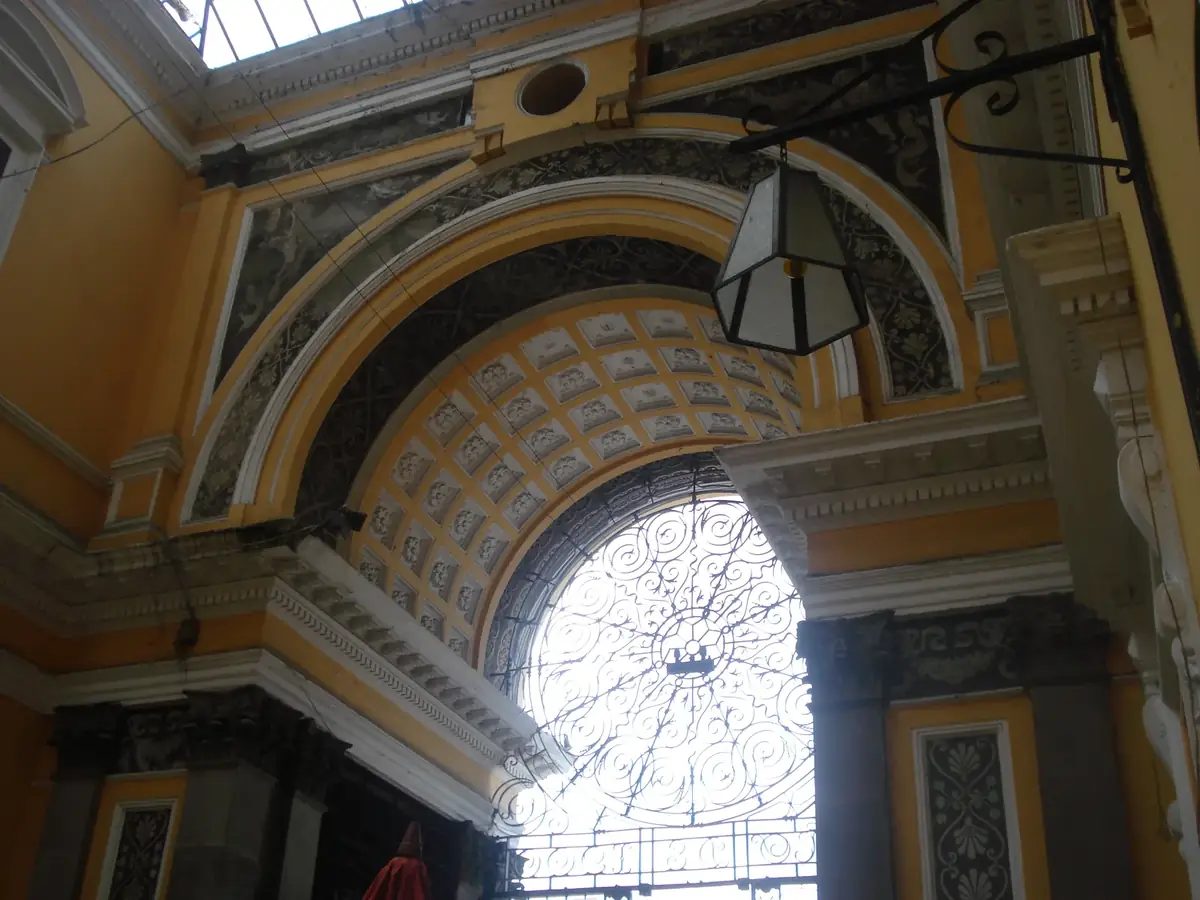
- Pasaje Enriquez — The 19th-century covered passage off the southwest corner. Salón Tecún anchors it; smaller bars, craft shops, and old hand-painted signage fill the rest.
- Mercado La Democracia — One block north of the park. The market food stalls (see /xela/restaurants/) and fabric vendors are the highlights.
- Templo de Minerva — A small classical-style temple at the western edge of Zona 1, built in 1916 to honor education. Photo stop, 15 minutes.
The Parque is ideal for a 1-2 hour evening wander before dinner. Sit on a bench, watch families with kids, listen for marimba on weekends, then walk to the Pasaje Enriquez for drinks.
San Andrés Xecul — The Photographed Church
The Iglesia de San Andrés Xecul is the famous yellow-and-red baroque-Maya syncretic church about 30 minutes north of Xela by car or chicken bus. It is genuinely one of the most colorful churches in Guatemala — vivid yellow facade with red, blue, green, and orange Maya-influenced figures climbing across the front. Built in the 18th century, repainted in the modern color scheme more recently.
Getting there: Chicken bus from Xela’s terminal toward San Andrés Xecul, Q10-15, 30-40 minutes. Private taxi Q150-200 round trip. Guides arranged through Xela tour operators run combined trips with Almolonga market for $20-30/person.
On-site: The church is free to enter. The interior contains traditional Catholic statuary that contrasts with the syncretic exterior. The plaza in front has a few small comedores and street-food vendors.
Combined day trip: Pair San Andrés Xecul with the Almolonga indigenous market (Tuesday and Friday are the plaza days, per Deguate’s municipal profile) and/or Zunil for a full half-day cultural circuit. Many Xela Spanish schools run this exact combination as a Saturday day trip.
Cerro El Baúl — The Sunset Lookout
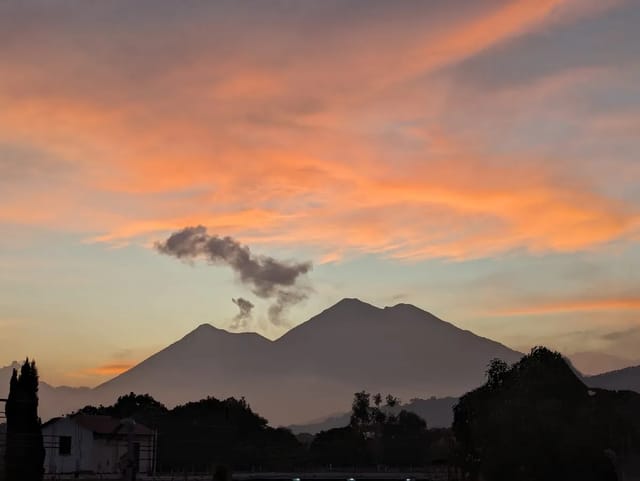
Cerro El Baúl is a forested hill in Xela’s Zona 8, accessible by a 30-40-minute walk uphill from Zona 1 or a Q15 tuk-tuk ride. The lookout at the top has unobstructed views of Xela below, the Volcán Santa María to the south (with Santiaguito’s ash plumes if you’re lucky), and the surrounding valleys.
Best timing: 5:30-6:30 PM for sunset, especially in dry season (November-April) when the volcanoes are visible. Bring a light jacket — the temperature drops fast at altitude when the sun goes down.
Safety note: The walk up is fine during daylight hours. After dark, take a tuk-tuk or taxi back down to Zona 1 — the trail is less patrolled at night and the descent is steep.
Volcán Santa María — The Serious Volcano Hike
Volcán Santa María (3,772m) is the dominant volcano in the Xela skyline, with its perpetually-active vent Santiaguito on its southwestern flank. Climbing Santa María is a serious undertaking: a 12-hour round trip starting at 1-2 AM to reach the summit at sunrise.
The reward: Standing on the summit at dawn, looking down at the cloud-forest valley below and watching Santiaguito erupt small ash plumes from above — a vantage point geologists describe as one of the best in Central America for active-volcano observation.
Difficulty: Hard. The trail starts at around 2,500m and gains 1,200+ meters of elevation. Sections are steep and cold; the summit is windy and below freezing pre-dawn even in dry season. Altitude sickness is a real risk for travelers who haven’t acclimatized.
Cost: Local guide $25-50/person (group rate). Total trip including transport from Xela $35-60.
Versus Acatenango near Antigua: Acatenango is the more famous volcano hike in Guatemala (overnight at high camp, sunrise at summit, views of Volcán Fuego). Santa María is a one-day push with an earlier start. Both are serious. If you can only do one, Acatenango has the better volcano-eruption views in normal years; Santa María gives you Santiaguito’s smaller, more frequent ash plumes from above.
Easier alternative: Volcán Santiaguito viewpoint — a much shorter hike on a side trail that lets you see Santiaguito erupting from a safe distance (without climbing Santa María). 3-4 hours round trip; moderate difficulty; same guides offer it as an alternative for less-fit travelers.
Indigenous Markets — Almolonga and Zunil
Almolonga (15 minutes east of Xela by chicken bus) and Zunil (30 minutes south) both have full-scale indigenous markets that are calibrated for local trade, not tourists. This is what makes them worth visiting.
Almolonga is famous for its enormous vegetables — the soil and altitude produce carrots, lettuces, and onions at 2x the size of typical Guatemalan produce. Deguate’s municipal profile gives Tuesday and Friday as the plaza days, with produce sold in smaller quantities the rest of the week, and INGUAT’s visitor guide recommends going in the morning, when the market has the most energy. The town itself is small but the market is genuinely impressive.
Zunil is on the way to Fuentes Georginas, so most visitors combine the two. Zunil’s market spreads through the central streets; the highlight for many visitors is the home of Maximón (also called San Simón) — a syncretic Maya-Catholic figure venerated locally. The Maximón shrine moves between local houses each year; ask in the Zunil central plaza for the current location, expect a Q5-10 entry donation, and bring a small bottle of liquor or a cigarette as an offering if you want to participate respectfully in the local custom.
Day Trips Out of Xela
Lake Atitlán (Panajachel, San Pedro La Laguna): 2.5-3.5 hours by shuttle (Q100-150 each way) or chicken-bus combination. Doable as a long day trip or a 1-2-night side trip. Most Xela travelers spend at least one weekend at Atitlán.
Huehuetenango: 2-2.5 hours north by chicken bus or shuttle. The city itself is workmanlike; the reason to go is the surrounding mountain region (Todos Santos Cuchumatán, Zaculeu ruins) and the stark Cuchumatanes plateau scenery.
Tikal: Effectively requires flying to Flores (Avianca operates daily from Guatemala City; from Xela it requires a connection). Multi-day commitment; $300+ all-in. Most Xela visitors do Tikal as a separate trip rather than a Xela day trip.
Volcán Tajumulco: Highest peak in Central America (4,222m). Serious 2-day climb from a trailhead north of Xela. Guides $50-80/person. For experienced hikers only.
Rainy Day Backup
Xela’s rainy season (May-October) brings reliable afternoon rain, often starting around 1-2 PM and continuing into the evening. Most outdoor activities should be done in the morning. Indoor options:
- Casa de la Cultura — Free regional history museum (south side of Parque Centro América)
- Museo de Arte de Quetzaltenango — Local art museum, Q15-25 entry
- Cinépolis Pradera Xela — Modern multiplex in Zona 3, $4-6 USD per ticket
- Spanish-school cooking class — Most schools run one-off cooking classes for Q150-250 (kak’ik, pepián, tamales, chuchitos)
- Café-coworking — A long afternoon at Café Cuates, Café Black Cat, or El Cuartito with a laptop and pastries
- Spa / massage — Several spas in Zona 1 offer massages for Q150-300 (lower than Antigua)
Festivals and Annual Events
Feria de la Independencia (September 12-15): Xela’s regional independence celebration. Marimba performances, parades, traditional dance, food stalls. The city fills with families from surrounding municipios.
Feria de Xelajú (Mid-September, around the 15th): The main municipal feria patronal. Concerts, fairground rides, mass at the cathedral, processions. The biggest annual event in Xela.
May 3 Cruz Festival at Volcán Chicabal: Sacred Maya gathering at Laguna de Chicabal. Generally not appropriate for casual tourist visits unless invited by the community. The day before and after are also affected.
Quema del Diablo (December 7): The pre-Christmas burning of effigies happens in plazas around Xela the evening of December 7. Smoky and atmospheric.
Semana Santa (Holy Week): Less elaborate than Antigua’s Semana Santa but still significant — alfombras (sawdust carpets), processions through Zona 1, packed cathedral. A reasonable alternative to Antigua’s tourist-heavy version.
Frequently Asked Questions
What are the top things to do in Xela?
Top picks: (1) Fuentes Georginas — natural hot springs at 2,900m, 30 minutes south of Xela in Zunil. (2) Volcán Chicabal — sacred crater-lake hike, 4–5 hours round trip from San Martín Sacatepéquez. (3) Parque Centro América — the colonial central park with the cathedral and the Casa de la Cultura. (4) San Andrés Xecul — the famously colorful yellow-and-red church, 30 minutes north. (5) Cerro El Baúl — the city’s lookout hill in Zona 8 with sunset views over Xela and the surrounding volcanoes.
How much do Fuentes Georginas cost?
Q60–80 (~$8–10) entry per person for non-residents (lower for Guatemalans with DPI). Open daily roughly 8 AM–6 PM. Round-trip transport from Xela by chicken bus is Q15–25 (transfer in Zunil); a private taxi or shuttle is Q200–350 round trip. Plan 4–5 hours including transit. Bring towel, swimsuit, and a change of clothes — the air is cold even when the water is hot.
Is Volcán Chicabal hard to hike? Do I need a guide?
Volcán Chicabal is moderate — about 4–5 hours round trip from San Martín Sacatepéquez (the trailhead village), with around 600 meters of elevation gain to the crater rim and then a steep descent to the lagoon. Trail is well-marked. You technically don’t need a guide, but going with a local guide ($15–25/person from Xela tour operators) helps because the lagoon is a Maya sacred site and a guide can explain the significance and the protocol around ceremonies you may witness. Avoid the May 3 festival day unless you’re specifically there for that.
Is San Andrés Xecul really as colorful as the photos?
Yes. The Iglesia de San Andrés Xecul is a 19th-century baroque-Maya syncretic church painted in vivid yellow with red, blue, green, and orange figures. It is unironically one of the most photographed churches in Guatemala and lives up to the photos. Free to visit, ~30 minutes by car or chicken bus from Xela. The interior is also worth seeing — different from the exterior, with traditional Catholic statuary.
What is there to do in Xela on a rainy day?
Xela’s rainy season (May–October) brings afternoon rain almost daily. Indoor options: Casa de la Cultura on the Parque Centro América (free regional history museum), Museo de Arte de Quetzaltenango, the cinemas at Pradera Xela (Zona 3), Spanish-school cooking classes (most schools offer one-off cooking classes for Q150–250), and the café-and-coworking circuit in Zona 1. Mornings are usually clear; plan outdoor activities before 1 PM.
Is Volcán Santa María worth climbing?
Volcán Santa María (3,772m) is a serious dawn-summit hike — typically a 12-hour round trip starting at 1–2 AM to reach the summit at sunrise. Views of the active vent Santiaguito erupting below you are extraordinary. Difficulty is high (steep, cold, altitude); fitness required. Always go with a guide ($25–50/person from Xela tour operators). Less suitable for casual visitors than Chicabal. Acatenango near Antigua is a more popular volcano hike and similarly serious.
Related Xela Resources
- Best Restaurants in Xela — Salón Tecún, Royal Paris, comedores under Q40
- Where to Live in Xela — 5 zones compared, rent and climate
- Getting Around Xela — Chicken buses to Fuentes Georginas, tuk-tuks, walking
- Quetzaltenango Department — Wider department guide