What this page tracks
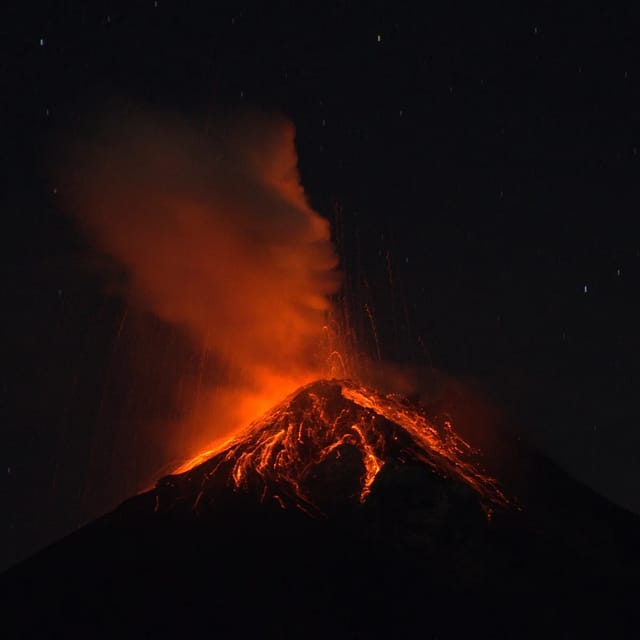
Volcán Santiaguito is the lava dome complex growing on the southwest flank of Santa María, the catastrophic 1902 stratovolcano whose VEI 6 eruption killed about 5,000 people and remains one of the largest 20th-century volcanic events. The dome emerged 20 years after the 1902 collapse and has been continuously active ever since.
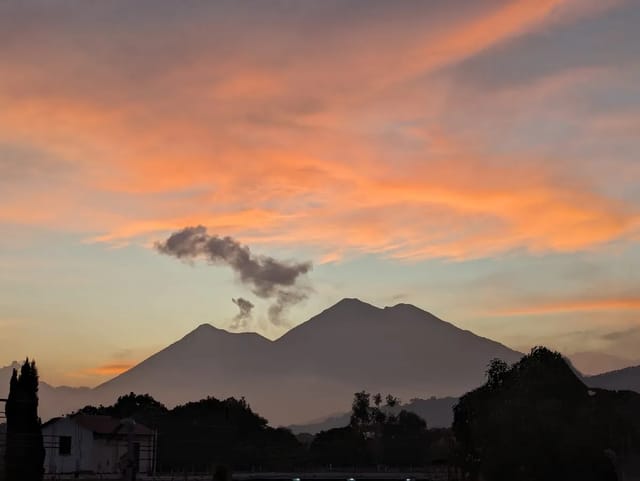
For residents of Quetzaltenango (Xela) — Guatemala’s second-largest city, only 12 km north of the dome — Santiaguito is a constant presence: a daily plume visible on clear mornings, ash that in the 74 INSIVUMEH daily bulletins we read (every other day, 1 May–24 Sep 2026, rainy season only) was named on villages beside the dome (San Marcos Palajunoj, Loma Linda) and never on Quetzaltenango itself (counts by community), and the ongoing risk of lahars during rainy season. Corrected 25 September 2026: this sentence said Xela gets occasional ashfall, without a source. For visitors hiking Santa María, Santiaguito provides one of the most extraordinary volcano views in the world: looking down into an actively venting dome from 1,000 m above.
This page pulls live data from three sources:
- INSIVUMEH — daily Boletín Vulcanológico, alert level, explosion counts, ash plume heights from the Santiaguito Observatory.
- Smithsonian Global Volcanism Program (GVP) — confirmed eruption record back to the 1902 Santa María event.
- Washington VAAC — ash advisories that can affect Quetzaltenango and the southern Pacific coast airspace.
When INSIVUMEH’s daily PDF is image-only and our scraper can’t read it automatically, the live card falls back to the most recently curated alert level. The bulletin URL is always live so you can read the source in Spanish.
Where Santiaguito sits
The Santiaguito dome complex grows at 2,500 meters above sea level on the southwest flank of the much taller Santa María (3,772 m) parent stratovolcano. It is located in Quetzaltenango department, with the city of Quetzaltenango at 14.836°N (about 12 km north of the dome) and Retalhuleu south on the Pacific coastal plain.
Santiaguito is classified as a lava dome complex — a different beast from Fuego or Pacaya. Instead of fluid lava flows or explosive Strombolian bursts, Santiaguito grows slowly upward and outward as viscous dacite extrudes from the crater. The danger comes when sections of the dome collapse, generating block-and-ash flows that race down the southern drainages toward Retalhuleu and El Palmar.
The complex actually has four named domes — Caliente, La Mitad, El Monje, and El Brujo — which have taken turns being the active venting center since 1922. Caliente has been the dominant active dome in the most recent decades.
Risk zone and evacuation routes
The map above plots the official 15 km risk radius around the dome. Four nearby population centers:
- Quetzaltenango (Quetzaltenango) — Guatemala’s second-largest city, ~12 km north at 2,330 m elevation. Vulnerable to ashfall when winds shift north (rare; prevailing winds push ash south).
- Retalhuleu (Retalhuleu department) — on the Pacific coastal plain south of the dome, in the lahar runoff path.
- San Felipe (Retalhuleu department) — downstream community, historically affected by ashfall and lahars.
- El Palmar (Quetzaltenango) — the village destroyed by 1929 lahars; the modern El Palmar sits slightly downstream from the original site.
CONRED maintains evacuation plans down the Rio Nimá and Rio Tambor drainages — these are the historical lahar paths. The CONRED emergency line is 119.
Eruption history
The table below pulls Santiaguito and Santa María’s confirmed eruption record from the Smithsonian Global Volcanism Program. Headline events:
- 1922-present (VEI 3) — the Santiaguito dome’s continuous eruption episode, running over a century.
- 1929 (VEI 3) — devastating dome-collapse lahars destroyed the original El Palmar; hundreds killed.
- 1902 (VEI 6) — the Santa María Plinian eruption, ~5,000 killed, ash deposits across Mesoamerica, one of the largest 20th-century eruptions globally.
- 2006 (VEI 2) — block-and-ash flow episode prompted evacuations near El Palmar.
The GVP catalog also lists a 1903-1913 phase (VEI 2) that bridged the Santa María collapse and the dome’s emergence.
How activity is monitored
INSIVUMEH operates seismic and visual monitoring from the Observatorio Vulcanológico Santiaguito (OVSAN), positioned with a direct line-of-sight to the active vent. Daily readings include:
- Explosion count per hour and per day
- Ash column heights and drift direction
- Pyroclastic flow and block-and-ash flow events
- Lahar warnings during rainy season (typically May-October)
- Alert level coordination with CONRED
CONRED uses the standard 4-level system (Verde / Amarillo / Naranja / Rojo). Santiaguito has held at Yellow for the majority of the past decade, with occasional Orange windows during periods of dome growth surge or partial collapse.
The Santa María summit hiking trail is administered by CONRED and CONAP. At Yellow alert the trail is open at the visitor’s risk; at Orange alert the upper trail closes and tours redirect to lower viewpoints; at Red alert the entire trail closes.
What to do if Santiaguito escalates
If you are within the 15 km radius — including anywhere in Quetzaltenango, Retalhuleu, San Felipe, or El Palmar — and CONRED issues an Orange or Red alert:
- Move away from the south and southwest drainages — Rio Nimá, Rio Tambor, and adjacent valleys are the historical lahar and block-and-ash flow paths.
- Do not climb Santa María. The summit trail closes immediately at Orange.
- N95 masks for ash. Quetzaltenango’s high elevation and frequent inversions can trap ash in the city basin for days.
- During rainy season (May-October), avoid all river crossings near the volcano. Lahars can form hours after ashfall and travel faster than people can run.
- Listen to CONRED community-radio announcements. Many south-flank communities have permanent sirens.
- Emergency numbers: CONRED 119, Bomberos 122, Ambulancia 128, Cruz Roja 125.
Visiting near Santiaguito
The classic experience is the Santa María summit hike — a strenuous 6-8 hour round-trip from Llanos del Pinal (just south of Quetzaltenango) climbing roughly 1,400 vertical meters. From the summit you look directly down into Santiaguito’s active vent, often watching small explosions firsthand. The hike is for experienced trekkers — altitude, distance, and weather are all serious.
For travelers basing in Quetzaltenango, the city itself is a comfortable base at 2,330 m with full tourism infrastructure. Sunday volcano-watching from Quetzaltenango neighborhoods like Zona 3 sometimes yields visible plumes on clear mornings. Cross-link to sibling pages: Fuego live tracker and Pacaya live tracker.
Visit Santiaguito & Quetzaltenango
Affiliate links — we earn a commission if you book, at no extra cost to you. Operators verified for safety records.
Related resources
- Guatemala volcano tracker (hub) — all three active volcanoes at a glance, with shared map.
- Fuego live tracker — sibling page for Central America’s most active volcano.
- Pacaya live tracker — sibling page for Guatemala’s most accessible active volcano.
- Quetzaltenango real estate — living near the dome: neighborhoods, prices, ashfall considerations.
- Guatemala weather & climate — rainy season impact on Santiaguito lahars.