- ⚖️ Final titulacion supletoria ruling (civil first-instance court)
- 📐 Topographical survey signed by licensed surveyor or civil engineer
- 📜 Public notary deed based on the court ruling
- 🆔 Fiscal matricula issued by the municipality
- 💵 Tax receipts: 3% transfer tax + RGP 1.5% + Q200 fee
TL;DR: First registration is for properties that have NEVER been in the RGP — rural land without paperwork, generational inheritances, poorly documented lots. It almost always requires prior titulacion supletoria (civil court proceeding, 6-9 months, must prove 10 years of possession). Realistic total cost Q15,000-Q60,000 between lawyer, surveyor, taxes, and RGP. Registry-only timeline 60-180 days, but full process from zero 12-18 months. For diaspora: do it via apoderado with apostilled POA.
What is first property registration?
First property registration (primera inscripcion de inmueble) is the registry act by which a piece of land or a building enters the General Property Registry (RGP) for the first time, receiving its unique finca, folio, and libro numbers. It is completely different from a normal sale registration, where the property already has a folio and only changes hands.
In Guatemala there are thousands of properties — especially rural land in the interior, family parcels inherited across generations, and urban lots in informal-growth zones — that have never been registered. The historical reason: the RGP was created in 1877, but most rural property changed hands during the 20th century via private documents, ancestral possession, or informal family partitions that never reached the registry.
The almost-mandatory prerequisite: titulacion supletoria
To do a first registration, the RGP requires an inscribable title — and if you do not have a public deed showing a chain of ownership from a previously registered owner, you need titulacion supletoria. This is a court proceeding handled by the Civil First-Instance Court of the municipality where the property is located.
The Supplementary Titling Act (Decree 49-79) requires three things to title:
- Peaceful, public, continuous, good-faith possession for at least 10 years.
- The property is not registered under another person’’s name.
- Possession is not currently disputed in court.
The proceeding includes: petition to the judge, citation by edicts in the Diario Oficial (3 publications), witness testimony (minimum 2), the judge’’s on-site inspection of the land, and ruling. Total: 6-9 months if no one objects.
When you do NOT need titulacion supletoria
There are exceptional cases where you can go directly to first registration without a court proceeding:
- FONTIERRAS land grants (or former INTA) — the FONTIERRAS certificate serves as title.
- Judicial partition of a registered matriz property — if the parent property is registered, a partition ruling creates individual lots.
- Final ruling of acquisitive prescription — alternative to titulacion supletoria, rarer but valid.
- Adjudication via judicial auction — the judge’’s adjudication order is an inscribable title.
Complete requirements for first registration at RGP
Documents to submit (originals and copies):
- Notary deed testimony drafted by a notary based on the final titulacion supletoria ruling.
- Final court ruling with “ejecutoriada” notation (civil first-instance court).
- Topographical survey signed and stamped by a licensed surveyor or civil engineer with active membership, including GTM coordinates and boundary description.
- Property description memorial: location, area in square meters, north/south/east/west boundaries with neighbor names and physical references (river, road, fence).
- Fiscal matricula certification issued by the corresponding municipality (proves the property is enrolled for IUSI tax).
- Current ornato receipt of the applicant.
- Valid DPI of the applicant (or passport + NIT if foreigner). See Guatemala DPI ID.
- Tax payment receipts: 3% on first sale or 12% VAT as applicable (SAT), 1.5% cadastral value + Q200 (RGP), municipal fees.
- NIT certificate of the applicant (SAT). See Guatemala NIT Tax ID.
- Negative property certificate (RGP constancy proving the property is not already registered).
- If acting via attorney-in-fact: special power of attorney in public deed (apostilled if signed abroad).
Step-by-step: from zero to inscribed folio
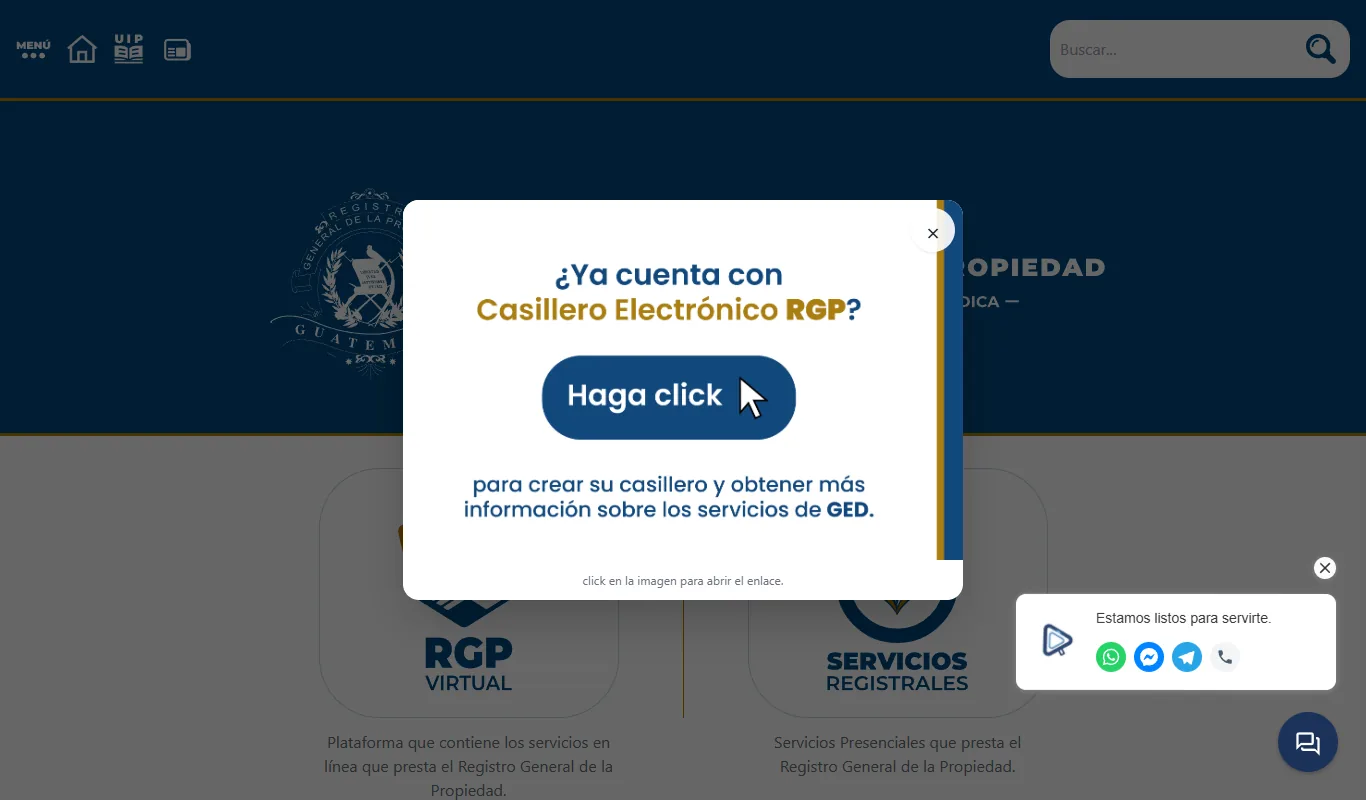
RGP homepage (rgp.org.gt). New visitors are greeted by a ‘Casillero Electronico’ (electronic mailbox) onboarding prompt — the digital notification channel RGP uses for filing updates. ‘RGP Virtual’ is the route for online services; ‘Servicios Registrales’ is for in-person filings.
Step 1: Topographical survey and descriptive memoir
Hire a licensed surveyor or civil engineer. They take precision GPS measurements, define boundaries, and identify neighbors. Cost Q2,000-Q8,000 depending on size and access difficulty. Time 30-60 days. Output: signed survey plan + descriptive memoir.
Step 2: Get fiscal matricula at the municipality
The municipality where the property is located must enroll it in its fiscal cadastre and issue a matricula certification. You need the survey from step 1 + your DPI. Cost Q100-Q500 by municipality. Time 15-45 days.
Step 3: Request negative certificate at RGP
You ask the RGP to certify that the property is NOT registered under anyone’’s name. This is a titulacion supletoria requirement — the judge will not title if the property is already registered. Cost Q60-Q150. Time 7-15 days.
Step 4: Start titulacion supletoria in civil court
Your lawyer prepares a petition with: survey, descriptive memoir, negative certificate, list of 2 witnesses who know your possession, sworn statement of 10+ years of possession. Filed at the Civil First-Instance Court of the property’’s municipality.
Step 5: Citation by edicts and witness hearing
The judge orders 3 publications of the edict in the Diario Oficial (10-day intervals between each) so any opposer can come forward. If no one opposes, your witnesses are summoned to testify. Time 2-4 months.
Step 6: On-site inspection by the judge
The judge (or court secretary) visits the land, verifies boundaries, talks with neighbors. Takes 1-3 hours on the day. The applicant or attorney-in-fact must be present.
Step 7: Ruling and finality
If everything is in order, the judge issues a ruling titling in your favor. You wait 5 days for finality (no appeal). The secretary stamps “ejecutoriada”.
Step 8: Notary deed based on the ruling
You take the final ruling to a notary, who drafts a public deed describing the property, identifying the holder, and requesting first registration at the RGP. Notary cost Q2,000-Q5,000.
Step 9: Pay taxes at SAT and RGP fees
Pay 3% on declared value (first-sale tax per SAT) + 1.5% cadastral value + Q200 fee (RGP). Receipts are generated through the SAT and RGP portals.
Step 10: Submission at RGP
You hand over the deed testimony + ruling + survey + receipts at the RGP counter. The registrar evaluates the document (legal review). If they find prevenciones (boundary errors, missing signatures, wrong data), you have 30 days to fix them. If everything is fine, they assign new finca, folio, and libro numbers. Time 60-180 days.
Cost and timeline (realistic budget)
| Item | Cost | Time |
|---|---|---|
| Topographical survey (surveyor) | Q2,000 - Q8,000 | 30-60 days |
| Municipal fiscal matricula | Q100 - Q500 | 15-45 days |
| RGP negative certificate | Q60 - Q150 | 7-15 days |
| Titulacion supletoria (lawyer + court costs) | Q5,000 - Q15,000 | 6-9 months |
| Diario Oficial publications (3 edicts) | Q500 - Q1,200 | 1 month |
| Notary public deed | Q2,000 - Q5,000 | 15-30 days |
| SAT tax (3% on declared value) | Variable (3%) | Pre-payment |
| RGP (1.5% cadastral value + Q200) | Variable + Q200 | Pre-payment |
| RGP inscription | Included in receipt | 60-180 days |
| TOTAL realistic for Q150,000 land | Q20,000 - Q35,000 | 12-18 months |
Costs verified May 2026 with notary in Guatemala City and central RGP.
Common mistakes (these will cost you time and money)
Poorly defined boundaries on the survey. If the surveyor describes neighbors as “whomever appears” or uses vague references (e.g., “old fence”), the RGP rejects. Demand a survey with GTM coordinates, exact m² area, and real names of neighbors.
Parallel double titling. If two people title the same land at the same time (neighbors disputing boundaries, siblings fighting over inheritance), the first to inscribe wins — the second loses everything invested. Before starting titling, get the negative certificate AND talk to neighbors.
Forgetting the 3% SAT tax. The RGP will not inscribe without proof of payment of the first-sale tax. Many people think they only pay 1.5% to the RGP — there is an additional 3% to the SAT (on the value declared in the deed).
Not enrolling for IUSI first. Without a municipal fiscal matricula, neither the court will title nor will the RGP inscribe. This is an almost-always-forgotten requirement by new buyers.
Under-declaring value to pay less tax. If you declare Q50,000 when the real value is Q300,000, the SAT can review 4 years later and charge the difference + penalties + interest (up to 100% of the difference). For diaspora planning to mortgage the property, the bank uses the deed value as the base — declaring low limits your loan amount.
Diaspora: how to register from the USA
First registration is one of the procedures that fails diaspora the most because it requires presence: witness hearings, judge’’s on-site inspection, RGP submission. But it can be done 100% remotely if you organize well.
Option 1: Attorney-in-fact with apostilled special power
In the USA: visit a US notary public and sign a Power of Attorney detailing: (a) full name of the person in Guatemala who will act for you (trusted family member, lawyer), (b) specific powers: title an identified property by boundaries, appear in courts, sign deeds, pay taxes, submit to RGP, (c) duration (recommended 2 years).
Apostille at the Secretary of State of the state where you signed the POA. Cost USD 8-25, time 1-3 weeks (varies by state). Important: the POA must be in SPANISH or include a sworn Spanish translation; some states require the notary to draft it bilingually.
Ship to Guatemala by DHL or FedEx. Your attorney-in-fact receives the original.
In Guatemala: the attorney-in-fact goes with a lawyer, registers the POA at the General Protocol Archive (Q200), and starts titulacion supletoria in your name.
Option 2: Sign POA at the Guatemalan consulate in the USA
If you prefer not to apostille, you can have a public deed of POA before the consul of Guatemala at the nearest consulate (Los Angeles, Houston, Chicago, Miami, NY, etc.). The consul acts as a notary and signs a POA valid in Guatemala without the need for apostille. Cost USD 50-100, time 1 day (by appointment). It is the cleanest legal option. See MINEX Apostille for cases where you do need apostille.
Option 3: Travel for the key hearing
Some judges are flexible and let the attorney-in-fact testify in your place, presenting your DPI (renewed or current). Others demand that you personally testify as the petitioner. If the latter, plan one trip of 10-15 days to Guatemala covering the hearing + on-site inspection + deed signing. The rest is handled by your attorney-in-fact.
For US-based heirs of family property without paperwork
Typical case: your parents died, they left a property in the interior without paperwork, you live in the USA, and you want to secure the property for your kids. Steps:
- Death certificates of your parents apostilled (if they died in the USA) or RENAP-issued (if in Guatemala).
- Probate proceeding — declaration of heirs in family court. Pay SAT inheritance tax (3% on value, partially exempt between spouses/direct children).
- Probate ruling declares you heir of the possessory right (not registered ownership because there is no folio).
- Titulacion supletoria in your name as heir, demonstrating 10 years of family possession (parents’’ possession + yours).
- First registration at RGP in your name.
Realistic timeline 18-30 months from USA, budget Q25,000-Q50,000.
Warnings: scams and traps in unregistered-land purchases
| Risk | Symptoms | How to protect yourself |
|---|---|---|
| Seller without real ownership | Offers land without deed or folio, “I have always worked it” | Request RGP negative certificate + verify with neighbors + on-site visit with a surveyor |
| Disputed boundaries | Neighbors claim part of the land is theirs | Before buying: on-site visit with neighbors + old municipal cadastre map + boundary acceptance act signed by all |
| Parallel double sale | Same seller sells to two different people | Only close a purchase when you have the public deed already submitted to RGP, never before |
| Subsequent invasion | Once you buy, another family “always worked it” and moves in | Fence the land physically, maintain presence (caretaker), title fast for legal defense |
| Undeclared easements | Village road crosses your land or neighbor passes through | On-site inspection at varied times before buying; review boundary acceptance acts with neighbors |
| Inherited unpaid IUSI | Seller owes years of municipal IUSI | Request current municipal solvency before closing; deduct any debt from price |
| Indigenous or ejidal reserves | Land is in protected communal territory | Verify with the municipality and CONAP if applicable before buying — communal territory cannot be individually titled |
Related procedures
- RGP Hub — all General Property Registry procedures
- Inheritance & succession in Guatemala — register inherited property into the heirs’ names (tax repealed 2026)
- Property Certification RGP — verify registry status after registration
- Property Subdivision RGP — if your first registration includes splitting into lots
- Property Record Search RGP — find folio numbers
- Mortgage Cancellation RGP — clear liens before resale
- Guatemala NIT Tax ID — required tax ID
- Guatemala DPI ID — required identity document
- PNC Antecedentes Penales — some courts require it for titling petitioners
- MINEX Apostille — apostille the POA if acting from abroad
- Guatemala Business Registration — if you need a Guatemalan corporation to hold border-zone property
Official links
- RGP Portal: www.rgp.org.gt — institutional, forms, fees
- Electronic Property Lookup: verify registry status before starting
- Electronic Registry (FIS): digital document submission by authorized notaries
- Document Validation: verify the authenticity of printed certifications
- Second Property Registry (Quetzaltenango): for properties in Quetzaltenango, San Marcos, Huehuetenango, Totonicapan, Solola, Retalhuleu, Suchitepequez
- RGP regional offices: Escuintla, Antigua Guatemala, Coban, Huehuetenango — document reception
- RGP central phone: PBX 2498-1111 (short number 1564)
- RGP central address: 9a Avenida 14-25 Zona 1, Guatemala City
- Hours: Monday to Friday 8:00-16:00