Errors in birth records are surprisingly common in Guatemala. A misspelled name, an incorrect birth date, a transposed letter in a parent’s name — these mistakes happen during registration, especially with records from decades past when municipal civil registries operated with limited oversight. Unfortunately, even a small error can create cascading problems: your DPI might not match your birth certificate, your passport application gets rejected, or your professional degree cannot be authenticated.
The rectificacion de partida is the legal process to correct errors in your birth, marriage, or death records at RENAP. It requires the involvement of a notary (via notarial proceedings) or a judge (via judicial proceedings), and in both cases the PGN (Procuraduria General de la Nacion) must issue a mandatory opinion before the correction can be inscribed. The process is not quick — expect 1 to 6 months depending on the path — but it is straightforward with the right legal help.
Quick summary: Notary fees range from Q1,000-Q3,000. RENAP inscription is free. The notarial route takes 1-3 months, the judicial route 3-6 months. The PGN review is mandatory and is the longest part of the process.
Prices verified April 2026. Check our exchange rate page for today’s USD/GTQ rate.
Cost
| Item | Cost |
|---|---|
| Notary fees (notarial rectification) | Q1,000-Q3,000 |
| Lawyer fees (judicial rectification) | Q3,000-Q5,000 |
| RENAP inscription | Free |
| New DPI after correction | Q100 |
| Birth certificate with correction | Q15 |
What Can Be Corrected
- Name errors — misspelled first name or last name
- Date errors — incorrect birth date or registration date
- Sex/gender — incorrectly recorded
- Parents’ information — wrong names, misspelled names, incorrect nationalities
- Place of birth — wrong municipality or department recorded
- Omissions — missing data that should have been included in the original record
Requirements
- Certificacion de partida con error — the official certificate showing the error (from RENAP)
- DPI del interesado — the person whose record needs correction
- Supporting documentation — documents that prove the correct information (other certificates, baptismal records, school records, etc.)
- Notary or lawyer — legal representation is mandatory
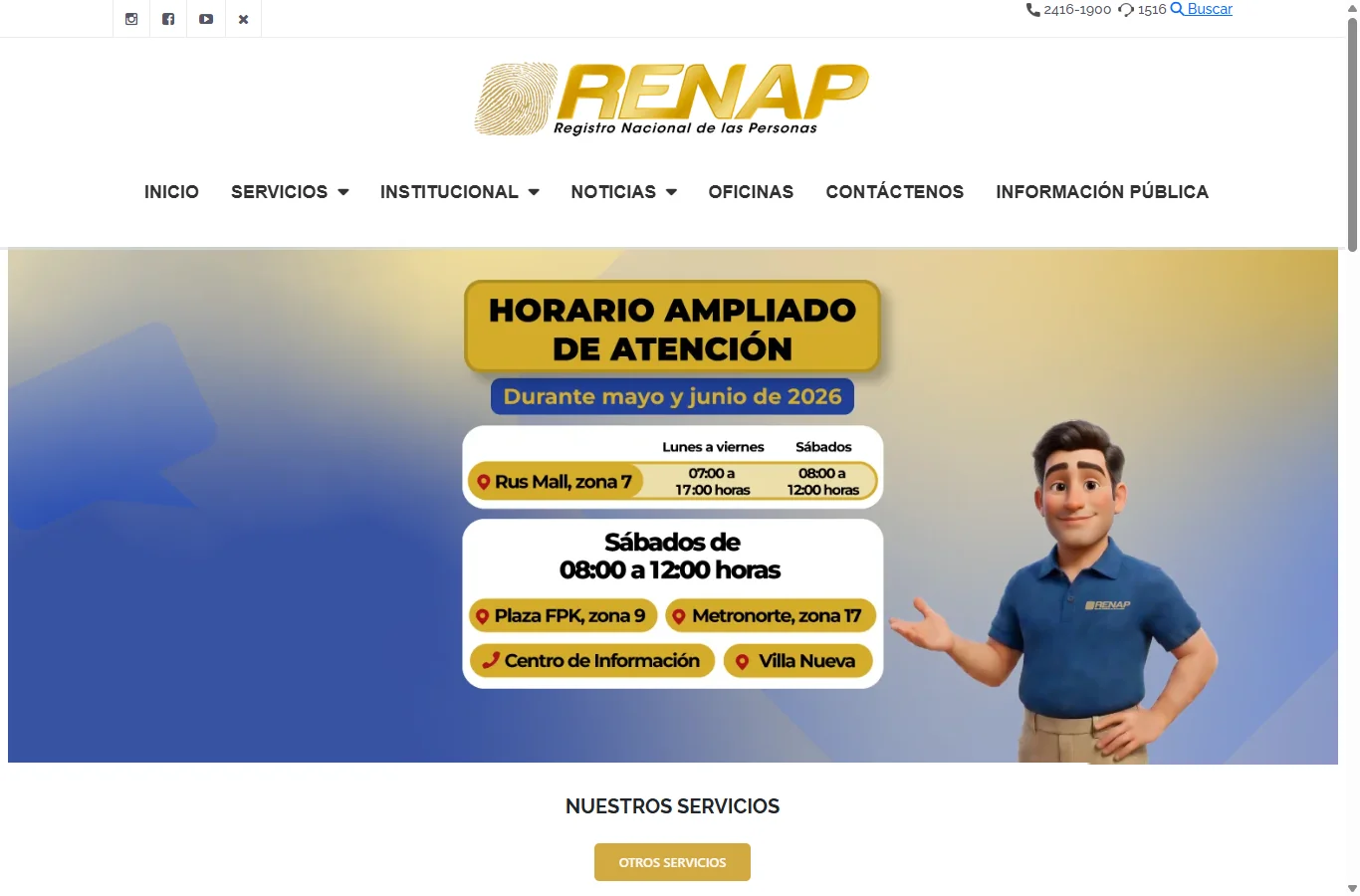
RENAP main page (renap.gob.gt). Extended-hours announcements and new sede openings are posted here — check before traveling to an office.
Step-by-Step Process (Notarial Route)
- Identify the error — obtain a current birth certificate from RENAP and identify exactly what needs correction
- Hire a notary — experienced in civil registry matters (fees: Q1,000-Q3,000)
- Notary drafts an acta de requerimiento — formally initiating the rectification proceedings
- RENAP Civil Registrar reviews the case and issues an opinion on the requested correction
- File is sent to the PGN — the Attorney General’s office reviews the case and issues a mandatory dictamen (opinion)
- PGN issues dictamen — either favorable (approving the correction) or with observations that must be addressed
- Notary issues notarial resolution — based on the PGN’s favorable opinion
- Two certified copies of the resolution are sent to RENAP
- RENAP inscribes the correction — updating the record
- Process a new DPI with the corrected information (Q100)
Judicial Route (When Necessary)
The judicial route is used when:
- The error involves a change of filiation (paternity)
- The PGN objects to the notarial rectification
- Multiple complex corrections are needed
The judicial process follows a similar path but through a Juzgado de Primera Instancia Civil, adding court hearings and potentially longer PGN review times.
Processing Time
| Stage | Notarial | Judicial |
|---|---|---|
| Notary/lawyer preparation | 1-2 weeks | 1-2 weeks |
| RENAP registrar opinion | 1-2 weeks | 1-2 weeks |
| PGN review and dictamen | 3-8 weeks | 4-12 weeks |
| Resolution/inscription | 1-2 weeks | 2-4 weeks |
| Total | 1-3 months | 3-6 months |
The PGN Review (Why It Takes So Long)
The longest part of the process is waiting for the Procuraduria General de la Nacion (PGN) to issue their dictamen. The PGN reviews every rectification case to protect against identity fraud and ensure the correction is legitimate. Their office handles thousands of cases, which creates a backlog.
There is no way to expedite the PGN review. Your notary should ensure the file is complete and well-documented before submission, as incomplete files get returned — adding more weeks to the process.
Details
The PGN can respond to a rectification request in three ways:
1. Dictamen favorable (approved):
- The correction is approved and the notary can proceed with the resolution
- This is the ideal outcome and happens in most straightforward cases (simple typos, clear documentation)
2. Dictamen con observaciones (approved with conditions):
- The PGN approves the correction but requests additional documentation or clarification
- Your notary must address the observations and resubmit — adds 2-4 weeks
- Common observations: “need additional supporting document,” “clarify relationship between petitioner and subject”
3. Dictamen desfavorable (rejected):
- The PGN opposes the correction
- Reasons may include: insufficient evidence, suspected fraud, or the correction requires judicial proceedings rather than notarial
- What to do: Your notary can address the PGN’s concerns and resubmit, or you may need to switch to the judicial route
- A judicial rectification through a Juzgado de Primera Instancia Civil can override a PGN rejection, but this adds months and cost
Prevention: The best way to avoid PGN problems is to submit a complete, well-documented file from the beginning. Your notary should anticipate potential PGN concerns and include preemptive evidence.
Details
One error in a birth record often creates cascading problems across multiple documents:
Common cascade:
- Birth certificate has a misspelled last name
- DPI was issued with the misspelled name (copied from the birth certificate)
- NIT at SAT has the misspelled name (copied from the DPI)
- Passport was issued with the misspelled name
- Professional degree (titulo) has the misspelled name
- Bank accounts, vehicle registration, property titles — all have the wrong name
Correction order:
- Fix the birth record first — this is the source document
- Get a new DPI with the corrected name (Q100, 30 business days)
- NIT updates automatically since March 2025 (CUI = NIT)
- Update passport at RENAP (new application required)
- Notify other institutions — banks, SAT, USAC/university, IGSS, etc.
Cost of a full cascade correction: Q1,000-Q3,000 (notary) + Q100 (DPI) + passport fee + time. Budget Q2,000-Q4,000 total and 3-4 months.
Tip: When correcting the birth record, ask your notary to provide extra certified copies of the notarial resolution. You will need them for multiple institutions.
Details
While this page focuses on birth record corrections, the rectificacion de partida process applies to ALL civil registry records:
Marriage record corrections:
- Same notarial/judicial process
- Common errors: wrong date of marriage, misspelled names of spouses, incorrect witness information
- Requires the marriage certificate showing the error
- PGN review is still mandatory
- After correction, both spouses may need new DPIs if the correction affects their names
Death record corrections:
- Same process, but initiated by a family member or legal representative of the deceased’s estate
- Common errors: wrong cause of death, incorrect date, misspelled name of deceased
- May be needed during inheritance proceedings if the death certificate has errors
Cost and timeline: Similar to birth record corrections — Q1,000-Q3,000 for notarial, 1-3 months.
From the US (Diaspora Info)
If you are in the United States and need to correct your Guatemalan birth record:
- Grant a poder especial (power of attorney) to a notary in Guatemala — the power of attorney can be notarized at any Guatemalan consulate in the US
- Your notary handles everything — from filing to RENAP interaction to PGN follow-up
- You do not need to be physically present at any stage of the process
- Send supporting documents — school records, baptismal certificates, or other documents that prove the correct information. If these are US documents, they will need apostille and Spanish translation
- After the correction — you will need to process a new DPI. This can be done at a Guatemalan consulate during a mobile RENAP visit, or during a trip to Guatemala
Tips & Common Mistakes
Gather all supporting evidence first. The more documentation you can provide proving the correct information, the faster the PGN will approve the correction. Baptismal records, school enrollment documents, and other official records all help.
Fix it before applying for a passport. If your birth certificate has an error, your passport application will be rejected. Correct the birth record first, then apply for the passport. The same applies to professional degree authentication.
Check for cascading errors. If your birth certificate has a misspelled name, your DPI probably has the same error, and so does your NIT record at SAT. After correcting the birth certificate, you will need to update your DPI and inform SAT of the change.
Use a notary experienced with RENAP. Not all notaries are equally familiar with the rectification process. A notary who regularly handles civil registry matters will prepare a better file and navigate the PGN process more efficiently.
Be patient with the PGN. The PGN review cannot be rushed. Budget 2-3 months of total time for a straightforward notarial correction. If you have a deadline (passport application, job requirement), start the process well in advance.
Common Errors and Solutions
PGN issues a dictamen desfavorable (rejection)
The PGN may oppose a rectification when the documentation is insufficient, when they suspect identity fraud (for example, a name change that is too drastic), or when they believe the case needs judicial rather than notarial proceedings. Solution: your notary can address the PGN’s observations and resubmit with stronger evidence, or switch to the judicial route where a judge can override the PGN’s objection. Either path adds 1-4 months to the timeline.
File returned by PGN as “expediente incompleto”
The PGN frequently returns poorly assembled files — missing evidence, contradictory data, uncertified copies. Each return adds 4-8 weeks. Solution: use a notary who regularly handles civil registry matters, not just a general notary. A notary experienced in RENAP rectifications knows what the PGN looks for and pre-empts the common objections.
Cascading errors (DPI, NIT, passport already issued with the same error)
Correcting the birth record is just step one. Solution in correct order: (1) fix the birth record first (1-3 months); (2) apply for a new DPI with the corrected data (Q100, 30 business days); (3) since March 2025 the NIT at SAT updates automatically because CUI=NIT; (4) renew the passport if needed; (5) notify bank, university, IGSS, employer, property registry. Total budget: Q2,000-Q4,000 and 3-4 months.
Error involves a deceased parent
When the error involves a parent’s name and that parent has died, the PGN usually requests additional evidence to confirm the relationship. Solution: present the deceased parent’s death certificate, their own birth certificate, and any marriage certificate of the parents. If paternity was informally recognized rather than legally established, the case usually requires the judicial route instead of notarial.
Notary completes the resolution but never sends it to RENAP
Sometimes notaries finish the rectification but never send the certified copies to RENAP, and months later you discover the change was never actually inscribed. Solution: 4-6 weeks after your notary hands you the resolution, check personally at RENAP whether the change is inscribed (request a fresh birth certificate to verify). If not, the notary is legally required to submit the two certified copies — demand they do it.
Applying for a passport before fixing the birth record
If your birth record has an error and you apply for a passport without fixing it first, RENAP/IGM will reject the application and you forfeit the fee. Solution: always correct the birth record BEFORE starting a passport, before professional degree authentication, and before any immigration filing. General rule: if you will use the document to formally identify yourself to a third party, the source data must be correct first.
Two notaries gave different opinions on whether the case is notarial or judicial
The line between notarial and judicial rectification is not always clean. Errors involving filiation/paternity, transgender name changes, or contested data usually require judicial proceedings. Simple typos, misspelled accents, and clear documentary errors usually qualify for notarial. Solution: a third opinion from a notary specifically with civil-registry experience is usually decisive. If still unclear, start notarial — if the PGN rejects on jurisdictional grounds, you have not lost much time.
Related RENAP Procedures
- Birth Certificate — obtain a corrected certificate after the rectification
- DPI (National ID) — must be reissued with corrected information
- Late Birth Registration — if the birth was never registered (different from correcting an existing record)
- Marriage Certificate — marriage records can also be corrected through rectificacion
- Age Certification (Fe de Edad) — judicial process when no birth record exists at all
Common Questions
What errors can be corrected in a Guatemalan birth certificate?
You can correct errors in names (first name, last name), dates (birth date, registration date), sex/gender, parents’ information (names, nationality), and place of birth. Essentially any factual error or omission in the original record.
How much does a birth certificate correction cost in Guatemala?
The RENAP inscription of the correction is free, but you need a notary whose fees typically range from Q1,000 to Q3,000. If the case goes to court instead (judicial rectification), costs can be Q3,000 to Q5,000 including lawyer fees.
How long does the rectificacion de partida process take?
The notarial route takes 1 to 3 months. The longest part is waiting for the PGN (Procuraduria General de la Nacion) to issue their mandatory opinion (dictamen), which can take 3-8 weeks. The judicial route takes 3 to 6 months.
Can I correct my birth certificate from the United States?
Yes. You can grant a poder especial (power of attorney) to a notary in Guatemala who will handle the entire process on your behalf. The power of attorney can be notarized at a Guatemalan consulate in the US.
What is the PGN’s role in birth record corrections?
The Procuraduria General de la Nacion (PGN) must review every rectification case to protect against identity fraud. Their mandatory opinion (dictamen) is the longest part of the process, typically taking 3-8 weeks. No correction can be inscribed without PGN approval.