Guatemala Independence Day is Tuesday, September 15, 2026 — commemorating the 1821 declaration of independence from Spain. In 2026 Guatemala marks 205 years of independence, and it is 3 days away. The two-day celebration (September 14 torch arrival + September 15 main holiday) is one of Guatemala’s biggest national events, with parades, marimba, fireworks, traditional food, and family gatherings across all 22 departments.
This guide covers what to expect, where to be, what’s open, history, food, and how the diaspora celebrates.
Update — August 17, 2026: the 205th-anniversary festivities kicked off on August 17 with National Flag Day (ceremony at 10:00 AM at the Plaza de la Constitución), and the Departmental Governor’s office of Guatemala has published the official 2026 activities calendar — including one big change for September 14: the capital’s torch-lighting is decentralized across five points (Erick Barrondo park, the Roosevelt fields, Campo de Marte, the Municipalidad, and the zone 18 auxiliary mayor’s office) instead of concentrating at El Obelisco (announced by governor Mauricio Benard, August 13, 2026, Diario de Centro América). Full details in “The official 2026 calendar” below.
The official 2026 calendar (Departmental Governor’s office)
The 2026 patriotic-festivities calendar, announced August 13 by Guatemala’s departmental governor Mauricio Benard (Diario de Centro América):
| Date | Activity |
|---|---|
| Mon, August 17 | National Flag Day — 10:00 AM ceremony at the Plaza de la Constitución; official start of the festivities |
| Tue, September 1 | Lighting of the Fuego Patrio (Patriotic Flame) |
| Wed, September 2 | Torches from the country’s four cardinal points enter the capital; one travels to Cuilapa, Santa Rosa, reaching Jalpatagua |
| Thu, September 3 | The Central American Torch of Peace and Liberty is handed over to El Salvador |
| Sat, September 5 | Gala de la Canción Guatemalteca (Guatemalan Song Gala) |
| Sun, September 6 | Marimba Ensemble |
| Tue, September 8 | Inter-school theater festival |
| Thu, September 10 | Official launch of the September 15 parade at the Palacio Nacional de la Cultura, with the commanders of the 131 marching bands that will parade |
| Fri, September 11 | Dramatization of the Conjurados de Belén |
| Mon, September 14 | Torch-lighting decentralized across 5 points (details below), 6:00 AM-6:00 PM |
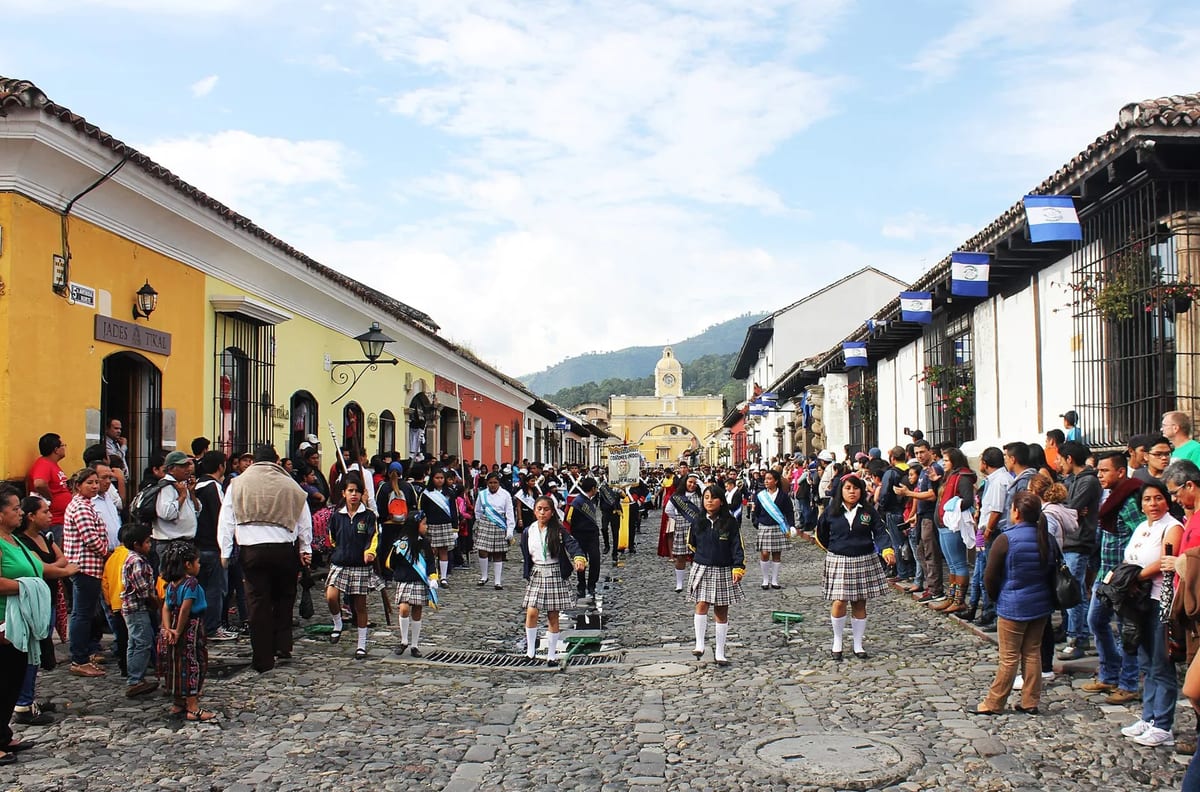
| Tue, September 15 | National holiday — civic parade in zone 1 with more than 120 school bands of 50-200 students each (La Red, August 14, 2026; DCA counts 131 bands at the launch); flag raising and lowering at the Plaza de la Constitución with President Bernardo Arévalo (Publinews, July 16, 2026) |
The 2026 change: torches at 5 sites, no longer at El Obelisco
For September 14, torch-lighting in the capital is decentralized across five sites, because of the problems crowd concentration at El Obelisco caused (Departmental Governor’s office, via DCA):
| Site | Serves |
|---|---|
| Erick Barrondo park (zone 7) | The west side — zones 7 and 2 and parts of Mixco |
| Roosevelt fields | Zones 11 and 12 and the southern area |
| Campo de Marte | Zones 4, 9, 10 and 15, Carretera a El Salvador and Santa Catarina Pinula |
| Municipalidad de Guatemala | Zones 1, 3 and 5 |
| Zone 18 auxiliary mayor’s office (Los Álamos shopping center) | Zone 18 |
All five sites operate 6:00 AM to 6:00 PM; torch-lighting is suspended after that to prevent vandalism. Emetra coordinates routes and security at the five points, and the operation is part of the Tradiciones Seguras program (Gobernación + National Civil Police), with the Army reinforcing controls.
And the most-repeated official request: no throwing water bags. The Governor’s office noted that in 2025 the practice left more than 700 tons of trash in the capital and ~38 injury emergencies, including children with skull fractures from frozen water bags — “an absolutely irrational act,” Benard said (DCA, August 13, 2026).
- Sept 14, 2026 (Mon evening) — Antorcha de la Independencia arrives at Plaza de la Constitución, Guatemala City
- Sept 15, 2026 (Tue) — National paid holiday. Parades, marimba, fireworks. Banks + government closed.
- Sept 16, 2026 (Wed) — Back to normal. NOT a holiday in Guatemala (it is in Mexico).
Were the antorchas banned in 2026? No — but four jurisdictions tried
If it feels this year like the torch runs disappeared, here is the actual sequence.
Between August 25 and 31, at least four jurisdictions prohibited school torch runs outright:
| Jurisdiction | Level | Reported |
|---|---|---|
| Jutiapa | Departmental education directorate | Publinews, August 30, 2026 |
| Santa Rosa | Departmental education directorate | Prensa Libre, August 31, 2026 |
| San Juan Comalapa, Chimaltenango | Municipal — supervisors’ oficio dated August 25 | Prensa Libre, August 31, 2026 |
| Izabal | Named by MINEDUC alongside Santa Rosa and San Juan Comalapa | Emisoras Unidas, September 1, 2026 |
Outlets do not agree on the exact list — Prensa Libre names Jutiapa, Santa Rosa and San Juan Comalapa; Emisoras Unidas names Izabal, Santa Rosa and San Juan Comalapa — so read it as at least four jurisdictions, not a settled four.
Then, on September 2, MINEDUC reversed the direction. Circular DIGECOR No. 42-2026 does not prohibit torch runs. It sets the safety conditions under which educational centers may hold them, and it instructs departmental education directorates to leave their own prohibitions sin efecto. Participation is voluntary — no school and no student is obliged to take part (Agencia Ocote, September 4, 2026).
What we could not verify. We have not been able to read Circular DIGECOR No. 42-2026 itself: mineduc.gob.gt returns 404 on its portal index and dca.gob.gt returns 403. Every condition below is as reported by Guatemalan press, not read from the document, so we do not quote it verbatim or cite article numbers. We also found no source confirming that any of the four jurisdictions has actually issued a rescission — only that MINEDUC instructed them to. Checked September 6, 2026.
The conditions, as reported (Prensa Libre and Infobae, September 3, 2026):
- Written parental authorization for each participant
- Permanent teacher supervision
- A participant registry with student identification
- Routes planned, safe and preferably local, without unnecessary extension
- Students may not handle or transport fuel or flammable material — lighting and refuelling is for responsible teachers only
- No throwing or wasting water on participants or bystanders
- Hydration and heat protection
- A weather and disaster-risk assessment before setting out
- A first-aid kit
- Verified safe transport
- Coordination with local authorities and rescue bodies
- Registration through a QR-code form included in the circular
- Suspend or reschedule if risks appear
Why the tightening. Bomberos Voluntarios recorded, during the 2025 antorcha season alone, 36 people struck by vehicles, 102 treated for dehydration, 15 with blows or injuries, 12 vehicle collisions and 8 reported missing (La Hora, August 31, 2026). Authorities also cite water bags escalating to ice bags, driver-runner altercations, and — outside the capital — a woman who suffered vision damage from battery acid (Prensa Libre, August 14, 2026).
How big it still is. The capital’s PMT expects more than 1,000 antorcha runs in Guatemala City between September 11 and 14 — against “between 700 and 1,500” in 2025 — and about two million people moving through the capital between September 10 and 15 (Amílcar Montejo, PMT / EMETRA: La Hora, September 2, 2026; Emisoras Unidas, September 6, 2026). An interinstitutional campaign called Antorchas Seguras is running alongside it, and PROVIAL is supporting the routes — asking drivers to slow down and keep distance around torch groups.
And the most likely reason your street is quiet right now: the concentrated run window in 2026 is September 10–14. In 2025 it was the 12th to the 14th. School band practice starts weeks earlier, which is why you can hear the bands long before you see a single torch.
Two things this is not. The Guatemala City change described above is a venue and hours decision by the departmental governor’s office with PMT/EMETRA — not a municipal ordinance and not a ban. And a widely-shared “Sin antorchas” article about a national cancellation is from September 2020, during COVID; it is not about 2026.
Quick facts
| Independence date | September 15, 1821 |
| Independence from | Spain (declared in the Acta de Independencia, Guatemala City) |
| Other countries that share this date | Costa Rica, Nicaragua, Honduras, El Salvador (all declared independence the same day) |
| 2026 holiday | Tuesday, September 15 — national paid holiday |
| Main symbols | Blue and white flag, ceiba tree (national tree), monja blanca (national flower), quetzal bird (national bird) |
| Anthem | Himno Nacional de Guatemala (1896, music by Rafael Álvarez Ovalle, lyrics by José Joaquín Palma) |
The Antorcha de la Independencia (Independence Torch)
The Independence Torch is the heart of Guatemala’s Sept 14-15 celebrations — and one of the most distinctively Guatemalan civic traditions.
2026 note: what follows describes how the torches traditionally work. For this year, the official Gobernación calendar (above) already sets concrete dates — torches from the four cardinal points on September 2, the Central American Torch of Peace and Liberty handed to El Salvador on September 3, and the capital’s September 14 lighting decentralized across 5 sites.
Two torches actually run, not one
Most articles get this wrong. Guatemala has TWO independence torches running simultaneously:
- The Central American Torch — starts in Cartago, Costa Rica on September 9 and runs through Nicaragua, Honduras, El Salvador, and into Guatemala. Symbolically retraces how news of the 1821 independence declaration spread through Central America.
- The Guatemalan National Torch (Antorcha de la Libertad) — starts at La Mesilla, the Guatemala-Mexico border crossing in Huehuetenango, on September 14 morning. Runs ~300 km south through Huehuetenango, Quetzaltenango, Sololá, Chimaltenango, Sacatepéquez, into Guatemala City. This is the torch most Guatemalans actually see — it converges on the Palacio Nacional at 11:59 PM September 14 for the official Grito de Independencia.
Each department also runs its own parallel local torch relay that converges on the departmental capital — so you might see torches in Antigua, Quetzaltenango, Cobán, etc. on Sept 14 evening even if you’re not on the main route.
How the relay works
- Costa Rica → Nicaragua → Honduras → El Salvador → Guatemala: each country’s leg takes 1-2 days, runners (mostly students from secondary schools) hand off the torch at borders
- Guatemala leg: torch enters from El Salvador around Sept 12-13, then crosses 5-6 departments before arriving in Guatemala City
- September 14 evening: arrives at the Plaza de la Constitución in front of the Palacio Nacional de la Cultura — typically 6-8 PM, depending on year
- Local school relays: simultaneously, every Guatemalan school district runs its own local torch relay through neighborhoods, with student runners in school uniforms carrying smaller torches
Where to see the torch
- Plaza de la Constitución (Guatemala City) — main arrival, biggest crowds, most cameras. Be there by 6 PM Sept 14 for atmosphere. The president (or designated official) receives the torch at exactly 11:59 PM, immediately followed by the Grito de Independencia — church bells ring, fireworks explode, the national anthem plays. This is the emotional peak.
- Interamericana highway (CA-1) between Chimaltenango and Guatemala City — best spot to actually see the runners between 8:00 PM and 11:00 PM Sept 14. Road is partially closed, crowds line the highway with flags and candles.
- Smaller departmental capitals (Quetzaltenango, Cobán, Antigua) — more authentic, less crowded. Each cabecera departamental has its own torch arrival.
- Schools running their relays — if you’re staying with a Guatemalan family, ask which school’s relay runs through their colonia. The local route is often more memorable than the national one.
What happens on September 15
Morning (6 AM - 12 PM)
- School flag-raising ceremonies at every public and private school across the country (even though it’s a holiday — some schools host morning ceremonies before the main holiday observance starts at noon)
- Civic ceremonies at municipal buildings nationwide
- Military parade in Guatemala City typically starts 9 AM along Avenida Las Américas, ending at the Plaza de la Constitución. Includes army units, navy, air force, and presidential guard
- Patriotic music plays from speakers at major plazas and from passing cars
Afternoon (12 PM - 6 PM)
- Family gatherings — most Guatemalans spend the day at home or at family members’ homes for a long lunch
- Marimba performances in central plazas of every major town
- Street food sells out — chuchitos, atol, elotes, dobladas, buñuelos at every corner
- Patriotic decorations — blue-and-white flags, ribbons, balloons in every household and business
Evening (6 PM - midnight)
- Fireworks countrywide, typically starting around 7-8 PM and continuing past midnight
- Marimba and live music in main plazas
- Restaurants in tourist areas (Antigua, Panajachel, Flores) host patriotic dinner specials
- Family time continues — September 15 is more of a family/neighborhood holiday than a party-out-late holiday
What food do Guatemalans eat on Independence Day?
The food is mostly Guatemalan street-festival classics — these are the same foods you find at any feria patronal, but with patriotic context:
| Food | What it is | Where to get it on Sept 15 |
|---|---|---|
| Chuchitos | Small tamales wrapped in corn husks, with chicken or pork and tomato sauce | Street vendors everywhere |
| Tostadas | Crispy corn tortillas with frijoles, guacamole, or salsa as topping | Local mercados, street vendors |
| Elotes | Corn on the cob with mayonnaise, lime, and chile | Street vendors, corner stands |
| Atol blanco / atol de elote / atol shuco | Warm corn-based drinks (white, sweet, or fermented) | Street vendors with pots, neighborhood ladies |
| Buñuelos | Sweet fried dough served with miel (cane syrup) | Street vendors, fairs |
| Enchiladas guatemaltecas | Cold tostadas with shredded beets, pickled vegetables, and a hard-boiled egg slice (NOT the Mexican enchilada) | Mercados, restaurants |
| Dobladas | Folded fried corn tortillas filled with meat, potato, or cheese | Street vendors |
| Pepián / kak’ik / fritada | Traditional family-meal centerpieces for Sept 15 lunch | Home-cooked or comedores |
The street food is affordable — most items Q5-15 each (~$0.65-2 USD). A full Sept 15 meal of street food runs Q30-50 ($4-7) per person.
What’s open / closed on September 15
| Service | Status |
|---|---|
| Banks | Closed |
| Government offices (RENAP, SAT, Municipalidad) | Closed |
| Public schools | Closed |
| Private offices | Closed (paid holiday) |
| Large supermarkets (PriceSmart, Walmart, Paiz) | Reduced hours or closed |
| Small tiendas / corner shops | Open, often expanded hours |
| Restaurants in tourist areas | Open with patriotic menus |
| Bars | Open (Sept 15 evening is busy in Antigua, Panajachel, Zona 4 GC) |
| Public transport (TransMetro, buses) | Reduced schedule, possible route changes for parades |
| Tourist attractions | Generally open (Tikal, Antigua churches, Lake Atitlán towns) |
| Pharmacies | Open (24-hour pharmacies operate normally) |
| Hospitals | Emergency services normal, scheduled appointments cancelled |
September 16 is a normal workday in Guatemala. (It’s a holiday in Mexico — don’t confuse the two.)
Where to be — by traveler type
First-time visitors / tourists
- Antigua Guatemala — colonial backdrop, central park celebration with marimba, manageable crowds, restaurants stay open. Best mix of authenticity + comfort.
- Plaza de la Constitución, Guatemala City — for the torch arrival (Sept 14 evening) and main parade (Sept 15 morning). Larger crowds, more authentic civic energy.
Photographers
- Smaller towns along the torch route the night of Sept 14 — runner candidates in school uniforms, lit torches in dark streets
- Plaza de la Constitución at the moment of torch arrival — the symbolic moment, peak emotional energy
- Indigenous community celebrations in Cobán, Sololá, or Chichicastenango — distinct cultural elements
Families with kids
- Antigua central park — manageable scale, kid-friendly food, fireworks at sundown
- Panajachel central park — Lake Atitlán views + festival energy
- Smaller departmental capitals (Cobán, Quetzaltenango) — local feel, less overwhelming
Diaspora visiting family
- Wherever your family is. September 15 is a family holiday in Guatemala first and a public spectacle second. The lunch with abuelita matters more than any plaza.
How the diaspora celebrates September 15
For Guatemalan-Americans and other diaspora:
- WhatsApp video calls home — calling parents/grandparents on Sept 15 morning is a near-universal ritual. Family group chats explode with patriotic memes, photos, and “feliz día de la independencia” messages.
- Local Guatemalan community events — for 2026, these US dates were verified at their own source pages on September 4, 2026: Sept 11 Alux Nahual, Berwyn IL · Sept 12 Alux Nahual, Adelphi MD; DC Art All Night at the Embassy of Guatemala, Washington DC; Festival Chapín, Moore OK · Sept 13 Festival Guatemala 2026, Providence RI (free) · Sept 15 Guatemalan Civic & Culture Celebration, Lynn MA (free) · Sept 17 Nor Cal Noche de Colores, Lafayette CA · Sept 18 Marimba 502, Pawtucket RI · Sept 19 Gira de Independencia de Guatemala, Charlotte NC. Full table with venues, addresses, admission and source links: Guatemalan events in the USA.
- Cooking traditional foods at home — recreating chuchitos, atol, or buñuelos in US kitchens
- Sending remittances — Sept 15 ranks in the top 6 remittance weeks of the year (after Mother’s Day, Christmas, Father’s Day, Day of the Dead, and back-to-school) — typical sends $50-200 to help family with the day’s expenses
If you want to send money: see our live remittance comparison for current rates across Wise, Xoom, Remitly, MoneyGram, and Western Union.
A brief history (for the curious)
Guatemala’s path to independence:
- September 15, 1821 — Acta de Independencia signed in Guatemala City. Peaceful declaration. The Captaincy General of Guatemala (covering modern Guatemala, Costa Rica, Nicaragua, Honduras, El Salvador, and Chiapas) declared independence from Spain in a single document signed by political leaders representing the region.
- January 1822 - July 1823 — Brief annexation to the First Mexican Empire under Agustín de Iturbide. Most Central Americans opposed it.
- July 1, 1823 — Federal Republic of Central America formed by the five nations after Mexican annexation collapsed
- 1838 — Federal Republic dissolves into the five modern republics. Guatemala becomes the standalone Republic of Guatemala.
- 1847 — Rafael Carrera proclaims the Republic of Guatemala formally separated from any Central American federation
- September 15 commemorations — have been observed continuously since 1821, with the modern format (military parade + torch relay + national anthem) standardized by the late 19th century
The Acta de Independencia was signed in what is today the Palacio Nacional de la Cultura in Guatemala City — formerly the Casa de los Capitanes Generales (residence of the Spanish colonial governor). The original document is preserved at the Guatemalan National Archives.
Sept 16 myth-buster
If you grew up in or near Mexico, you may associate September 16 with Mexican Independence Day (which it is). Don’t confuse the two:
- Sept 15 = Guatemala (and Costa Rica, Nicaragua, Honduras, El Salvador) Independence Day
- Sept 16 = Mexico Independence Day (a completely separate event in 1810, declared in Dolores by Miguel Hidalgo)
Guatemalans hear Mexican Sept 16 references and quickly correct: “no, Guatemala es el 15.”
The soundtrack of September
Certain songs play everywhere during Fiestas Patrias. If you’re in Guatemala on Sept 14-15, you’ll hear these on loop:
- “Guatemala Feliz” — the national anthem, played at every civic act
- “Luna de Xelajú” — the unofficial second anthem, a marimba waltz about Quetzaltenango
- “Soy de Zacapa” — classic Guatemalan folk song
- Marching band cadences — each school has signature drum patterns rehearsed for months
The marimba is Guatemala’s national instrument, and Sept 14-15 is when you’ll hear it the most. Municipal buildings, restaurants, town squares, and informal street setups all feature live marimba performances — the more rural the town, the more central the marimba is to the celebration.
What to wear
Guatemalans take Fiestas Patrias dress seriously:
- Blue and white — the colors of the flag. Almost everyone wears at least one item in these colors on Sept 15.
- Traditional Maya textiles (huipiles, cortes) worn with pride, especially by indigenous communities and cultural performers
- School uniforms for students participating in parades (mandatory)
- Casual but neat for spectators — Guatemalans dress up slightly for the day
- Comfortable shoes essential — you’ll be standing or walking for hours
For diaspora visiting from the US: a blue or white shirt is enough. You don’t need to bring traditional dress.
Weather in mid-September
September is the middle of rainy season. Plan accordingly:
- Morning (6 AM - noon): Usually dry. 18-25°C (64-77°F) depending on altitude.
- Afternoon (noon - 4 PM): Rain likely after 2 PM, sometimes heavy. Most parades try to finish by 1 PM to beat it.
- Evening (4 PM onward): Often clears for fireworks. But not guaranteed.
Bring a light rain jacket or compact umbrella. Parades happen rain or shine — Guatemalans don’t cancel for weather. Check our live weather page for real-time forecasts the week of.
Safety on September 14-15
September 15 is generally safe. It’s a family civic holiday, not a party night. That said:
- Crowds attract pickpockets — especially along the parade routes in Guatemala City. Keep valuables in front pockets or a cross-body bag.
- Fireworks are everywhere — Guatemalans love cuetes (firecrackers). Some are loud and unpredictable. If you’re sensitive to noise, bring earplugs (essential for kids and pets).
- Traffic is chaotic — major roads close for parades. Driving is brutal. Take Uber or public transport, or walk.
- ATMs may run out — banks are closed Sept 15. Withdraw cash on Sept 13-14.
- Sept 14 night around the Plaza — the midnight Grito gathers huge crowds. Stay in well-lit, populated areas.
- Acatenango and other volcano hikes — most operators run Sept 14-15 normally, but visibility from the summit is reduced during rainy season. Check weather before booking.
For current safety conditions by department, see our safety data hub.
Where Guatemalan-American communities celebrate in the US
For 2026 we verified each US event at its own source page rather than listing cities from memory: the dated September 11-19 list is in the diaspora section above, and the full table with venues, addresses, admission and source links is in Guatemalan events in the USA.
Your local Guatemalan consulate is the source for official consular events — see our consulates directory.
Practical summary
| Detail | Information |
|---|---|
| Holiday date | September 15 (every year, fixed) |
| Official holiday status | Yes — paid day off (Decree 17-67) |
| Main celebration window | Sept 14 evening + Sept 15 all day |
| Best city for parades | Guatemala City (largest), Quetzaltenango (best highland) |
| Estimated parade crowd (capital) | 200,000+ along the route |
| Two torches? | Yes — Central American (from Costa Rica) + Guatemalan local (from La Mesilla) |
| What to bring | Cash, umbrella, comfortable shoes, blue/white clothing, earplugs for fireworks |
| Safety level | Generally safe; watch pickpockets in crowds |
| What’s closed | Banks, government offices, public schools, large supermarkets |
| What’s open | Restaurants, tourist sites, pharmacies, small tiendas, hospitals (emergency) |
Guatemala’s Independence Day is one of those experiences that connects you to the country in a way that tourist attractions cannot. Whether you’re standing on 6a Avenida in the capital watching a 200-piece marching band thunder past, or sitting in a small-town parque central watching local kids proudly carry the flag, September 15 gives you a window into what it means to be Guatemalan.
Frequently asked questions
How many years of independence does Guatemala celebrate in 2026?
Guatemala marks 205 years of independence in 2026. The Acta de Independencia was signed on September 15, 1821 in Guatemala City, so 2026 − 1821 = 205 years.
Which anniversary of independence is celebrated in 2026?
The 205th anniversary of Central American independence. The number rises by one every September 15: 2025 was 204 years, 2026 is 205, and 2027 will be 206.
When was the Bicentennial?
The Bicentennial (200 years) was in 2021 — 1821 + 200 = 2021. That is why 2026 is the 205th anniversary, not the bicentennial.
Is it counted from 1821, 1823, or 1841?
From 1821. The anniversary counts from the signing of the Acta de Independencia from Spain. The separation from the Mexican Empire (1823) and the dissolution of the Federal Republic of Central America (1841) are different dates and are often confused with it.
When is Guatemala Independence Day 2026?
Tuesday, September 15, 2026 — 3 days away. The date is fixed every year. It is an official public holiday and a paid day off (Decree 17-67).
Related guides
- Guatemala events calendar — every major recurring event with dates and traditions
- Mother’s Day Guatemala 2026 — May 10 family + remittance guide
- Father’s Day Guatemala — June 17 fixed-date guide
- Live remittance comparison — daily rates for sending money to Guatemala
- Antigua Guatemala hub — best place to experience Sept 15 in a colonial setting
- Guatemala City zones guide — what’s in each zone for the parade route