Walk in Centro — the historic grid is only 12 blocks across and flat. Use tuk-tuks for short rides (Q5-15), Uber for night trips and outskirts (Q35-80 within city), and tourist shuttles for inter-city routes like Lake Atitlán ($15-25) or Quetzaltenango ($25-35). Chicken buses are dirt cheap (Q10-15 to Guatemala City) but expect crowds. For day trips, a private driver at Q300-600 is the most comfortable option.
Getting Around Within Antigua
Antigua’s historic Centro is genuinely walkable. The grid runs roughly 12 blocks east-west and 12 blocks north-south, with the Parque Central as the reference point. You can walk from the market to the Santa Catalina Arch to La Merced and back without needing any transport — it is 15-20 minutes end to end on a flat surface.
The catch is the cobblestones. More on that below.
| Mode | Typical Fare | When to Use | Notes |
|---|---|---|---|
| Walk | Free | Anywhere in Centro | The default. 12×12 block grid, flat, safe in daylight |
| Tuk-tuk | Q5-15 (short), Q20-40 (longer) | Short hops, market runs, luggage | Ubiquitous; agree on fare BEFORE boarding |
| Uber | Q35-80 within city | Night travel, outskirts, rain | Most reliable option; has surge pricing |
| Taxi (radio cab) | Q40-80 | When Uber surges or app is slow | Negotiate fare upfront; ask your hotel for trusted numbers |
| Bicycle rental | Q80-150/day | Morning rides, dry season, light luggage | Good for Jocotenango and outskirts; cobblestones are rough |
| Private driver | Q300-600/day | Full-day trips, airport runs, groups | Best for multi-stop days; ask hotel for vetted drivers |
To Major Destinations
The tourist shuttles departing Antigua are the most practical option for most inter-city routes. They run in the morning, pick up at hotels, and drop off at central points. Uber works for shorter routes (Guatemala City, airport). Chicken buses work if you travel light and have patience.
| Destination | Shuttle | Uber / Taxi | Chicken Bus | Duration | Detail |
|---|---|---|---|---|---|
| Guatemala City | Q70-100 | app quote | Q10-15 | 1-1.5 hrs | Full guide → |
| GUA Airport | USD$17-18 (published) | app quote | — | 1-1.5 hrs | Full guide → |
| Lake Atitlán (Pana) | $15-25 USD | — | Q20-25 + boat | 3 hrs | Full guide → |
| Monterrico Beach | $20-30 USD | — | Slow (multiple changes) | 2.5-3 hrs | Full guide → |
| Quetzaltenango (Xela) | $25-35 USD | — | Q30-40 (2 buses) | 3.5-4 hrs | Full guide → |
| Semuc Champey | $35-50 USD | — | Complicated multi-leg | 6-7 hrs | Full guide → |
For detailed options, pricing breakdowns, and departure times on each route, click the full guide link above.
Airport Route: Three Options in Detail
The Guatemala City La Aurora International Airport (GUA) run is the most-needed route for first-time visitors. Three practical options:
Tourist shuttle ($15-20 USD): The standard option. Most tour agencies on 5a Avenida sell shuttle tickets; your hotel can also book. Shuttles pick you up at your accommodation and drop you at the airport departures level. Depart at least 3 hours before your flight — the GC traffic entering the city from Antigua can be brutal.
Uber (app-quoted — Uber publishes no fixed fare for this route): Open the app and set the destination to “Aeropuerto Internacional La Aurora.” Works reliably during normal hours. During rush hour (7-9 AM, 4-7 PM) expect surge pricing and a longer drive. Some drivers are reluctant to take airport trips during heavy traffic — if you get a cancellation, request again.
Private driver ($30-50 USD): Book through your hotel the night before. A vetted driver who knows the route is worth the premium if you have an early flight or heavy luggage. They wait for you regardless of traffic, which a shared shuttle cannot promise.
The Cobblestones Reality
The cobblestones in Antigua are beautiful in photographs and hostile to everything else. They will twist your ankle on a bad step, destroy the wheels of a roller suitcase within two days, and make heels essentially unwearable outside of a car. This is not an exaggeration — the stones are uneven, often slippery when wet, and set at angles that catch feet wrong.
Practical rules: wear sneakers or solid walking shoes at all times. If you are arriving with luggage, use a backpack instead of a rolling suitcase, or hire a tuk-tuk from the bus terminal to your hotel for Q15-20. The one block of cobblestones between you and your door can be genuinely painful with a large rolling bag.
Walkable Antigua’s Actual Edges
Centro Antigua — the historic grid bounded roughly by Alameda Santa Lucía (west), Calle de los Pasos (east), the Cerro de la Cruz path (north), and the southern market area — is fully walkable day and night. Everything worth seeing on a tourist itinerary falls within this zone.
The edges matter: San Pedro las Huertas (south, 2 km from Centro) is walkable in daylight on the main road but requires a tuk-tuk or Uber for the return trip at night — it gets dark and the road has no lighting. Pastores (west, 3 km) requires a car or Uber; it is outside the walkable zone and the road is not pedestrian-friendly. Jocotenango (north, directly adjacent) is reachable on foot in 15 minutes from the north edge of Centro — it shares a continuous urban fabric with Antigua.
Parking Realities for Newcomers
If you are thinking about driving your own car to Antigua and parking in Centro, abandon that plan. Street parking in the historic center is nearly impossible on weekdays and entirely impossible on weekends and festivals. The streets are narrow, cobblestoned, and frequently blocked by delivery trucks. Locals who live in Centro either park in paid lots or do not own cars.
Paid lots near the central park charge Q40-80 per day for day visitors. Monthly parking in gated lots runs $50-100/month if you can find a space — most fill quickly. Residential buildings and gated communities (condominios) in Antigua almost universally include covered garage spaces for residents, which is why most car-owning expats live in those developments rather than colonial-era buildings.
Tuk-Tuk Safety
Tuk-tuks are the informal backbone of short-distance transport in Antigua and are generally safe during the day. They are three-wheeled open vehicles — not enclosed — that weave through the cobblestone streets quickly and cheaply. Drivers are licensed locally and the routes are well-worn.
The key rules: always agree on the fare before getting in, not after. The standard for a short Centro ride is Q5-15; anything over Q40 for an in-city trip is getting into taxi territory and you should clarify. For solo travel at night, especially in less-trafficked residential streets south and east of Centro, Uber is the better call. The risk is not extreme but the calculus changes after dark.
Tuk-tuks cannot legally access certain pedestrian streets in the historic center (5a Avenida near the Arch is the most common example). If your destination is on one of those streets, the driver will drop you on the nearest cross street.
The Chicken Bus
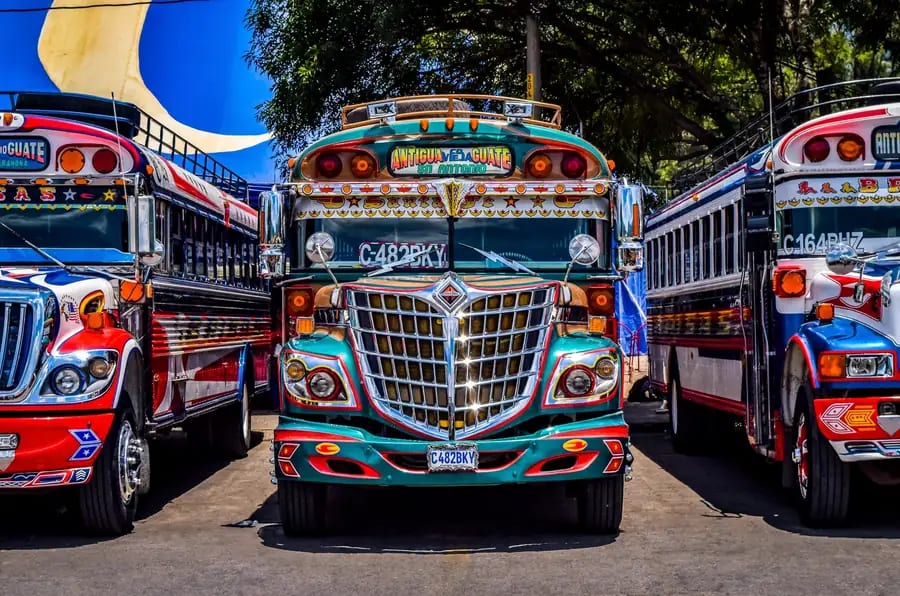
Chicken buses are Guatemala’s legendary fleet of retired US school buses — repainted in vivid colors, loaded with passengers, and running routes that predate most GPS maps. They are cheap, cultural, and an experience.
For most Antigua routes: buses to Guatemala City leave from La Terminal (the main market area on Alameda Santa Lucía, on the west side of the historic center) every 10-15 minutes during daylight hours. The fare is Q10-15 per person, and the trip takes 1.5-2 hours depending on stops and traffic. Buses terminate at CENMA, which a 2023 MAGA market study places in zona 12 of the municipality of Villa Nueva, south of Guatemala City rather than inside the capital — take an Uber or bus from there.
Practical notes: expect a full bus. Have exact change in small bills (Q10, Q20). Keep your bag on your lap or between your feet, not in an overhead rack. The drivers and ayudantes (assistants) know the route — tell the ayudante your destination and they will signal you when to get off. Avoid chicken buses after dark on this or any long-distance route.
Car Rental
Renting a car in Antigua makes sense if you are planning multiple day trips to off-shuttle destinations — Iximché ruins, Chichicastenango market (Thursdays and Sundays), or the villages of the Sacatepéquez valley. For just moving around the city itself, it creates more problems than it solves (see parking section above).
Agencies near Parque Central include Hertz, Tabarini (a local chain with good prices and reliable vehicles), and Avis. Budget $30-50/day for a basic compact before insurance; a decent compact with basic insurance runs $45-70/day. Requirements: your home country driver’s license (accepted from most countries without an international permit), a major credit card for the deposit, and a passport.
Highway driving from Antigua toward Guatemala City, Lake Atitlán, or the Pacific coast is straightforward — well-maintained roads, signs, and no unusual hazards. The cobblestones of Antigua Centro are hard on wheels and low-clearance vehicles. If you can choose, a slightly higher-clearance sedan or small SUV is easier on the streets and the rims.
Private Drivers
For full-day excursions — Chichicastenango, Iximché, the Caoba Farms, or a coffee plantation tour where you want to control the timing — a private driver is the best option.
Rates run Q300-600 for a full day (8-10 hours), plus a tip of Q50-100. The range depends on distance, whether the driver speaks English, and whether they are sourced through a hotel (typically 20-30% higher) versus a direct contact. Ask your hotel, Spanish school, or Airbnb host for driver recommendations — vetted referrals matter more than booking through an app for this. Drivers who have worked with the same properties for years are reliable in ways that random apps cannot guarantee.
For multi-day trips (visiting Atitlán and Chichicastenango in the same overnight, for example), negotiate the full trip price upfront including accommodation for the driver if you are going far.
Frequently Asked Questions
How do I get around Antigua?
Walk everywhere in Centro — it is only about 12 blocks by 12 blocks and flat. For short rides (under 1 km) or when your feet are tired, tuk-tuks charge Q5-15 and are everywhere. For night trips or outskirts, Uber runs Q35-80 within Antigua and is reliable. Taxis (radio cabs) are an option at Q40-80 but require negotiating the fare first.
Does Uber work in Antigua?
Yes. Uber operates fully in Antigua and is the best option for night travel and anything beyond walking distance from Centro. Within the city expect Q35-80. For the airport and Guatemala City runs Uber publishes no fare — the app quote before you confirm is the only reliable number. Surge pricing applies during rain, festivals, and rush hours. Have the app set up before you arrive.
Are tuk-tuks safe in Antigua?
Yes, during the day. Tuk-tuks are a perfectly normal and safe way to get around Antigua. Agree on the fare before you get in — Q5-15 for a short ride in Centro, Q20-40 for longer trips to the outskirts. Avoid tuk-tuks for solo travel at night in less-populated areas; Uber is the better call after dark.
How much is a shuttle to Lake Atitlán?
A tourist shuttle from Antigua to Panajachel (Lake Atitlán) costs $15-25 USD per person and takes about 3 hours. Shuttles leave in the morning (usually 7-8 AM) and drop you at the Panajachel dock. From there, you take a lancha (boat) to your specific village. Book through your hotel, any tour agency on 5a Avenida, or platforms like GuateGo.
Can I rent a car in Antigua?
Yes. Several agencies operate near Parque Central — Hertz, Tabarini, and Avis all have Antigua locations. Expect $30-50/day for a basic compact plus insurance. You will need your home country driver’s license (accepted from most countries) and a credit card for the deposit. Highway driving is easy; cobblestone streets in Centro are brutal on small cars and rims.
How does the chicken bus work in Antigua?
Chicken buses leave from La Terminal — the main market area on Alameda Santa Lucía. For Guatemala City, buses leave every 10-15 minutes during the day for Q10-15 per person, dropping you at CENMA, in zona 12 of Villa Nueva, just south of Guatemala City. They are extremely cheap but crowded, slow, and not ideal for luggage. Watch your belongings. Daytime use is fine; avoid after dark.
![Getting Around Guatemala: Complete Transport Guide [2026]](/cdn-cgi/image/width=640,format=auto,quality=80/images/articles/rio-dulce.webp)