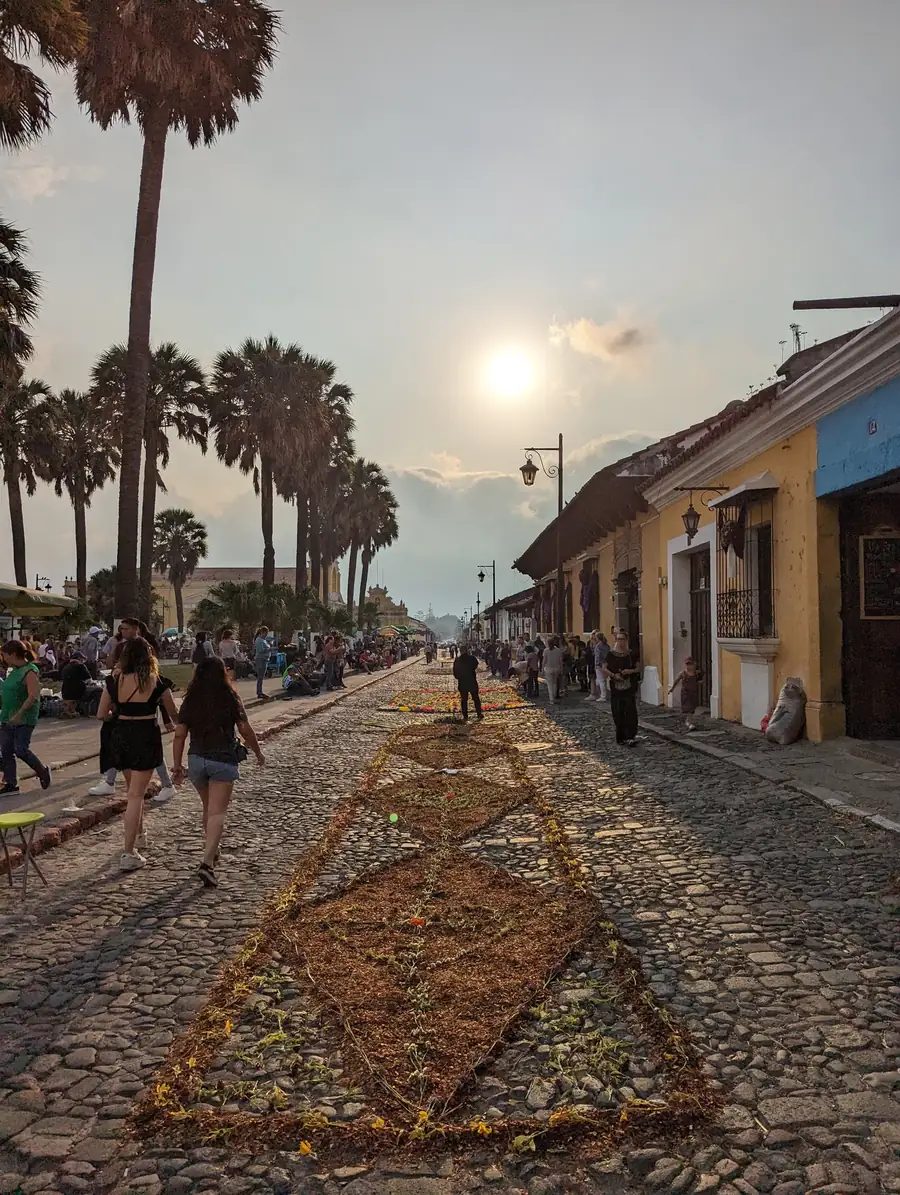
October–November and February are the ideal months to visit Antigua — dry season, mild crowds, normal hotel prices (one exception: the Festival de las Flores weekend, Nov 14–15 in 2026, fills the city completely). May is the secret best month: post-Easter calm, perfect weather, almost no tourists. Want the spectacle? Come for Semana Santa (late March–April) — but book your hotel 9–12 months out and expect 300,000 visitors in a city of 45,000. Independence Day weekend (Sep 14–15) and Christmas–New Year are the other big spikes. Everything else is genuinely pleasant.
12-Month Festival Calendar
Built from our Guatemala events calendar with Antigua-specific additions and local crowd data.
| Month | Major Event(s) | Crowd Level | Hotel Surge | Visit or Flee? |
|---|---|---|---|---|
| January | New Year recovery, dry season begins | 1/5 | None | Visit |
| February | Dry season peak, pre-Lent calm, Carnival prep | 2/5 | None | Visit |
| March | Lent begins, processions kick off weekends | 3/5 | Weekends +20% | Visit (weekdays) |
| April | SEMANA SANTA (Good Friday Apr 3, 2026) | 5/5 | +50–100% | Visit FOR it or stay away |
| May | Post-Easter quiet, rainy season hasn’t started | 1/5 | None | Best kept secret |
| June | Rainy season starts (afternoon showers) | 1/5 | None | Visit |
| July | Slight uptick — US/European summer travel | 2/5 | +10% | Visit |
| August | Rainy season peak, lighter tourist crowds | 1/5 | None | Visit |
| September | INDEPENDENCE DAY Sep 14–15, parades, antorchas | 4/5 | +30–50% | Mixed |
| October | Dry season returning, Día del Niño Oct 1 | 2/5 | None | Visit |
| November | KITE FESTIVAL Nov 1 (Sumpango) · FESTIVAL DE LAS FLORES Nov 14-15 (2026) | 2/5 most of month; 5/5 flower weekend | +10%; flower weekend books out | Visit — but book the flower weekend far ahead |
| December | CHRISTMAS markets, posadas, Quema del Diablo | 4/5 | +40–70% | Mixed |
Crowd level key: 1 = nearly empty, 5 = wall-to-wall tourists, no hotel rooms, police managing crowds.
Semana Santa: The Main Event
Semana Santa — Holy Week — is what put Antigua on the global tourism map. It is also the reason you either fall in love with the city or avoid it for an entire month of the year depending on your tolerance for crowds.
The numbers: Antigua’s population sits around 45,000. During Semana Santa, the estimate is 300,000+ visitors arriving across the week, with Good Friday (Viernes Santo) being the absolute peak. The city’s cobblestone streets are not designed for this. You will be in a crowd, all the time.
What they come for is genuinely extraordinary. Alfombras are intricate carpets laid on the street the night before each major procession — made of colored sawdust, flowers, pine needles, fruits, and vegetables. Local families and church groups start construction at midnight and finish by 4 or 5 AM. The processions then walk over them, destroying hours of work in minutes. The cycle repeats daily throughout the week.
The processions themselves are massive. Enormous andas — multi-ton wooden floats — are carried entirely on the shoulders of cucuruchos (purple-robed male bearers) and cargadoras (female bearers in black). Each anda requires 80–120 bearers and weighs several tons. The processions can run 12+ hours from start to finish. La Merced church and the Cathedral are the main focal points, but processions cross most of the city.
For 2026: Good Friday falls on April 3. Palm Sunday (March 29) is the week opener — a good day to arrive if you want to see the buildup without the worst of the crowds. See our full Semana Santa in Guatemala guide for the day-by-day schedule of the whole week, and the detailed Viernes Santo Antigua guide for hour-by-hour procession times and the best viewing positions.
The booking reality: Hotels in Centro Antigua book out for Semana Santa in May or June of the prior year. Not June of the same year — the prior year. If you are reading this in January and want to go in April, your options are: stay outside Antigua (Jocotenango, San Pedro las Huertas, even Chimaltenango) and drive or take a shuttle in, or accept a room at 2–3x normal rates at whatever is left. The processions are visible from anywhere in the city — you do not need a hotel on the parade route to experience it.
UNESCO recognition: Semana Santa in Antigua is recognized as Intangible Cultural Heritage. This is not purely a tourist event — it is deeply embedded in local Catholic practice, with families participating in alfombra construction and procession carrying as acts of devotion passed through generations.
Independence Day: Sep 14–15
Independence Day is Guatemala’s second major crowd event of the year, and Antigua stages one of the best celebrations in the country outside of Guatemala City itself.
The night of September 14 is the antorcha relay — the independence torch carried by runners from the Mexican border (Chiapas) arrives in major cities at night. In Antigua, the torch arrives to fireworks, a crowd at Parque Central, and the kind of collective energy that is hard to replicate. If you are in Antigua, stay up for this.
September 15 is the parades. Every school in Guatemala sends their marching band through town. The quality ranges from excellent (well-practiced brass and percussion) to endearingly chaotic (younger students, sometimes with very loud drums). The entire city is decorated in blue and white — Guatemala’s national colors. Flags on every building, on cars, on people.
Crowd level is a 4/5 — the city fills with Guatemalan domestic tourists (Guatemala City families coming to Antigua for the holiday weekend), not primarily international visitors. Hotels run 30–50% premium. Book at least 2 months ahead. The atmosphere is patriotic and celebratory rather than the religious intensity of Semana Santa — a different energy, and generally more accessible for visitors who want to participate rather than observe.
Christmas Season: Posadas, Markets, Quema del Diablo
December in Antigua runs as one long festival from early in the month through New Year.
December 7: Quema del Diablo. This is a Guatemalan tradition where locals burn trash and old items in front of their homes at 6 PM — symbolically driving out evil before the Christmas season. In Antigua and Guatemala City, this produces an enormous amount of smoke, fire, and chaos. Large effigies of the devil are burned in plazas. It is not a tourist event in the way Semana Santa is — it is something that happens throughout the city simultaneously. If you find it alarming, stay inside. If you find it fascinating, wander the residential streets.
December 16–24: Posadas. Traditional Catholic processions re-enacting Mary and Joseph’s search for shelter. A different neighborhood hosts each night, with a procession, singing, breaking of piñatas, and sharing of food (ponche — a warm fruit punch, and tamales). These are community events that visitors can join. Ask your hotel or Airbnb host which neighborhood is hosting that evening.
Christmas markets spring up throughout December around Parque Central and the main commercial areas. Quality ranges from excellent (local artisan crafts, textiles, food) to tourist-trap. The local markets (not the ones specifically set up for tourists near the main park hotels) are better for quality and price.
December 24 (Nochebuena) is the main family night — midnight tamales, fireworks at 12, gift exchange. The fireworks in Antigua on December 24 and 31 are genuinely overwhelming — earplugs are not an overstatement.
December 22–January 2 as a block is crowd level 4/5. Hotels run 40–70% above normal rates. Book 3–4 months ahead if you want to be in Centro.
When Antigua Gets Overrun
Worst Time to Visit Antigua
If forced to rank purely on logistics: Semana Santa Good Friday weekend is the hardest. Not because the experience is bad — it is extraordinary — but because the city physically cannot absorb the visitors. Traffic stops. Sidewalks become impassable. Every restaurant has a 45-minute wait. Parking does not exist. If you want to see the processions, you will stand in place for hours. This requires commitment and planning, not a casual drop-in.
The Hidden Best Time Nobody Talks About
May is the empirically underrated month. Post-Easter calm hits immediately: hotel prices drop back to normal, the crowds are gone, the rainy season hasn’t locked in yet (it starts properly in mid-May to June), and you have the city mostly to yourself. Restaurants that were slammed for two weeks suddenly have tables. The light is good. Flowers are out from the late dry season. If you have flexibility on timing and are not chasing the Semana Santa spectacle, May is genuinely the answer.
Hotel and Airbnb Booking Timing
The general rule:
- Semana Santa: Book 9–12 months ahead for anything in Centro. For the outer barrios (San Sebastián, Santa Ana, San Francisco north), 4–6 months. For villages outside Antigua, you can often book 1–2 months ahead.
- Independence Day (Sep 14–15) weekend: 2–4 months ahead.
- Christmas–New Year: 3–4 months ahead for Centro, 6–8 weeks for outer areas.
- Everything else: 2–4 weeks is usually fine. October–November rooms are often available same-week.
When Centro is full: The villages immediately outside Antigua are 10–20 minute drives and have legitimate accommodation at significantly lower prices. San Pedro las Huertas (south), Jocotenango (north, directly adjacent), San Juan del Obispo (southeast), and Ciudad Vieja all have guesthouses and small hotels. Shuttles run to Antigua from all of these. Chimaltenango (30 minutes) has budget hotel inventory that almost never sells out.
Price surge reality: During Semana Santa, a Q600/night room becomes Q1,200–1,500. Airbnbs that are Q400/night in January list for Q900–1,200 in Holy Week. This is consistent and predictable — if you book early, you pay normal rates; if you book late, you pay the surge.
Smaller Events Worth Catching
These are lower-profile but genuinely worth being around for if your timing aligns:
Antigua Brewfest — typically held in the dry season (January–March). Guatemalan craft brewers plus some international labels, in a colonial courtyard setting. Numbers grow every year.
Beerwalk Antigua — periodic self-guided bar crawl through the historic center. Relaxed, social, good way to see bars you might not find otherwise.
Día del Niño (October 1) — Children’s Day. Schools put on events, parks fill up, generally a cheerful day. Low-key for visitors but pleasant to be around.
Festival de las Flores (November) — Antigua’s biggest non-Easter weekend: the city fills with large-scale flower installations, and the 2024 edition drew 327,469 visitors per INGUAT. The 2026 edition (10th) is confirmed for November 14–15. Full program, crowd numbers and parking/shuttle logistics: Antigua Flower Festival guide. (Nearby San Juan del Obispo runs its own Festival del Níspero — a loquat harvest festival, not a flower festival — which has previously scheduled dates around the same weekend.)
Festival Internacional Antigua (FIA) — a cultural festival with music, theater, and art spanning multiple weeks. Dates vary year to year; check the city’s cultural calendar. Runs at venue spaces and colonial courtyards.
Festival de Cine Antigua — international film festival, typically in the first half of the year. Screenings in colonial settings. Underattended relative to quality — you can usually walk in.
Sumpango Giant Kite Festival (November 1) — technically not in Antigua (it is in Sumpango, 30 minutes away, and also at Santiago Sacatepéquez). Arrive by 8 AM. The kites are enormous — some reach 20 meters — and the construction is months in the making. It is held in the cemetery, which is part of the tradition. Fiambre (the elaborate cold salad dish eaten on Día de los Santos) is available everywhere. This is a must-see if you are anywhere near Antigua in early November.
Frequently Asked Questions
When is Antigua most crowded?
Semana Santa (Holy Week, late March–April) is by far the most crowded period — 300,000+ visitors in a city of 45,000. Hotel rooms book out 9–12 months ahead and prices double. Independence Day weekend (Sep 14–15) is the second peak, followed by Christmas–New Year (Dec 22–Jan 2). The rest of the year is manageable.
What is Semana Santa in Antigua?
Semana Santa is Holy Week — the week before Easter. In Antigua it is one of the largest and most elaborate Easter celebrations in the world. Streets are covered in alfombras (intricate carpets of colored sawdust, flowers, and fruits), and massive processions carry andas (floats) on the shoulders of cucuruchos (purple-robed bearers). Good Friday is the peak day. UNESCO recognizes it as Intangible Cultural Heritage.
What is the best time to visit Antigua?
October–November is the sweet spot: dry season has returned, crowds are mostly minimal, prices are normal, and the Giant Kite Festival in nearby Sumpango falls on November 1 — with one exception: the Festival de las Flores weekend (November 14–15 in 2026) fills the city completely. February is also excellent — dry season, pre-Lent calm, low hotel prices. May is the secret: post-Easter quiet, near-zero tourists, perfect weather.
What is the worst time to visit Antigua?
If you want a quiet trip: avoid Semana Santa (late March–April), Independence Day weekend (Sep 14–15), and the Christmas–New Year stretch (Dec 22–Jan 2). Hotels fill completely and prices spike 40–100%.
What festivals happen in Antigua year-round?
Antigua has something every month: Carnival prep in February, Lenten processions from March, Semana Santa in April, Independence parades in September, the Sumpango Giant Kite Festival November 1, Quema del Diablo December 7, posadas December 16–24, and Christmas markets throughout December. Smaller events like Antigua Brewfest, Festival Internacional Antigua (FIA), and Festival de Cine Antigua fill the quieter months.
Do I need to book hotels far in advance for festivals?
For Semana Santa: 9–12 months ahead is not an exaggeration. Good Friday weekend rooms are gone by June of the prior year. For Independence Day and Christmas–New Year: 2–4 months ahead. For everything else: 2–4 weeks is usually fine. When Centro is full, San Pedro las Huertas, Jocotenango, and San Juan del Obispo are 10–20 minutes away with availability at normal prices.
Related Antigua Resources
Working from Antigua rather than visiting? The fireworks and feria noise calendar covers the Sacatepéquez valley ferias you can hear from town.