Antigua is the easiest Latin American city for Canadian snowbirds and remote workers: 15-25°C year-round at 1,500m elevation, no winter coats needed, ~200 Spanish schools at USD $200-400/week including homestay, a strong Canadian and North-American expat community at Café No Sé, Caoba Farms, and Hotel Casa Santo Domingo, and a 45-minute drive to Hospital Herrera Llerandi for complex healthcare in Guatemala City. Total winter cost for a single Canadian: roughly CAD $7K-12K modest, $15K-25K premium.
If you are Canadian and looking past Mexico and Costa Rica for somewhere to spend winters, learn Spanish, or quietly retire, Antigua Guatemala is probably the most underrated city in Latin America for you. This guide covers why Canadians end up here, what the climate, cost, healthcare, and community actually look like, and the practical steps for a snowbird trip or a longer move.
For the broader Antigua picture, our Antigua hub covers neighborhoods, restaurants, transportation, safety, and weekend trips. This article focuses on what is specifically different or relevant for Canadians.
Why Canadians Pick Antigua
Three numbers explain most of it.
| Factor | Antigua | Cancun (Mexico) | San José (Costa Rica) | Florida (winter) |
|---|---|---|---|---|
| Daily temp Dec-Mar | 20-25°C | 25-30°C | 22-28°C | 15-23°C |
| Daily cost (modest snowbird, USD) | $50-90 | $80-130 | $90-150 | $120-200 |
| Spanish-immersion schools | ~200 (highest density in LatAm) | ~30 | ~50 | n/a |
| Direct Canadian flights | None (1 stop via US/Mex) | Multiple direct | Multiple direct | Many direct |
| Crime rate (city level) | Low | Medium-high | Medium | Low |
| Altitude | 1,500m | Sea level | 1,170m | Sea level |
The combination Antigua wins on is mild climate + immersive Spanish + low cost + walkable cobblestone city + safe. Costa Rica is more expensive and less Spanish-school dense; Mexico is hotter and more humid; Florida costs three times as much for less culture. Once Canadians visit, a meaningful share return for a longer stretch the following year.
Climate: What 1,500m Elevation Does for You
Antigua sits at roughly 1,500 meters above sea level, surrounded by three volcanoes (Agua, Fuego, Acatenango). The altitude is the entire reason the climate works for Canadians who would melt in lowland Latin America.
| Month | Avg high | Avg low | Rain days |
|---|---|---|---|
| December | 23°C | 11°C | 1 |
| January | 23°C | 9°C | 1 |
| February | 24°C | 10°C | 1 |
| March | 26°C | 12°C | 2 |
| April | 26°C | 13°C | 5 |
| May | 26°C | 14°C | 14 |
| June | 25°C | 15°C | 21 |
| July | 24°C | 14°C | 21 |
| August | 24°C | 14°C | 22 |
| September | 24°C | 14°C | 23 |
| October | 24°C | 13°C | 16 |
| November | 23°C | 12°C | 4 |
Practical meaning: December to April is dry, sunny, 23-26°C in the day, cool at night. May to October is the rainy season, with afternoon thunderstorms most days but mornings still sunny. The peak Canadian snowbird season is December to March, exactly when winter is brutal in Toronto, Calgary, and Halifax.
What to pack: Daytime layers (T-shirts, light long sleeves), one fleece or hoodie for evenings, comfortable walking shoes for the cobblestones, sunscreen (UV index is high at altitude), and a light rain jacket if visiting in shoulder season. Leave the parka.
Cost of Living for Canadians (CAD)
Below is a typical mid-range monthly budget for a Canadian snowbird in Antigua, in Canadian dollars at roughly CAD $1 = Q5.65 (May 2026 reference; check live rates on our exchange rate page).
| Category | Modest (CAD/month) | Comfortable | Premium |
|---|---|---|---|
| Furnished 1-BR rental | $880-1,400 | $1,400-2,200 | $2,500-4,500 |
| Utilities + internet | $90-140 | $140-220 | $220-350 |
| Groceries | $300-450 | $500-700 | $700-1,000 |
| Eating out (8-12 meals) | $140-280 | $300-500 | $500-900 |
| Spanish school (4 weeks) | $560-880 | $880-1,400 | $1,400-2,500 |
| Transport (taxi, occasional Uber) | $50-100 | $100-200 | $200-400 |
| Health insurance (snowbird) | $440-700 | $440-700 | $700-1,200 |
| Tours and weekend trips | $100-300 | $300-600 | $600-1,200 |
| Total | $2,560-4,250 | $4,060-6,520 | $6,820-12,050 |
A modest Canadian snowbird who Airbnbs a small place, cooks half the time, and takes daily Spanish classes can spend a winter in Antigua for less than a winter in Florida. Premium spenders with private homes and frequent dining out still come in well under what they would pay in Vancouver or Toronto for the same months.
For broader cost data including comparisons to Guatemala City and Lake Atitlán, our cost of living guide breaks it down by city tier.
Spanish Schools: The Antigua Speciality
Antigua is the highest-density Spanish-immersion school city in Latin America — roughly 200 schools and language institutes. Most cost USD $200-400 per week including 20 hours of one-on-one instruction and a homestay with a Guatemalan family (private bedroom, three meals a day).
Schools popular with Canadians:
- Maximo Nivel — large, professional, structured curriculum, plays well with Canadian student-visa documentation if needed.
- Cooperación Spanish School — community-oriented, strong scholarship contributions to local social programs.
- Probigua — non-profit, profits fund rural libraries.
- Antigueña Spanish Academy — small, family-run, very personal.
- Don Pedro de Alvarado — long-established, walkable from Parque Central.
Two weeks of one-on-one Spanish at 4 hours/day moves a complete beginner from “hello” to ordering food, asking directions, and basic small talk. Six weeks moves a beginner to functional conversational Spanish. For Canadian retirees who plan to stay long-term, six to twelve weeks is the typical arc.
Arriving with the basics means your first school week goes further. Ways to start from home, described from each company's own site (checked September 24, 2026):
Affiliate links: we earn a commission if you buy, at no extra cost to you. Prices and offers are set by each company and can change. Disclosure
Real Estate and Long-Term Rentals
If you progress from snowbird to permanent move, Antigua real estate is accessible to Canadians.
| Type | Long-term rent (CAD/month) | Purchase (CAD, mid-2026) |
|---|---|---|
| Studio in colonial center | $700-1,100 | $90,000-140,000 |
| 1-BR furnished apartment | $880-1,600 | $130,000-220,000 |
| 2-BR house in residential zone | $1,400-2,500 | $230,000-450,000 |
| 3-BR colonial with patio | $2,000-3,800 | $380,000-800,000 |
| Restored colonial mansion | $3,500-7,000 | $700,000-2,000,000+ |
Foreigners (including Canadians) can own property in their own name in Guatemala with the same rights as Guatemalans. The Antigua market is dollarized — both rents and purchase prices are commonly quoted in USD. Use our live exchange rate and CAD-Quetzal tracker to translate before signing.
For more on the broader real-estate picture, our Antigua hub and city neighborhood pages cover the colonial center, San Juan del Obispo, San Pedro las Huertas, and Jocotenango — each with different price brackets and walkability.
Healthcare in Antigua
For day-to-day care, Antigua has dozens of English-speaking general practitioners, several well-known dental clinics popular with North Americans (Casa de Salud, Dental Solutions Antigua), and a pharmacy on virtually every block (Cruz Verde, Galeno, San Nicolás).
For hospital care:
- Hospital Hermano Pedro — private, on the eastern side of Antigua, handles routine and moderately complex cases.
- Hospital Privado de Antigua — smaller private option, good for urgent care.
- Hospital Nacional Pedro de Bethancourt — public hospital, free for emergencies but heavily used.
For complex cases (cancer treatment, advanced cardiology, major surgery), Canadians transfer 45 minutes by car to Hospital Herrera Llerandi or Hospital Centro Médico in Guatemala City. This is standard and well-organized — most Antigua doctors maintain admitting privileges at one of the Guatemala City hospitals.
For insurance, see our dedicated Canadian health insurance in Guatemala guide — the short version is that snowbirds buy travel-medical, longer-term residents combine an international plan with a local Mapfre or Hospital Herrera Llerandi membership.
Where Canadians Hang Out
Antigua does not have a formal Canadian community in the way Lake Chapala does, but informal Canadian hubs exist:
- Café No Sé — narrow bar on 1a Avenida Sur, infamous mezcal speakeasy in the back, a default expat hangout where Canadians regularly outnumber Americans.
- Caoba Farms — sustainable farm with weekend food market, popular with the long-stay expat crowd including many Canadian retirees.
- Hotel Casa Santo Domingo — hosts cultural events, art shows, and an annual Canada Day-adjacent BBQ in some years; the on-site museum complex is a regular stop.
- The Maximo Nivel and Probigua student crowds — winter cohorts at the big language schools include many Canadians on 2-8 week courses.
- Antigua Public Library / Centro Cultural La Azotea — quieter, more cultural; long-term Canadian residents.
- Snowbirds Antigua Facebook group — active Nov-Apr, organizes hikes, restaurant meet-ups, and information swaps.
For the broader expat picture, our Antigua expat community page covers the wider scene including Spanish-speaking and other-nationality groups.
Tips Specific to Canadians
- Time your arrival before the rainy season ends. Direct flights are easier to find Dec-Mar; secondary cities of Calgary, Halifax, and Winnipeg almost always require a US connection (Houston, Dallas, Atlanta, or Miami).
- Bring CAD plus a USD card. Many Antigua businesses, especially Spanish schools and tour operators, quote in USD. A no-foreign-fee Canadian card (Scotiabank Passport Visa, Wealthsimple Cash, Wise) saves 2.5% per swipe.
- Sign up for ROCA before you fly. Voluntary registration with the Canadian government takes 5 minutes and lets the embassy reach you if there is a volcanic event, earthquake, or political crisis. See our Canadian Embassy in Guatemala guide.
- Check vaccinations. Yellow fever is not required for Canada; routine boosters (tetanus, hepatitis A) are recommended. The Public Health Agency of Canada keeps a current Guatemala page.
- Plan around Semana Santa (Holy Week). Late March or April depending on year, accommodation triples in price and the city packs out. If your goal is quiet immersion, avoid those two weeks.
- Cobblestones are real. Bring shoes that handle uneven surfaces; ankle injuries are common in heeled shoes or rigid hiking boots.
- Set up Wise or Scotiabank for spending money. A Wise multi-currency card converts CAD→GTQ at near-mid-market rates. Scotiabank Guatemala (despite the brand) is now operated locally — see our Scotiabank Guatemala for Canadians guide.
Practical First-Week Plan for a Canadian in Antigua
| Day | Action |
|---|---|
| 1 | Land at La Aurora (GUA), Uber to Antigua (app-quoted, about Q320 one-way, 1 hour). Settle in. |
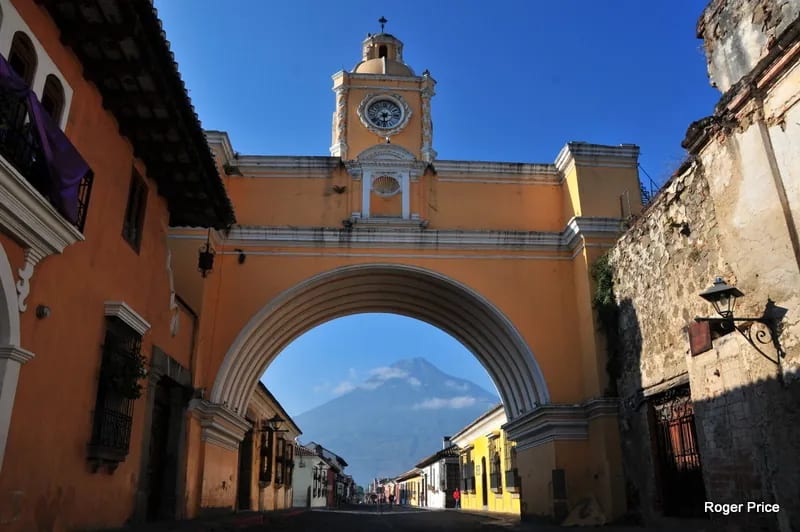
| 2 | Walk Parque Central, Arco de Santa Catalina, Cerro de la Cruz. Get a SIM (Tigo or Claro, ~Q60). |
| 3 | Visit your Spanish school in person, do placement test, confirm homestay if applicable. |
| 4 | Open a Wise or Scotiabank account if not already; withdraw quetzales. |
| 5 | Doctor’s check-in if needed (long-term stays). Healthcare orientation at Hospital Hermano Pedro. |
| 6 | First weekend trip: Volcán Pacaya hike, San Juan del Obispo village, or Lake Atitlán day trip. |
| 7 | Settle into routine: morning Spanish class, afternoon errands, evening Café No Sé or Caoba Farms. |
When to Plan a Longer Move
If your snowbird trips become four-month winters, then six-month winters, then “I might just stay,” look into:
- IGM extension of stay (prórroga) — extends the 90-day visa-free entry by another 90 days.
- IGM temporary residency — for two-year (renewable) residency.
- Canadian taxes when emigrating to Guatemala — the CRA non-residency, departure tax, and RRSP/TFSA implications.
- Send money from Canada to Guatemala — Wise vs Remitly vs Scotiabank comparison.
Keep Reading
- Antigua Guatemala (hub) — full city overview, neighborhoods, transportation, restaurants.
- Moving from Canada to Guatemala (hub) — pre-departure checklist, visa, banking, taxes.
- Canadian Health Insurance in Guatemala — provincial coverage gap and private alternatives.
- Canadian Embassy in Guatemala — passport, emergency, ROCA registration.
- Scotiabank Guatemala for Canadians — cross-border banking realities.
- Today’s Exchange Rate — live USD/GTQ for budgeting.
Prices and contacts are accurate as of May 2026. Always verify current rates and reservations directly with schools, hotels, and tour operators.
Frequently Asked Questions
Why do so many Canadians choose Antigua over other Latin American destinations?
Antigua sits at 1,500m elevation, which gives it 15-25C year-round — warm enough to lose the winter coat, cool enough to sleep without AC. Add a 4-hour direct flight from Houston/Atlanta with onward connections from most Canadian cities, no malaria, the lowest crime rate of any major Latin American tourist city, and a 200-school Spanish-immersion ecosystem and you have the most popular winter destination for Canadians outside Mexico and Costa Rica.
How cold does Antigua actually get for a Canadian?
Daytime: 20-25C year-round. Nighttime in the dry season (Nov-Apr) drops to 8-13C, which feels cool to a Canadian only because most Antigua houses have no heating or insulation. A fleece, thick socks, and one wool blanket solve it. There is zero risk of frost or snow, and the morning sun warms the city by 9 AM.
How much does it cost a Canadian snowbird to spend a winter in Antigua?
A modest 4-month winter (December to March) runs roughly CAD $7,000-12,000 all-in for one person — flights, accommodation in a furnished apartment or B&B, food, Spanish school, weekend trips, and basic insurance. A premium experience with a private rental, dining out frequently, and weekend tours can run CAD $15,000-25,000. Compared to wintering in Florida or Arizona, Antigua is roughly 40-60% cheaper for the same lifestyle.
Can Canadians buy property in Antigua?
Yes. Foreigners can own property in Guatemala in their own name with the same rights as Guatemalans, including in Antigua. There is no nationality restriction outside the 15-km coastal/border buffer (which does not affect Antigua). A Canadian buyer needs a passport, NIT (tax ID), Guatemalan bank account or escrow arrangement, and a Guatemalan lawyer to handle the title transfer at the Registro General de la Propiedad.
What is the Canadian community in Antigua like?
Smaller than the American community but visible and welcoming. Café No Sé, Caoba Farms, Hotel Casa Santo Domingo events, and the Spanish-school crowd at Maximo Nivel and Cooperación Spanish School are common Canadian gathering points. Several restaurants and B&Bs are Canadian-owned. There is no formal Canadian club but informal coffee meet-ups, Canada Day BBQs, and the Snowbird Facebook groups for Antigua are active during winter months.
Will my Canadian dollar go far in Antigua?
Yes — quetzal stability against USD plus a relatively weak CAD-USD makes Antigua manageable for Canadians. A 60-min Spanish class runs Q70-100 (CAD $12-18), a meal at a mid-range restaurant Q80-150 (CAD $14-26), and a furnished 1-bedroom rental Q5,000-9,000/month (CAD $880-1,580). See our live CAD-Quetzal exchange rate for current numbers.
What about healthcare in Antigua specifically for Canadians?
Hospital Hermano Pedro is the main private hospital, capable of routine and moderately complex care. For serious or specialized cases (cancer, complex surgery, advanced cardiology), Canadians transfer 45 minutes to Hospital Herrera Llerandi or Hospital Centro Médico in Guatemala City. There are dozens of English-speaking GPs, several dentists popular with North Americans, and well-stocked pharmacies on every block.